TL;DR
- Over a thousand years, the substrate of civilisation changes beyond recognition, but the human core - love, grief, storytelling, the search for meaning - almost certainly does not
- Computation and energy will have hit their physical cost floors by 3026; intelligence is ambient, woven into the environment so thoroughly that “using AI” becomes as meaningless a phrase as “using oxygen”
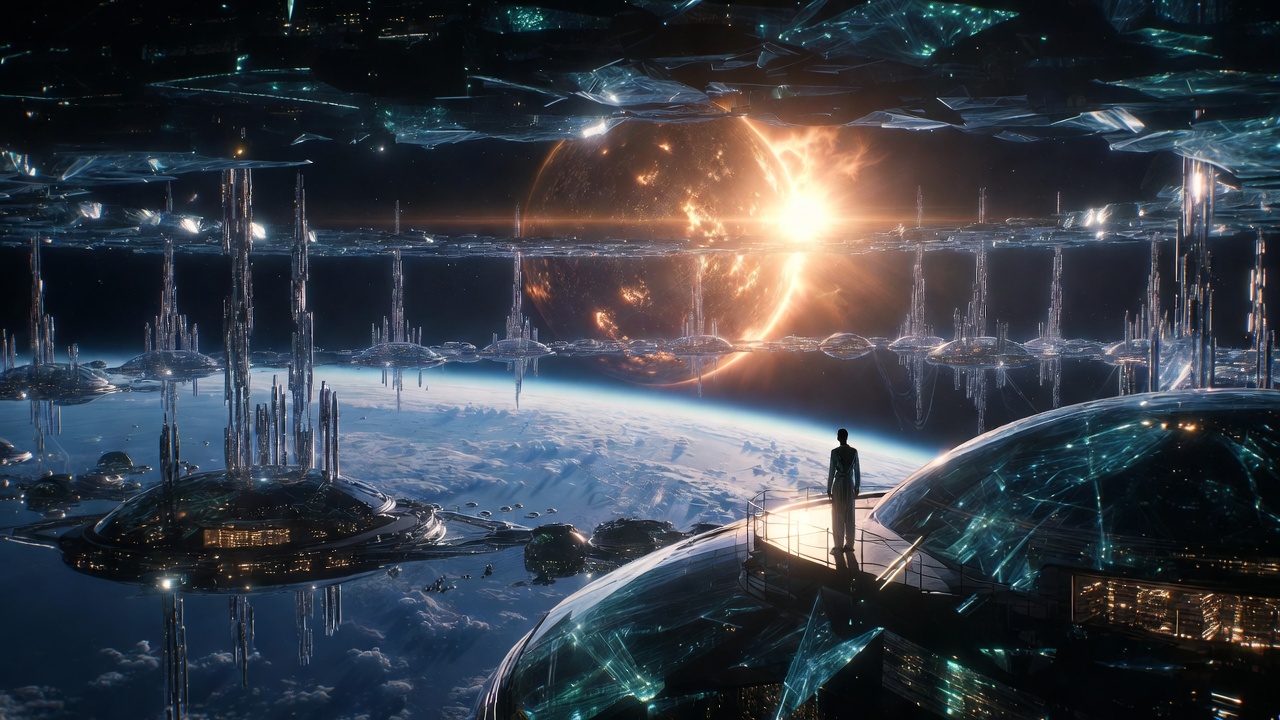
- The built environment is almost certainly at solar-system scale - with the Earth a protected biosphere and heavy industry, compute, and energy capture distributed across the inner solar system
- No company, currency, or nation founded in 2026 is likely to survive in any meaningful continuity; the middle layer of institutions gets hollowed out, leaving fewer but far longer-lived structures
- The decisions being made right now - on AI safety, climate, and coordination - have genuinely astronomical consequences, because they determine whether there is a 3026 worth having at all
Most writing about the future of AI stops at ten years. A few brave pieces stretch to fifty. I wrote one of the ten-year ones myself in The Next Decade of AI, and the honest reason the horizon stays short is that the uncertainty gets unmanageable much past that. Forecasting even the shape of the economy in 2040 is already mostly vibes.
A thousand years, then, is almost ridiculous as a frame. But almost is not quite the same as is. There is a specific kind of value in trying to think at this distance, precisely because it forces you to let go of the things that cannot survive the journey - companies, currencies, programming languages, probably nations - and look at what, if anything, does.
So this is the thought experiment. The year is 3026. What can we say honestly about it?
The 1026 Calibration
Before guessing forward, it’s worth calibrating backward. A thousand years ago, in 1026, Cnut the Great ruled a North Sea empire that stitched England to Denmark and Norway. There was no printing press. No heliocentric model. No germ theory. No nation-state in the modern sense. No concept of a company, a corporation, or a limited-liability entity. The English language existed but was closer to modern German than to what you are reading now. A literate person in 1026 could not have read Shakespeare, let alone a Python script.
Someone in 1026 trying to predict 2026 would have been operating with the wrong primitives entirely. They could not have predicted electricity, because they had no concept of an electron. They could not have predicted the internet, because they had no concept of information as something separate from speech and parchment. They could not have predicted air travel, because the idea of heavier-than-air flight was not only untested but actively ridiculed for most of the intervening millennium.
What they could have predicted, and got right, were the slow-moving constants. People would still fall in love. Seasons would still turn. Power would still concentrate and then redistribute and then concentrate again. Grief and joy and boredom would still be the texture of most lives. Stories would still get told, and most of them would still be the same stories.
That’s the frame. Over a thousand years, the substrate of civilisation is likely to change beyond recognition. The human core probably does not.
   1026                       2026                       3026
    │                          │                          │
    ├─ Cnut the Great          ├─ AI emerging             ├─ Ambient intelligence
    ├─ No printing press       ├─ Intelligence priced     ├─ Solar-system scale
    ├─ No electricity          ├─ Nation-states peak      ├─ Kardashev I to II
    ├─ No germ theory          ├─ Climate inflection      ├─ Institutions thin
    ├─ Old English             ├─ You are here            ├─ Categories dissolve
    │                          │                          │
    └────── 1000 years ────────┴─────── 1000 years ───────┘
         substrate churn             substrate churn
         human core persists         human core persists
What Extrapolates and What Breaks
Some trends plausibly survive the full thousand years because they are rooted in physics and thermodynamics rather than fashion. Others will not make it past the next fifty.
The cost of computation per unit of useful work, adjusted for what that work means, has been falling by many orders of magnitude per century for a long time now. Moore’s Law is the famous local instance, but the underlying pattern of compute getting cheaper goes back to the abacus. That trend continues until it hits a physical floor - Landauer’s limit on the minimum energy required to erase a bit, and then whatever reversible-computing and quantum regimes let us do past that. By 3026 we are almost certainly at or near those floors. Computation, as a resource, is effectively free.
Energy follows a similar logic. Fusion is either working at civilizational scale by 3026 or we have an explanation for why it never did. If it works, terrestrial energy constraints stop being the dominant limit on anything, and the conversation shifts to solar-system-scale engineering. If it doesn’t, the story is radically different, but the thousand-year frame still implies we have found something, because no civilisation capable of looking at this horizon stays on a constrained energy budget that long.
What breaks is almost everything built on the current information and institutional stack. No company founded in 2026 is likely to exist in 3026 in any meaningful continuity. The oldest continuously-operating company in the world is Japanese and about 1,400 years old, which is the exception that proves the point. National currencies last an average of a few decades. Nations themselves, in the modern sense, mostly date from the nineteenth century. None of this is mystical. These are all institutional forms invented to solve specific coordination problems in specific technological contexts, and when the context shifts enough, the forms either adapt unrecognisably or disappear.
Programming languages, operating systems, protocols, file formats - all of this is fashion layered on a very thin stack of mathematical invariants. The mathematics survives. The rest gets replaced, probably several times over.
Intelligence as Ambient Substrate
The most confident claim I can make about 3026 is that intelligence is not a thing anyone thinks about, in the same way that nobody currently thinks about the availability of oxygen or the legibility of text.
I argued in We Are Learning to Buy Intelligence that we are early in a transition from intelligence-as-expensive-service to intelligence-as-commodity. A thousand years later, that transition is long complete and mostly forgotten. Intelligence is ambient. It is in the walls, the clothes, the air, the bloodstream. There is no “using AI” because the category is meaningless. It is like asking a fish whether it is using water.
The interesting question at that horizon is not how smart the machines got. Capability concerns will have long since been resolved one way or another. The interesting question is what the relationship between human minds and ambient intelligence looks like after a thousand years of co-evolution.
The plausible answers span a huge range. At one end, humans remain biologically more or less continuous with their 2026 ancestors, augmented by constant collaboration with non-biological minds but distinctly separate from them. At the other end, the distinction between biological and non-biological intelligence has dissolved to the point of irrelevance. Most of the serious long-horizon thinkers - Nick Bostrom, Ray Kurzweil, David Chalmers, and going further back Hans Moravec and J.D. Bernal - land somewhere in the latter half of that range.
I don’t know which is right, and neither does anyone else. But the framing worth holding is that after a thousand years of ambient intelligence, asking what a “human” is starts to resemble asking what a “kingdom” is. Both are historical categories whose edges have become negotiable.
The Scale of the Built Environment
By 3026, if the civilisation survives at all, the built environment is almost certainly at solar-system scale rather than planetary scale.
This is not science fiction speculation. It is straightforward extrapolation from energy consumption trends and the physics of available resources. The Kardashev scale - Type I civilisations harnessing the energy of their planet, Type II their star, Type III their galaxy - was proposed by Nikolai Kardashev as a simple way to think about the upper bound of what civilisations could do given unlimited time and no extinction events. Humanity is currently around Type 0.73 by most estimates. A thousand years at historical rates of energy growth puts us somewhere meaningful on the Type I to Type II axis.
What that looks like in practice is Dyson-style partial capture of solar output, large-scale off-world habitation, and industrial activity distributed across the inner solar system. The Earth itself is probably a protected biosphere rather than a primary industrial site. Heavy industry, compute centres, and energy capture all move to where they belong, which is somewhere that does not have a biosphere to damage.
I want to be clear that I am not predicting this happens. I am saying that if the civilisation continues on anything like its current trajectory for a thousand years, this is roughly the shape of the physical infrastructure that supports it. If we are still on one planet in 3026, it is because something went badly wrong, or because we made a deliberate, costly choice not to expand - both of which are possible, but neither of which is the default extrapolation.
The Timescale Problem for Institutions
The part of 3026 I find genuinely hard to reason about is not the physics or the compute. It is the institutions.
We do not currently have institutional forms that work well on thousand-year timescales. The Catholic Church is roughly 2,000 years old and is the rare institutional survivor. A few universities, a few monarchies, a handful of family businesses. Everything else churns on a much shorter cycle. The reason is partly that the coordination problems change faster than the institutions can adapt, and partly that the people inside the institutions die, and the institution has to rebuild its memory and culture in each generation.
Long-term artificial memory changes this. If a civilisation can maintain continuous, faithful records across a thousand years - and we are obviously on the path to being able to do that - then the institutional memory problem partially dissolves. Whether that produces more stability or less is genuinely open. More stability, if continuity of memory lets institutions learn from mistakes they literally remember making. Less stability, if the resulting institutions become so entrenched that they cannot adapt and eventually snap.
My guess - and it is only a guess - is that 3026 has dramatically fewer institutions than 2026, but the ones that exist are enormously long-lived. Consolidation at the large scale, fluidity at the small scale. The middle layer - companies, nations, universities as we know them - is the layer that gets hollowed out.
There is a version of this that looks a lot like the techno-feudal scenario I described in Four Futures for the Machine-Speed Economy, scaled up and played forward a thousand years. There is another version that looks like broad abundance finally arriving in a form we would recognise as genuinely distributed. Which one actually happens depends on decisions being made right now, which is the uncomfortable but important thing to notice.
What Persists
Here is the part I am most confident about, and the part I find most grounding.
In 3026, people - whatever “people” means by then - will still fall in love. They will still lose those they love. They will still tell stories, and most of the stories will be variations on the ones we already tell. They will still crave meaning, and the meaning they find will still be tied to relationships, work that matters, places they belong to, and a sense that their life adds up to something. They will still sit in silence sometimes and wonder why any of this is happening. They will still look up at the sky.
I wrote in Taste Is the New Scarcity that when intelligence becomes infrastructure, judgment becomes power. The thousand-year version of that claim is stronger. When capability is effectively unlimited, the scarce resource is the one that was always scarce underneath the temporary scarcity of capability: the ability to know what is worth doing, what is beautiful, what is true, and what matters.
The ten-year list I gave in Top 5 Human In-Demand Jobs in 10 Years holds up surprisingly well at this horizon. The specific jobs evaporate. The underlying categories - human presence in moments that matter, stewardship of powerful systems, physical craft, meaning-making, ultimate accountability - persist in some form, because they are rooted in things about the human condition that do not expire with a change of substrate.
This is the answer to the “what should I spend my life on” question that the thousand-year frame gives you, to the extent it gives you anything at all. The things that mattered in 1026 and still matter in 2026 are the things that are likeliest to still matter in 3026. Trust, love, beauty, courage, the willingness to tell the truth when it costs you something, the ability to make another person feel seen. None of that is replaceable by ambient intelligence, because none of it was ever really about intelligence in the first place.
The Astronomical Waste Argument
There is a darker consideration worth naming. Nick Bostrom published a paper in 2003 called Astronomical Waste that made a simple, uncomfortable point: every year that a technologically-capable civilisation delays colonising the accessible universe is a year in which a huge amount of potential value is permanently lost, because the universe continues expanding and some resources become unreachable. On a thousand-year horizon, the argument has real teeth.
I am not a utilitarian of the sort that takes this argument to its extreme conclusions, and I am suspicious of anyone who is. But there is a version of the point that I think is legitimately important. Decisions being made now - about safety, about coordination, about whether the civilisation remains on a trajectory at all - have implications that are genuinely astronomical in scale, in a way that was not true for our ancestors and will not be true for whichever distant descendants look back at us. This is a peculiar moment to be alive.
It does not follow that you should live differently because of it. The 1026 peasant whose decisions affected what the 2026 world looks like had no way of knowing which of his decisions mattered, and the same is substantially true for us. But it does mean that the stakes of getting the next fifty years right, in terms of whether there is a 3026 worth having, are larger than most historical generations have had to reckon with.
The Honest Uncertainty
I want to end by naming how little any of this is actually known.
The probability that 3026 looks remotely like any of the scenarios I have just described is modest. The probability that it looks like something none of us can currently imagine is much higher. The 1026 person was not just wrong about the specifics of 2026; they were wrong about the categories. They did not have the right vocabulary to describe what the next thousand years would produce. We almost certainly do not either.
The value of this kind of thinking is not predictive. It is orientational. It forces you to notice that most of what feels urgent right now is ephemeral on the thousand-year scale, and that the things that persist are quieter, older, and more personal than the news cycle suggests. It is a corrective to the foreshortening of attention that the current AI moment tends to produce.
If you zoom out to 3026 and squint, the fifty-year arc we are inside of looks like a single, compressed inflection in a much longer story. It matters - it matters enormously - but not because this particular decade is the point of everything. It matters because it is one of the decades that determines whether the longer story continues, and what kind of story it turns out to be.
That is enough weight for any decade to carry, and it is a different weight than “we are about to invent superintelligence.” Both claims can be true. They are not the same claim.
The people in 3026, whatever they are, will look back at us the way we look back at 1026 - with a mixture of curiosity, condescension, and occasional real respect. What we owe them is not a particular technical outcome. It is a civilisation they can still recognisably inherit. Whether we give them one is being decided now, by people who will not live to see the result.
Related reading:
- The Next Decade of AI - The ten-year view underneath this thousand-year one
- Four Futures for the Machine-Speed Economy - Near-term scenarios that cast long shadows
- Reading the Signals: Which of the Four Futures Is Actually Emerging? - How current signals weight the scenarios
- Taste Is the New Scarcity - What becomes valuable when intelligence is free
- Top 5 Human In-Demand Jobs in 10 Years - The human core that survives automation
- We Are Learning to Buy Intelligence - The commodification arc these posts sit on
- The Exponential Curve: Understanding Human Advancement Acceleration - Why compressed innovation is the default now
External sources:
- Nick Bostrom, Astronomical Waste (2003)
- The Kardashev Scale
- Landauer’s Principle
- The Long Now Foundation - An organisation explicitly built around thousand-year thinking
Related Reading
- The Year 2126: What the Next Hundred Years Actually Looks Like
- Four Futures for the Machine-Speed Economy
- Reading the Signals: Which of the Four Futures Is Actually Emerging?
- The Next Decade of AI: What Actually Happens From Here
- The Meaning of Work in an Age of Abundance: Finding Purpose When Agents Do the Heavy Lifting