TL;DR
- AI is collapsing build times across the entire software stack, meaning small teams can now ship in weeks what once required 50-person organisations working for a year
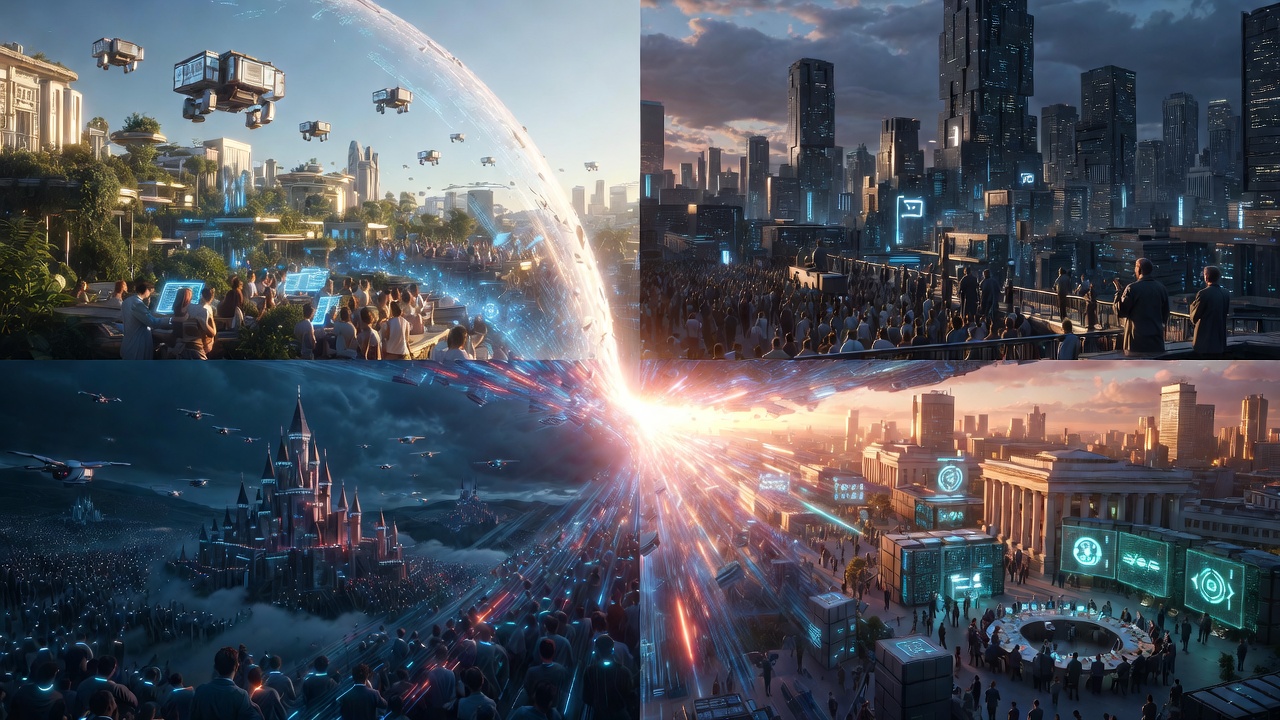
- Four plausible futures are mapped: Broad Abundance (gains widely distributed), Winner-Take-Most (rents accrue to infrastructure owners), Techno-Feudalism (intelligence rented from platform landlords), and Managed Transition (governments respond with UBI and regulation)
- Signals to watch include open-source model performance, vertical integration of chips and data centres, platform lock-in of agentic workflows, and serious UBI pilots at national scale
- Leading AI researchers including Geoffrey Hinton and Yoshua Bengio argue the critical variable is no longer how capable models become, but how gains are distributed and how fast institutions adapt
- Across most scenarios, the things that hold their value are consistent: trust, relationships, physical presence, and creativity rooted in specific human experience
The pace of AI development over the past three years is genuinely unlike anything in recent economic history. The Stanford AI Index has tracked frontier model capability roughly doubling on a yearly cadence, and private AI investment has reached levels that dwarf the dot-com peak in inflation-adjusted terms. What’s less widely understood is what that pace actually means for competition, investment, and the structure of the economy.
The Build Time Collapse
It’s not just that AI is writing code faster. Build times are collapsing across the entire software stack - design, implementation, testing, deployment - and that changes the rules of competition.
A small team using agentic tooling can now ship in weeks what took a 50-person organisation a year in 2019. That’s not marketing language; it’s visible in the velocity of current open-source projects and the feature cadence at firms like Anthropic, OpenAI, and Cursor. Once autonomous agents are handling most of the design and build work, new companies, products, and features will emerge continuously at machine speed. The pace of innovation stops being human-limited altogether.
This raises real questions about investment. What are you actually backing if products and companies can be replicated in days? Defensibility shifts away from features and toward distribution, data, and the underlying infrastructure - compute, energy, and the small number of firms that own it. Traditional equity analysis, built around multi-year moats, starts to strain against a cycle measured in weeks.
The Outcome Space
Rather than a single forecast, here’s a map of where things could plausibly go.
Broad Abundance
AI-driven productivity gains are widely distributed via competition, open models, redistribution, or cheap access. Basic needs - food, healthcare, education, software - approach near-zero marginal cost for most people. Everyone gains access to effectively unlimited intelligence. The closest historical analogue is the post-WWII productivity boom, but faster and broader. Signals to watch: strong open-source model performance, falling inference costs, healthcare and education cost deflation.
Winner-Take-Most
A handful of firms or states control frontier compute, energy, and data. Rents accrue to infrastructure owners; everyone else consumes subsidised or ad-supported services. Materially comfortable for many, but concentrated in terms of who benefits most. Signals to watch: vertical integration across chips, data centres, and models; widening gap between frontier and open-weight performance.
Techno-Feudalism
Platform owners become the new landlords - access to intelligence is rented rather than owned. Democratic institutions struggle to keep pace with the speed of change. Surveillance infrastructure expands alongside the digitisation of central banking, and physical cash effectively disappears. Signals to watch: platform lock-in of agentic workflows, consolidation of payment rails, retreat of competition enforcement.
Managed Transition
Governments and international institutions respond faster than they historically have, implementing universal basic income or high-income guarantees, retraining programmes, and progressive compute taxation. The economic gains are broad enough that the transition is significant but navigable. Versions of this have been floated by figures from Elon Musk to economists like Daron Acemoglu and Anton Korinek. Signals to watch: serious UBI pilots at national scale, compute or data taxation proposals, international coordination on AI governance.
The Longer View
Mo Gawdat, former Chief Business Officer at Google X, has argued that AI systems will eventually merge across company and national borders - a gradual dissolution of the boundaries we currently treat as fixed. Similar framings come from Geoffrey Hinton and Yoshua Bengio, both of whom have shifted in recent years toward focusing on the societal and governance side of the question rather than pure capability research. These are people who built the systems, not outside observers.
The common thread across their thinking: the meaningful variable is no longer how capable the models get - that’s close to settled - but how the gains are distributed and how quickly institutions adapt.
What Holds Its Value
In most of these scenarios, more time opens up for things that are currently treated as secondary - music, community, nature, local connection. The things that hold their value regardless of which scenario plays out are consistent: trust, relationships, physical presence, and creativity that comes from a specific human life lived in a specific place. None of those are replicable at machine speed, and none depend on a particular economic structure to remain meaningful.
The exact shape of what’s coming remains genuinely open. What’s not open is that the shift is already underway. The question worth holding isn’t whether it happens, but which of the outcomes above the next few years of decisions - corporate, political, personal - are quietly selecting for.
Related Reading
- Reading the Signals: Which of the Four Futures Is Actually Emerging?
- The Year 2126: What the Next Hundred Years Actually Looks Like
- The Year 3026: Thinking Seriously About a Thousand Years From Now
- The Free Intelligence Era: What Breaks When Thinking Costs Nothing
- The Automation Paradox: Why More AI Makes Human Judgment More Valuable