TL;DR
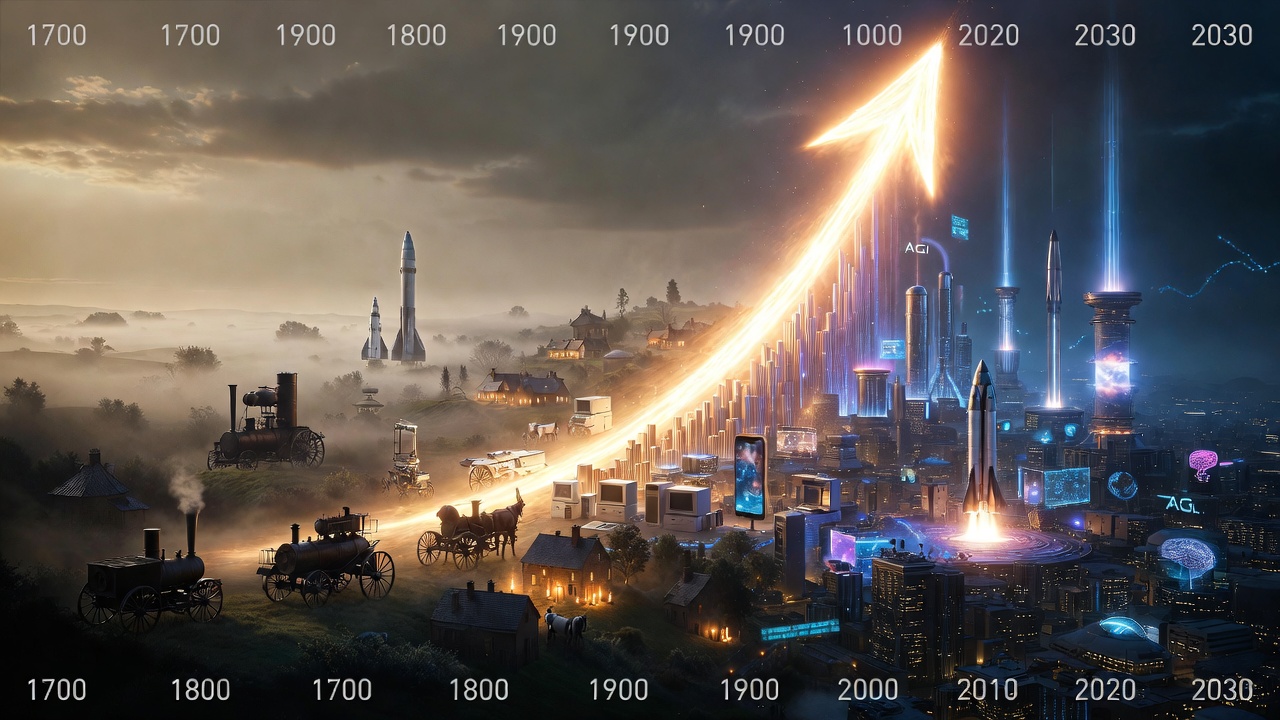
- A child born in 1700 inherited a world barely changed from their grandparents’; a child born today may see more transformation in 30 years than the 18th century saw in a century
- Moore’s Law drove ~50,000,000x transistor growth since 1971 - exponential growth is geometry, not hyperbole
- The transistor (1947) collapsed barriers to innovation: talent, equipment, communication, and capital
- AI is the latest accelerant on an already-exponential curve - the question is how we shape it, not whether it happens
- We are the first generation to face civilisation-scale choice at this speed
A child born in 1700 inherited a world barely changed from their grandparents’. A child born in 1900 saw horses give way to automobiles, then aircraft, then space travel within a single lifetime. A child born today will witness more transformation in their first 30 years than humans experienced across the entire 18th century.
This isn’t hyperbole. It’s geometry.
   INNOVATION DENSITY PER DECADE (1700 - 2030)
   ════════════════════════════════════════════════════════════

   1700s │▏
   1710s │▏
   1720s │▎       The "slow century"
   1730s │▎       Marine Chronometer (1735)
   1740s │▍
   1750s │▍
   1760s │▌       Spinning Jenny (1764)
   1770s │▋  ◀──  Steam Engine (1769) - Industrial Revolution begins
   1780s │▊
   1790s │▉
   1800s │█       Photography emerges
   1810s │█▏
   1820s │█▎
   1830s │█▌      Telegraph (1837)
   1840s │█▋
   1850s │█▊      Bessemer Steel
   1860s │██      Internal Combustion Engine
   1870s │██▎     Telephone (1876), Phonograph
   1880s │██▌     Electric Light, Automobile
   1890s │██▊     Radio Waves, X-rays
   1900s │███     Powered Flight (1903)
   1910s │███▎
   1920s │███▌    Television
   1930s │████    Antibiotics
   1940s │█████   ◀──  ENIAC + Transistor - Computing era begins
   1950s │██████  Commercial Jets, DNA Discovered
   1960s │████████        Integrated Circuit, Moon Landing
   1970s │██████████      Microprocessor, Personal Computer
   1980s │█████████████   Internet, Mobile Phones
   1990s │████████████████  World Wide Web
   2000s │█████████████████████  Smartphones, Social Media
   2010s │██████████████████████████  Deep Learning, CRISPR
   2020s │█████████████████████████████████████  ◀──  YOU ARE HERE
         │
         └──→  AGI? Fusion? Age Reversal?  ──→  2030s
What ‘Exponential’ Actually Means
Most people nod along when someone says “technology is accelerating,” but few grasp what exponential growth looks like up close.
Consider Moore’s Law: the number of transistors on a chip has roughly doubled every two years since 1965. A 1971 microprocessor had 2,300 transistors. A 2025 Apple silicon chip has over 100 billion.
That’s not 1,000x more. Not even 10,000x more. It’s roughly 50,000,000x more.
If car efficiency had improved at that rate, your car would now travel from London to New York on a single drop of fuel.
The Three-Century Sprint
In 1700, the world was largely unchanged from 1500. Most people died within 30 miles of where they were born. Medical practice still relied on bloodletting. The fastest way to send a message was a horse.
By 1900, descendants of those same families had electricity, photography, telephones, and trans-Atlantic shipping. Genuinely new categories of human experience had emerged.
By 2026, we carry computers in our pockets more powerful than 1990s supercomputers. AI systems pass professional licensing exams. Gene editing tools can rewrite the code of life. Reusable rockets land themselves on barges.
Each leap took less time than the last.
The Transistor Changed the Game
The transistor (1947) deserves its own category. Before it, every major innovation demanded talented humans, expensive equipment, slow communication, and high barriers to entry.
The transistor enabled something unprecedented: machines that help us think. Computers don’t just automate manual work - they automate the process of innovation itself.
Modern drug discovery uses AI to screen millions of molecular candidates that would take human researchers centuries to evaluate. Aircraft are designed in simulation before any metal is bent. Climate models predict outcomes impossible to test empirically.
When tools start helping you build better tools, you get a feedback loop.
Innovation Compounds Like Interest
There’s a deeper pattern. Each breakthrough doesn’t just add to human capability - it multiplies what’s possible next.
The printing press didn’t just spread books. It spread literacy, which created scientists, who developed scientific method, which created engineering disciplines, which created the steam engine, which powered factories, which generated wealth, which funded universities, which produced more scientists.
Every node in this network increased the productivity of every other node.
What Could Slow It Down?
Exponential curves can’t continue forever in a finite world. Several constraints are visible on the horizon:
- Physics: Moore’s Law is hitting atomic-scale limits. Transistors can’t be smaller than the atoms they’re made from.
- Energy: Computing power requires electricity, and grid capacity isn’t growing exponentially. Training a single large AI model can consume as much power as a small town.
- Talent: The pool of researchers grows linearly while problems grow in complexity.
- Wisdom: Our ability to make good decisions about new technology lags badly behind our ability to create it.
The last two are arguably the most important. New materials and architectures can solve physics. More power plants can solve energy. But governance, ethics, and collective decision-making operate on human timescales, not technological ones.
The Question Isn’t ‘When’ but ‘How’
The next 30 years will likely deliver more transformation than the last 300. Artificial general intelligence, brain-computer interfaces, somatic gene editing, fusion energy, longevity treatments - any one of these would reshape civilisation. We’re getting them in parallel.
The choice we face isn’t whether change will happen. It’s whether we shape it deliberately or let it shape us.
History suggests the people who think about these questions early have outsized influence on outcomes. The architects of the internet built openness into its DNA partly because Cold War researchers worried about centralised control. The shape of AI will similarly be determined by choices we make in this decade.
We are, quite literally, the first generation in human history to face this scale of choice. And probably not the last - assuming we navigate it well.
Related Reading
- Four Futures for the Machine-Speed Economy
- Why Is There Something Rather Than Nothing?
- The Year 2126: What the Next Hundred Years Actually Looks Like
- Policy on the AI Exponential
- Recursive Self-Improvement: Can AI Bootstrap Its Own Intelligence?
Sources
- Our World in Data: Technological Progress - Comprehensive data on innovation timelines
- The Long Now Foundation - Long-term thinking about civilisation
- MIT Technology Review - Current analysis of emerging technologies
- Moore’s Law - Wikipedia - The pattern driving computing acceleration
- Future of Humanity Institute - Academic research on long-term technological impact
- Ray Kurzweil: The Law of Accelerating Returns - Foundational essay on exponential technological progress