jamesm.blog
  • Search
  • Tags
  • AI
  • Blockchain
  • Data Eng
  • Data Science
  • DevOps
  • General
  • Music
  • Personal Dev
  • Retro
  • Space
Home

Music Production

Comprehensive music production resources including synthesizers, DAWs, plugins, courses, hardware reviews, and artist inspiration.
Modular Synths Icon

Introduction to Modular Synthesis - The Building Blocks

Modular synthesis can feel overwhelming at first. There are dozens of modules, hundreds of cables, and infinite ways to patch them together. But underneath all that complexity lies a simple truth: modular synthesis is about understanding how audio flows from one place to another, and learning to shape that signal at every step. If you’ve ever felt lost looking at a Eurorack case, this post is for you. We’re going to break modular synthesis down to its essential building blocks - the modules that do the heavy lifting in almost every patch. ...

April 18, 2026 · 8 min · James M
Software Synths Icon

The Best Software Synths of 2026: From AI-Native to Analog Perfection

The landscape of software synthesis has undergone a massive shift over the last two years. While the legends of the 2010s are still present, 2026 has introduced a new generation of “intelligent” instruments that bridge the gap between complex sound design and intuitive creativity. Here are the top software synths currently defining the sound of 2026. 1. Xfer Serum 2 (The Evolution) After years of anticipation, the successor to the most popular wavetable synth in history has finally matured. Serum 2 maintains the workflow we love but adds a “Neural Resynthesis” engine. You can now drop any audio sample into the oscillator, and the AI will reconstruct it as a fully morphable wavetable with uncanny accuracy. ...

April 10, 2026 · 3 min · James M

u-he Zebra 3: The Modular Beast Unleashed

In the realm of software synthesizers, few names command as much respect and anticipation as u-he. And among their legendary lineup, Zebra has always stood out as a chameleon – a semi-modular powerhouse capable of almost any sound. Now, with the long-awaited arrival of Zebra 3, the beast has truly been unleashed, promising to redefine what’s possible in digital sound design. This isn’t just an update; it’s a complete reimagining, building on the strengths of its predecessor while pushing the boundaries of flexibility, sonic fidelity, and user experience. ...

April 9, 2026 · 4 min · James M

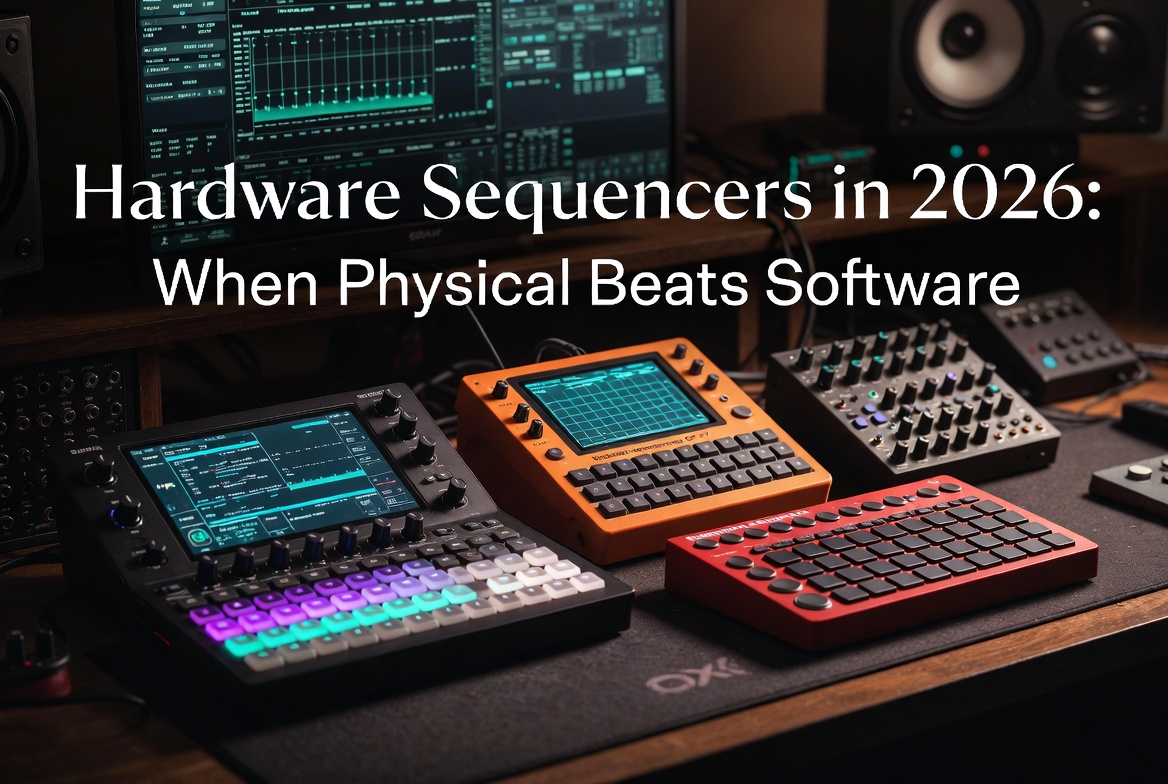
Hardware Sequencers in 2026: When Physical Beats Software

In an era of AI-generated melodies and infinite DAW power, the physical hardware sequencer has transitioned from a niche tool to a vital mental anchor for the modern producer.

April 8, 2026 · 3 min · James Myddelton

Native Instruments: From Preliminary Insolvency to M&A - What Comes Next

When Native Instruments entered preliminary insolvency in late January, it felt like a seismic moment. Two months later, the picture has gotten clearer - and in some ways, more complex. The company has now moved into formal insolvency proceedings, and simultaneously revealed it’s in active merger and acquisition talks with multiple interested buyers. This isn’t a bankruptcy death spiral; it’s a controlled restructuring. But it raises harder questions about what went wrong, and what salvation might actually look like. ...

April 4, 2026 · 6 min · James M

Physical Modeling Synthesis: The Underrated Future of Sound Design

If you’ve spent any time with Pianoteq or the Audio Modeling SWAM instruments, you’ve felt something different. Not the crisp accuracy of a sampled library, not the flexibility of wavetable synthesis - but something that responds like an instrument. Strings that vibrate with sympathetic resonance. Piano keys with wooden resistance. A cello that sings differently when you bow it hard versus soft. This is physical modeling: mathematics as an instrument, not just a sampler or synth engine. ...

April 4, 2026 · 8 min · James M

The Yamaha DX7: The Most Influential Synthesizer Ever Made

The Yamaha DX7 wasn’t the first synthesizer. It wasn’t the most powerful. It wasn’t the cheapest. But in 1983, it became the most important instrument released that decade - and arguably the most influential synthesizer in history. By 1989, over 200,000 units had been sold. Today, it remains the second-best-selling synthesizer of all time (after the Casio VL-Tone, which was technically a calculator with a synth). Here’s why that matters: the DX7 didn’t just change synthesizer design. It fundamentally altered how modern music sounds. ...

March 9, 2026 · 8 min · James M

When Circuits Go Public: Patents, Copyright, and the Rise of Clone Synths

If you’ve ever compared a Behringer Model D or Poly D to a classic Moog, you might have thought: “Wait… that looks exactly like a Minimoog!” Yet somehow, Behringer isn’t breaking any laws. How does that work? The answer lies in the fascinating intersection of patents, copyright, trademarks, and trade dress - the legal forces that shape hardware synth design. Patents: The Clock Ticks Out Patents are the most obvious form of protection for inventors. They grant exclusive rights to an invention for a limited time - usually 20 years. Once a patent expires, the invention becomes public domain. ...

February 8, 2026 · 4 min · James M

Native Instruments: A Turning Point in Music Tech

Today feels like one of those rare moments in music technology where the ground really shakes. Native Instruments, the Berlin-born powerhouse behind the tools that countless producers, DJs, and composers have built entire careers around, has entered preliminary insolvency proceedings. This isn’t just industry news - it’s a big, honest moment that makes you pause. For many of us, Native Instruments has been more than a brand. It was the company that helped reshape how music gets made. Products like Maschine, Kontakt, Traktor, Reaktor, and Massive aren’t just plugins or hardware; they’re part of the creative rituals that defined genres and workflows for a generation. The grooves in a beat, the evolving sound of a synth patch, the loop that became a track - a lot of that has Native Instruments DNA in it. ...

January 27, 2026 · 3 min · James M

Roland Jupiter‑X Review: A Workstation‑Level Synth with Legendary Sound

The Roland Jupiter‑X is one of Roland’s most ambitious synthesizers, combining classic analog-inspired tones with advanced digital synthesis and modern performance features. Designed for musicians, producers, and live performers, it offers the sonic breadth of vintage instruments while providing hands-on control and studio-ready flexibility. As of January 2026 in the UK, the Jupiter‑X typically retails around £2,155 at Andertons Music Co. A Modern Take on a Classic Lineage The Jupiter‑X isn’t a simple reissue of any single classic synth. Instead, it leverages Roland’s ZEN-Core synthesis platform to model multiple legendary instruments, including the JUPITER‑8, JUNO‑106, SH‑101, and classic drum machine sounds. This makes it a complete sound studio in a keyboard, capable of producing everything from vintage leads and pads to complex layered textures and modern synth sounds. ...

January 22, 2026 · 3 min · James M
Next  »
© 2026 jamesm.blog · Powered by Hugo & PaperMod