TL;DR
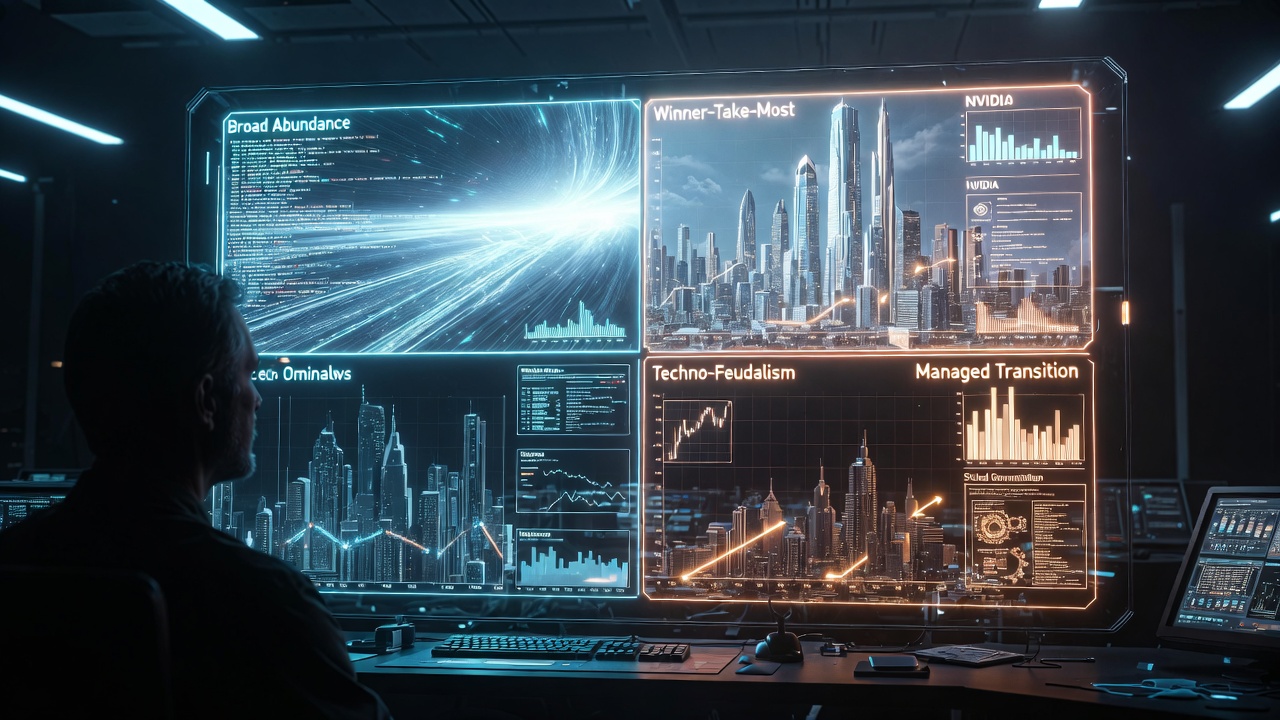
- Scoring four future scenarios against real-world signals: winner-take-most has the clearest corporate and capital logic behind it as of April 2026, driven by vertical integration across chips, data centres, models, and distribution
- Broad abundance gets partial credit - inference costs have fallen two orders of magnitude and open-weight models are competitive, but institutional-level gains in healthcare and education haven’t materialized
- Techno-feudalism is quietly accumulating through agentic platform lock-in (Claude Code, Cursor, Devin) and payment rail consolidation, with competition enforcement as the main counterweight
- Managed transition is the weakest scenario - UBI pilots haven’t scaled nationally, compute taxation remains a proposal, and institutional response cycles are mismatched with AI deployment speed
- The three signals that will determine where this goes: whether the open-weight frontier gap widens or closes, whether agentic memory becomes portable or platform-owned, and whether any serious economy moves past pilot-scale on redistribution
I recently mapped four plausible futures for the machine-speed economy and listed the signals to watch for each. The obvious next question is the one I deliberately held back from answering: which signals are actually firing right now, and what does the mix say about where we’re heading?
The honest answer is that all four scenarios have real evidence in their favour, which is part of why this moment is so hard to read. But the weights aren’t equal. Some signals are strengthening; others have stalled or reversed. Here’s what the dashboard looks like this week.
Broad Abundance: Partial Credit
The strongest evidence for this scenario remains inference cost deflation. The per-token price of frontier-class intelligence has fallen by more than two orders of magnitude since GPT-4’s debut, and the gap between open-weight models and closed frontier systems has narrowed further with Meta’s Llama line, Mistral, DeepSeek, and Qwen all shipping genuinely competitive releases. For a developer or a small business, the cost of applied intelligence in 2026 is a rounding error compared to 2023.
Healthcare and education cost curves are the weaker part of the story. AI tutoring is getting measurably better - Khan Academy’s Khanmigo and a wave of similar tools are quietly doing real work - but tuition and insurance premiums have not moved. The productivity gains are real at the tool level and invisible at the institutional level, which is a pattern worth taking seriously on its own.
Verdict: partial credit. The technology side of abundance is genuinely arriving. The distribution side isn’t, yet.
Winner-Take-Most: The Loudest Signal
This is where the evidence is most concentrated. Vertical integration across chips, data centres, models, and distribution is the defining corporate strategy of the current cycle. NVIDIA’s margins, the Microsoft-OpenAI Stargate build-out, Google’s TPU and Gemini stack, and Amazon’s investment in Anthropic all point the same direction: compute, energy, and frontier models concentrating inside a small handful of firms.
The gap between frontier and open-weight performance closed for a while but has recently widened again at the very top end. Frontier reasoning models trained on millions of dollars of post-training compute are not trivial to replicate, and the capital requirements are rising faster than the efficiency gains that would democratise them. Epoch AI’s compute tracking shows the largest training runs doubling on a cadence that open projects simply cannot match without sovereign backing.
Verdict: the most fully supported scenario as of April 2026. Not because the others are wrong, but because this one has the clearest corporate and capital logic behind it.
Techno-Feudalism: Quietly Accruing
Platform lock-in of agentic workflows is the signal that has moved most in the last six months. A year ago, people were talking about agents in the abstract; today real work is being done inside Claude Code, Cursor, Devin, and a widening roster of vertical agent products. Switching costs are beginning to accrue in the form of memory, context, integrations, and workflow muscle memory - the same way they accrued around email, cloud storage, and CRM a decade ago.
Payment rail consolidation is harder to read. Stripe and Adyen are expanding, stablecoin infrastructure is maturing, and several central banks have accelerated digital currency pilots. Physical cash use keeps declining in most developed economies. None of this is dystopian on its own; the question is whether the combination of agentic platforms, consolidated payments, and digital identity produces a stack where individual exit becomes genuinely hard.
Competition enforcement is the one place this scenario has met real resistance. The FTC, the European Commission, and the UK’s CMA have all opened meaningful investigations into cloud, AI, and app-store dynamics in the last eighteen months. Whether those investigations produce structural remedies or just consent decrees is the real test.
Verdict: accumulating quietly. Not the loudest signal, but arguably the one with the longest tail.
Managed Transition: The Laggard
This is the weakest of the four scenarios by the signal test. Serious UBI pilots have not scaled to national level anywhere. Sam Altman’s Worldcoin/World ID work continues, and there are small-scale trials in Finland history, Kenya via GiveDirectly, and a handful of US cities, but nothing that meaningfully redistributes AI-driven productivity gains at a population scale.
Compute or data taxation has been floated by Daron Acemoglu and others but remains a paper proposal rather than legislation. International coordination on AI governance is somewhere between the Bletchley and Seoul summit communiqués and the EU AI Act implementation timeline - real diplomatic activity, modest binding effect so far.
The gap between the pace of AI deployment and the pace of institutional response is the single biggest structural issue in this scenario. Institutions are not failing to act because they don’t want to; they’re failing to act because the cycle time is genuinely mismatched.
Verdict: the scenario that would most require deliberate coordination is the one with the least momentum behind it. This is uncomfortable but worth naming honestly.
What the Mix Is Actually Saying
If you weight the signals by how loudly they’re firing right now, the current trajectory looks like a blend of winner-take-most with techno-feudal accumulation, partially offset by genuine abundance at the tool layer and partially checked by competition enforcement. That’s not a prediction; it’s a reading of the present tense.
What’s interesting about this mix is that it’s not stable. The tool-layer abundance creates bottom-up pressure against lock-in; the competition cases create top-down pressure against concentration; the capital logic of frontier compute creates constant pressure toward both. Which one wins depends heavily on decisions that haven’t been made yet - specifically around interoperability, data portability, and whether agentic memory becomes a user-owned artifact or a platform-owned one.
If I had to pick the three signals that matter most for where this goes over the next twelve months:
- Whether the open-weight frontier gap keeps widening or closes again. This is the abundance-versus-concentration fulcrum.
- Whether agentic memory and context become portable across platforms, or get locked in. This is the feudalism fulcrum.
- Whether any serious economy moves past pilot-scale on redistribution of AI gains. This is the managed-transition fulcrum.
None of these are predictions. They’re the variables that would cause me to update the weights if they moved.
The Personal Read
The original post ended with what holds its value regardless of which scenario plays out - trust, relationships, presence, creativity tied to a specific life lived in a specific place. Reading the signals a day later hasn’t changed that. If anything, the fact that the mix is tilting toward concentration makes the counterweight even more worth cultivating.
The scenarios are not things that happen to us. They’re the aggregate of a lot of small decisions about what to build, what to buy, what to regulate, what to walk away from. The signals above are just the public face of those decisions. The private face is whichever ones you and I make this month.
Related Reading
- Four Futures for the Machine-Speed Economy
- The Year 2126: What the Next Hundred Years Actually Looks Like
- The Year 3026: Thinking Seriously About a Thousand Years From Now
- The Free Intelligence Era: What Breaks When Thinking Costs Nothing
- The Automation Paradox: Why More AI Makes Human Judgment More Valuable