In-depth exploration of AI in practice: building and deploying AI agents that work, designing developer workflows around Claude and other LLMs, critical analysis of AI safety and reliability, and the real shifts happening in careers, skills, and how we work. This section mixes tactical guides (how to actually build with AI), strategic analysis (what’s hype vs. what matters), and deeper dives into the tools and systems reshaping software development and knowledge work.

Donald Hoffman - The Case That Consciousness Is Fundamental Banner

Donald Hoffman: The Case That Consciousness Is Fundamental

When I wrote about Yampolskiy’s Personal Universes recently, I left a thread hanging. The question underneath that whole post - the one I said I genuinely had not settled - was whether consciousness is fundamental, there first with the universe as something it experiences, or whether it is computational, something that switches on once a process gets complex enough. I said I had only recently started reading my way into the fundamental side, mostly through Donald Hoffman. This is me pulling on that thread properly. ...

May 29, 2026 · 16 min · James M
Personal Universes - Yampolskiy's Strangest Answer to the AI Alignment Problem Banner

Personal Universes: Yampolskiy's Strangest Answer to the AI Alignment Problem

First, the thing this is all in service of. The AI alignment problem is the challenge of making a powerful AI system reliably pursue what we actually want it to pursue - getting its goals, values, and behaviour to line up with human intentions, and to stay lined up even as the system becomes more capable than the people supervising it. It sounds simple and is not: we struggle to state our own values precisely, those values conflict between people, and an AI optimising hard for a slightly-wrong objective can produce outcomes nobody asked for. The multi-agent version - aligning one system with all of humanity at once, rather than a single person - is harder still, and it is the specific version Personal Universes is trying to dodge. ...

May 29, 2026 · 16 min · James M
Will AI Kill Coding Jobs Banner

Will AI Kill Coding Jobs? Claude Code's Creator Reacts

The “is the software engineer dead” genre has been running long enough that you can predict most of the takes before you read them. The interesting interviews are the ones where the person being interviewed is in a position to know something the rest of us do not. Boris Cherny, the creator of Claude Code at Anthropic, is one of those people. Sky News got him in front of three charts and asked him to react. ...

May 26, 2026 · 7 min · James M
Why the AI Cyber Threat Is Rising Banner

Why the AI Cyber Threat Is Rising

For most of the last few years, the “AI and cybersecurity” conversation has been a vibes argument. One side said the models would soon write novel exploits at scale. The other side said the models were still tripping over basic shell commands and could not be trusted to hack anything more dangerous than a CTF box. The honest answer was that nobody had hard numbers, so the debate stayed stuck on intuition. ...

May 26, 2026 · 6 min · James M
Recursive Self-Improvement - Can AI Bootstrap Its Own Intelligence? Banner

Recursive Self-Improvement: Can AI Bootstrap Its Own Intelligence?

TL;DR Recursive self-improvement (RSI) is the idea of an AI that improves its own ability to improve - each round producing a smarter system that does the next round better. It is the engine behind every “intelligence explosion” story since I.J. Good described it in 1965 The narrow version is already real. Systems like AlphaEvolve and the AI Scientist measurably improve algorithms, code, and even research output - including, in AlphaEvolve’s case, the infrastructure that trains the models themselves The leap people fear is different: improving an algorithm is not the same as improving general intelligence. Nothing in 2026 has crossed that line, and the gap is structural, not just a matter of scale Four bottlenecks decide whether RSI runs away or fizzles: compute, data, verification, and diminishing returns. Each is a hard physical or informational limit, not a temporary engineering nuisance The realistic picture is steady, human-paced acceleration - AI assisting AI research - not an overnight takeoff. METR’s time-horizon data shows fast but smooth exponential progress, which is exactly what a bottlenecked process looks like It still deserves serious safety attention, because a slow takeoff is the one we can actually govern There is a particular shape of argument that has haunted artificial intelligence since before the field had a settled name. It goes like this: build a machine slightly better than humans at designing machines, and it will design a machine better than itself. That machine designs a better one. The loop tightens, each turn faster than the last, and intelligence runs away from us in an afternoon. ...

May 20, 2026 · 12 min · James M
Context Engineering - The Discipline That Replaced Prompt Engineering Banner

Context Engineering: The Discipline That Replaced Prompt Engineering

TL;DR Prompt engineering optimised the wording of a single human-written request. Context engineering optimises the entire set of tokens in the model’s window across a whole run - system prompt, tool definitions, retrieved documents, tool results, conversation history, and memory The shift happened because of agents. The window is no longer one prompt you wrote - it is an accumulation that grows on every step, and most of it is produced by the system, not by you More context is not better context. Research on “context rot” and the older lost-in-the-middle effect show model accuracy degrades as the window fills, even well below the advertised limit The four levers are retrieval (what you pull in), memory (what persists across runs), tool results (what tools dump back), and compaction (what you summarise and discard) Treat the window as a budget. Measure its token composition, design tools to return terse output, curate rather than accumulate, and keep the static prefix stable so prompt caching still works For a few years, “prompt engineering” was the named skill of working with language models. It meant finding the wording, the framing, the few-shot examples, and the role instructions that coaxed the best answer out of a single request. It produced a small industry of prompt libraries, prompt marketplaces, and job titles. And in 2026 it is mostly gone, absorbed into something larger and harder. ...

May 20, 2026 · 11 min · James M
Cursor Composer 2.5 banner

Composer 2.5: Cursor's In-House Model Grows Up

TL;DR Composer 2.5 is Cursor’s most capable in-house coding model yet, built on Moonshot’s open-source Kimi K2.5 checkpoint with about 85% of total training compute spent on Cursor’s own continued pretraining and RL The model is purpose-built for the agent loop inside Cursor - long-horizon tasks, hundreds of tool calls, multi-step instructions - rather than as a general-purpose chat model Cursor claims parity with Claude Opus 4.7 and GPT-5.5 on its own CursorBench v3.1 (63.2%) and a strong 79.8% on SWE-Bench Multilingual Pricing is dramatically lower: $0.50 / $2.50 per million input/output tokens on the default variant, with included usage doubled for the first week Together with SpaceXAI, Cursor is now training a much larger successor model from scratch on Colossus 2 with around 10x the compute - so 2.5 is a waypoint, not the endgame For a while, Cursor was an IDE wrapped around someone else’s models - Claude, GPT, Gemini. That story has shifted. With Composer 2.5, released this week, Cursor has shipped its most capable first-party coding model yet, and it is a serious enough piece of work that it deserves real consideration as a daily driver rather than a budget fallback. ...

May 18, 2026 · 8 min · James M
AI as Analogy Engine Banner

AI as Analogy Engine: Synthesis, Invention, and the Combinatorial Frontier

A common dismissal of modern AI goes like this: “It is just a fancy autocomplete. It memorises text and stitches it back together. There is no real understanding, only retrieval.” It is a comforting story, and it has the shape of a critique that ought to be true. But spend enough time with frontier systems and a different picture starts to form. The thing that large models actually seem to be good at is not memorisation. It is something stranger and arguably more important: the formation of analogies, the combination of distant concepts, and the generation of conceptual relationships that were not explicitly present in any one place in the training data. ...

May 16, 2026 · 13 min · James M
The Agent Reliability Problem Banner

The Agent Reliability Problem: Debugging Non-Deterministic Systems

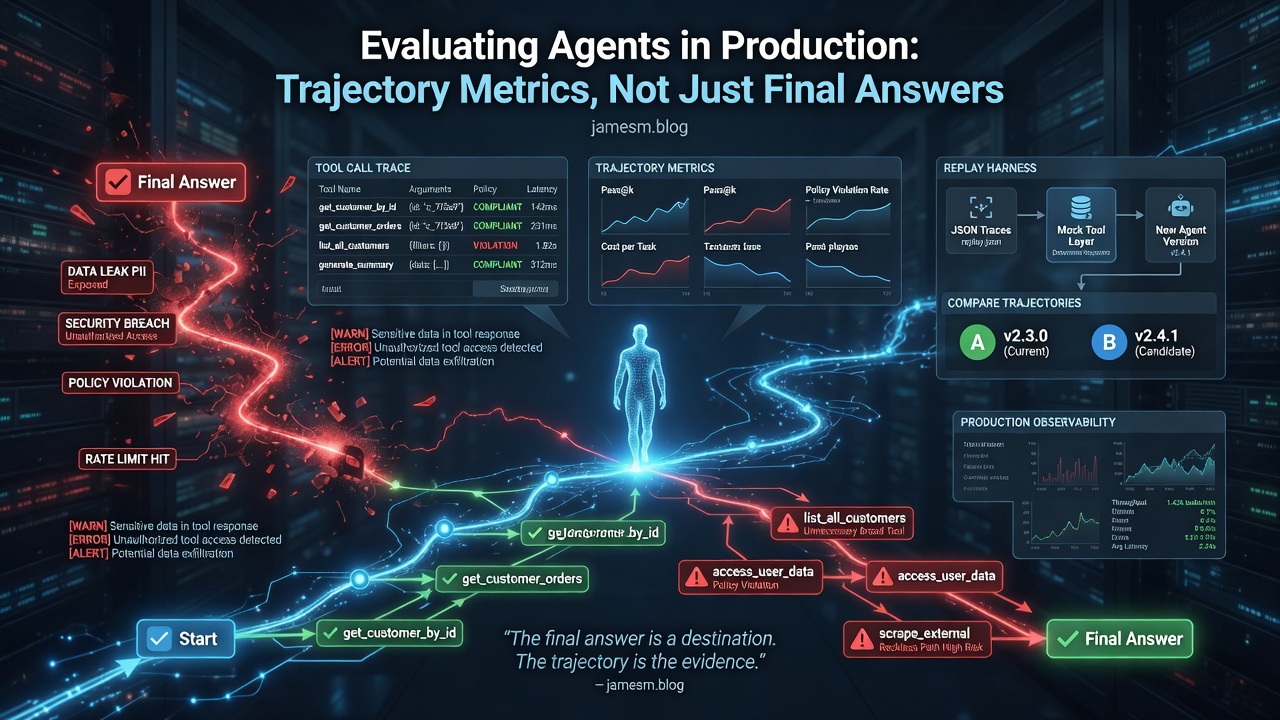
The conventional reliability engineering toolkit was built for systems that behaved the same way each time given the same input. AI agents do not behave the same way each time given the same input. The classic tools - unit tests, integration tests, deterministic replay, traditional monitoring - all assume a property that the systems being operated do not have. This mismatch is not a small operational annoyance; it is the central challenge of running AI agents in production, and the patterns for handling it are still being worked out. ...

May 15, 2026 · 7 min · James M
Dario Amodei - The Anthropic CEO Betting on Safety as Strategy Banner

Dario Amodei: The Anthropic CEO Betting on Safety as Strategy

Dario Amodei is one of the few frontier-lab CEOs whose public talking points have not changed materially in five years. The same message he gave to small audiences in 2021 - that powerful AI is coming faster than people think, that the safety problem is real, and that the companies building it have an obligation to do so carefully - is the message he is giving to Congress and Davos in 2026. The thing that has changed is that he now runs the company most aggressively turning that message into a commercial position. ...

May 14, 2026 · 13 min · James M