TL;DR
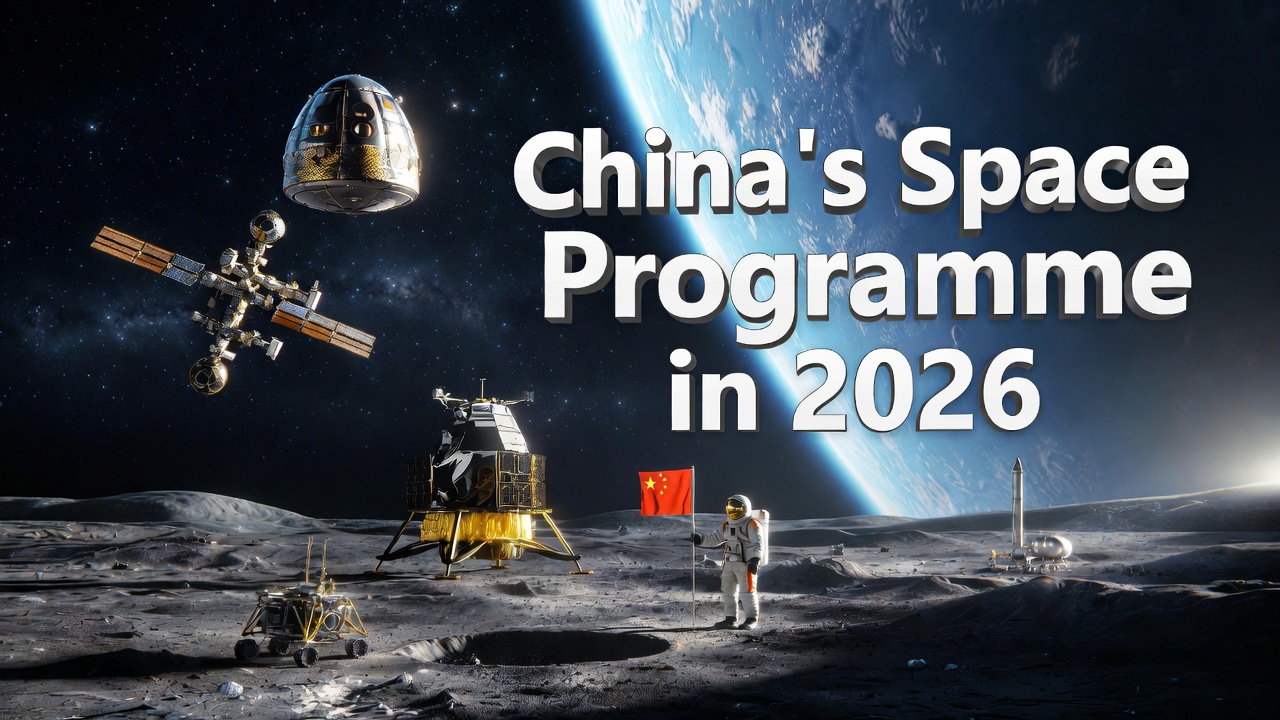
- China’s space programme in 2026 is one of the most consistently executed national space efforts in history. Where Western programmes have lurched between budgets and political cycles, China’s CNSA has shipped roughly what it announced, on roughly the timelines it announced.
- The Tiangong space station is fully operational, continuously crewed, and has hosted both domestic and international experiments.
- The Chang’e lunar series has progressed from sample return (Chang’e 5, 6) to the precursors of a crewed lunar landing programme planned before 2030. China has now returned samples from both the near and far sides of the Moon - the only nation to have done so.
- The lunar plan centres on the International Lunar Research Station (ILRS) - a long-term, China-led, multinational lunar surface base, with crewed landings as a milestone rather than the goal.
- Mars sample return, deep-space exploration, and a permanent lunar presence are all on a credible timeline. The realistic 2030 picture is two distinct, durable lunar architectures - American and Chinese - running in parallel.
Why It Is Worth Looking Carefully
It is easy in Western coverage to treat China’s space programme as a backdrop to the Artemis story. That undersells what is actually happening.
The simplest framing: most major space-faring nations announce ambitious plans, slip them, and quietly walk back the schedules. China announces plans, hits the milestones, and tends to under-promise rather than over-promise on the public-facing dates. Whether you find that politically reassuring or alarming, it is worth taking the programme seriously on its own terms.
In 2026, that programme has three pillars: the orbital station, the lunar series, and the broader deep-space architecture being built around them.
Tiangong - The Operational Orbital Programme
Tiangong (“Heavenly Palace”) is China’s third-generation space station and the only fully operational continuously-crewed station outside of the International Space Station consortium.
The station was assembled across 2021-2022 with three modules: Tianhe (the core habitation module), Wentian, and Mengtian (laboratory modules). Subsequent expansions have added an extension module and visiting Tianzhou cargo missions.
What is notable about Tiangong in 2026:
Continuous occupation. Crewed Shenzhou missions rotate roughly every six months. The station has been continuously occupied for the bulk of its operational life.
Genuine science output. Tiangong is producing peer-reviewed scientific results in materials science, fluid physics, biology, and Earth observation. The output is real and is published.
International experiments. Despite the political framing, Tiangong has hosted experiments from European, Asian, and Middle Eastern partners. The station is more open than its reputation suggests, particularly relative to the bilateral US-led posture.
Strategic timing. With the ISS retirement planned for the end of the decade, Tiangong is positioned to be the primary continuously-crewed Earth-orbital facility in the early 2030s, alongside whatever commercial replacements (Axiom, Vast, Starlab) actually launch on schedule.
The station is not as large as ISS. It does not have the same partner ecosystem. But it works, it has been on schedule, and it is doing the job.
Chang’e - The Lunar Series
The Chang’e programme is the part of China’s space architecture that has changed the most over 2024-2026.
Chang’e 6 returned samples from the far side of the Moon in 2024. This was the first time any nation had returned samples from the lunar far side, and the scientific implications are still being worked out. The samples are continuing to produce papers in 2026.
Chang’e 7, planned for 2026, targets the lunar south pole - the same region of strategic interest as Artemis III. Its mission profile includes a hopper that will explore permanently shadowed regions for water ice. If the mission succeeds, China will have ground-truth water-ice data from the south pole well before any Artemis crewed landing.
Chang’e 8, planned for around 2028, is positioned as a precursor to the lunar research station - testing in-situ resource utilisation, 3D printing of lunar regolith, and long-duration surface infrastructure.
The pattern is deliberate. Each Chang’e mission demonstrates a capability that the next one extends. Sample return, far side, south pole, ISRU, permanent infrastructure. By the time crewed landings are attempted, the programme will have walked through every supporting capability rather than betting it all on a single mission.
This is a much slower, more incremental approach than the Apollo or Artemis framings. It is also the approach that has historically produced the most durable space infrastructure.
The Crewed Lunar Programme
China’s stated goal is a crewed lunar landing before 2030. The infrastructure for this is real and visible.
The architecture - as currently described - involves two launches of the new Long March 10 rocket:
- One Long March 10 launches the Lanyue lunar lander to lunar orbit.
- A second Long March 10 launches the Mengzhou crew vehicle carrying the astronauts.
- The crew transfers to the lander in lunar orbit, descends to the surface, performs the EVA, ascends, transfers back to Mengzhou, and returns to Earth.
Compared to Artemis III, this architecture is simpler in some ways and more conservative in others. There is no orbital propellant transfer, no super-heavy lander, no NRHO rendezvous. The lander is small, the surface stay is short, and the mission profile is closer to Apollo than to Artemis.
That conservatism cuts both ways. The mission cannot do as much as a Starship-HLS surface mission could in principle. It also has dramatically fewer ways to fail. For a first crewed lunar landing in over 50 years, conservative is a reasonable choice.
The Long March 10 has been progressing through component tests and is on track for first flights in the back half of the decade. The Lanyue lander has been through hardware tests. The Mengzhou crew vehicle is in development with milestones publicly visible.
The International Lunar Research Station
The strategic frame for all of this is the International Lunar Research Station (ILRS) - a long-term, China-led, multinational lunar surface base.
ILRS is announced in three phases:
- Phase 1 (current to ~2028): Reconnaissance and precursor missions. The Chang’e series, Russian Luna missions where they materialise, and partner contributions.
- Phase 2 (~2028-2035): Construction. Robotic deployment of habitat, power, and communications infrastructure. Initial crewed visits.
- Phase 3 (~2035+): Operations. Continuous or near-continuous crewed presence, scientific operations, ISRU pilot plants.
The partner list has grown. As of 2026 it includes Russia, Pakistan, Venezuela, Belarus, Egypt, Thailand, Senegal, Nicaragua, the Asia-Pacific Space Cooperation Organization, and a handful of others. The technical contributions vary - some partners are providing instruments, some are providing landing site studies, some are nominal.
Compared to the Artemis Accords - the parallel US-led framework - ILRS has fewer signatories and fewer high-capability partners. It is also less prescriptive about norms. The two frameworks compete and to some extent represent competing visions for how the lunar surface gets governed.
Mars And Beyond
Outside the lunar focus, the Chinese deep-space programme has been producing real results.
Tianwen-1 delivered the Zhurong rover to Mars in 2021 - the first successful Chinese Mars surface mission. Zhurong went into hibernation in 2022 and has not returned, but the operational baseline is established.
Tianwen-2, launched in 2025, is targeting near-Earth asteroid 469219 Kamoʻoalewa for sample return.
Tianwen-3, currently in planning for the late 2020s, is China’s Mars sample return mission. If it flies on schedule, it would beat the troubled NASA-ESA Mars Sample Return programme.
Tianwen-4, planned for 2029-2030, targets the Jupiter system.
The pattern across the deep-space programme is the same as in the lunar programme: announce conservatively, ship reliably, expand incrementally.
How Chinese And American Programmes Will Coexist
The realistic 2030 picture is not “one nation lands first and wins.” It is two parallel lunar architectures, each with its own goals, partners, and operational tempo.
United States and partners (Artemis): Higher ambition per mission, more dependence on novel architecture (Starship HLS, distributed launch, sustained surface presence), more variable schedule.
China and partners (ILRS): More incremental ambition per mission, more conservative architecture, more reliable schedule.
Both will succeed at landing crew on the Moon in the late 2020s or early 2030s. Both will establish surface infrastructure. Both will operate continuously-crewed orbital stations. The competition is real but the framing as a sprint to a single milestone misses the longer-term shape.
The thing the Chinese programme actually changes about the global picture is competition for partners. Smaller space-faring nations now have a real choice between two frameworks rather than one. That is a structural shift that will outlast any specific mission.
What Could Slip
Nothing about the Chinese space programme is destiny. Specific risks:
Long March 10. A new heavy-lift vehicle is a lot of capability to develop on schedule. Delays here delay the crewed lunar landing.
Lander surface stay duration. Short stays limit science output. Extending stays requires power, life support, and EVA capabilities that have not yet been demonstrated at duration.
ILRS partner reliability. Russian contributions have been complicated by the war in Ukraine and broader strategic shifts. Any meaningful Russian role in ILRS depends on Russian capability that is increasingly uncertain.
Domestic political continuity. The programme’s stability has depended on continuous prioritisation. Any meaningful political shift could change priorities.
Budget growth in the AI and military domains. Space is one of several capital-intensive priorities. Internal competition for resources is real even if not visible from outside.
None of these are likely to be programme-killing. All of them are plausible enough to take the public schedules with at least some uncertainty.
The Honest Verdict
China’s space programme in 2026 is the most consistently executed national space programme in operation. It is not the most ambitious - Artemis and SpaceX both reach further per mission - but it is the most reliable. That reliability has compounded over the last decade and is now visible in a fully operational station, a robust lunar series, and a credible plan for crewed lunar landings before the end of the decade.
For Western readers who have followed mostly American space coverage, the most useful update is probably: stop treating Chinese announcements as aspirational. They are mostly schedules. Some slip. Most do not.
The lunar surface in the early 2030s will be a place where two distinct national architectures operate. That is a different picture from the one Apollo painted and the one Artemis is implicitly painting. Adjusting to that picture is the actual work.