TL;DR
- Interstellar visualised a spinning black hole rigorously enough to produce a peer-reviewed physics paper with Kip Thorne
- Core ideas: wormhole traversal, supermassive black hole Gargantua, gravitational time dilation, Penrose slingshot, and the five-dimensional Tesseract
- The film honours general relativity where Hollywood usually fudges - but bends science where story demands it
- Gravitational time dilation on Miller’s planet is the most famous trade-off between accuracy and narrative
- For a blockbuster, taking physics this seriously is unusual - and worth unpacking
There are not many films where the visual effects pipeline produces a peer-reviewed physics paper. Christopher Nolan’s Interstellar is one of them. The visualisation of the supermassive black hole Gargantua was rigorous enough that it ended up in Classical and Quantum Gravity, co-authored by the visual effects team and Nobel laureate Kip Thorne.
That single fact captures what makes the film unusual. It is, on the surface, a story about love, time, and survival. Underneath, it is a serious attempt to take Einstein’s general relativity and put it on a 70mm IMAX screen with as little fudging as Hollywood would allow.
This post walks through the central physics ideas in the film - the wormhole, Gargantua, gravitational time dilation, the Penrose slingshot, and the Tesseract - and looks at where the science was honoured, where it was bent, and what the philosophical implications are when a blockbuster decides to take physics seriously.
Interstellar Official Trailer
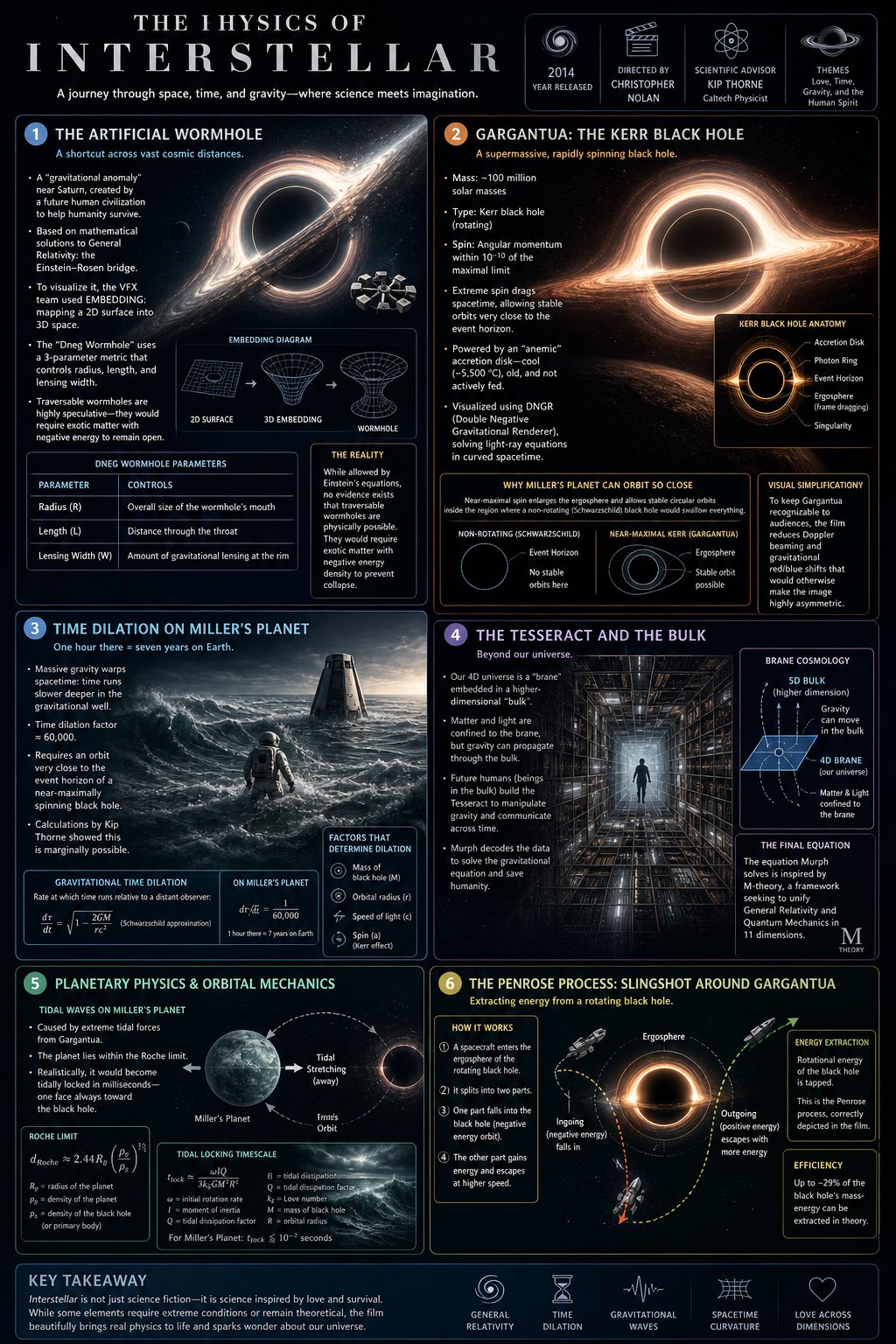
Infographic
A Film Built on a Physicist’s Treatment
The project began not with a screenplay, but with a treatment by Kip Thorne and producer Lynda Obst. Thorne, then the Feynman Professor of Theoretical Physics at Caltech, had two non-negotiable rules. Nothing in the film would violate established physical law. Any speculation would have to start from real science and stay within what serious physicists were willing to entertain.
That constraint is unusual for a blockbuster. Most science fiction trades on plausible-sounding language. Interstellar asked its filmmakers to either work the equations or argue with the man who had spent his career writing them.
The result was a film that, despite some compromises, treats general relativity as an active character rather than a backdrop.
The Wormhole Near Saturn
The Endurance reaches another galaxy through what Romilly describes as a “gravitational anomaly” parked near Saturn. It is, of course, a wormhole - a tunnel in spacetime that connects two distant points without traversing the space between them.
The Theoretical Basis
Wormholes appear in general relativity as mathematical solutions to Einstein’s field equations. The earliest version, the Einstein-Rosen bridge, was a curiosity - a feature of the Schwarzschild solution describing a non-rotating black hole. The trouble is that an Einstein-Rosen bridge collapses faster than anything, even light, can travel through it.
To make a wormhole traversable, you need to thread it with so-called exotic matter - matter with negative energy density, capable of holding the throat open against its own gravitational tendency to pinch shut. Whether such matter exists in any practically useful form is, to put it mildly, an open question.
The film handles this honestly. The wormhole is not described as something humans built. It is presented as an artefact left by an advanced civilisation - eventually revealed to be future humans - precisely because there is no realistic short-term path to engineering one ourselves.
The “DNeg Wormhole”
For visualisation, the team at Double Negative built a three-parameter wormhole metric. The director could adjust radius, length, and lensing width to get the look the film needed. A short throat was chosen partly to keep the audience oriented - a longer wormhole would have produced multiple distorted images of the destination galaxy that would have been hard to read on screen.
This is the first of many places where the film makes a deliberate, well-understood compromise rather than papering over physics with hand-waving.
Will Wormholes Allow Fast Interstellar Travel? - PBS Space Time
Gargantua: The First Cinematic Black Hole
Gargantua is the centrepiece of the film’s middle act and the reason its visual effects pipeline produced an actual research paper. It is depicted as a Kerr black hole - a rotating one - with a mass of about a hundred million Suns.
Why It Has to Spin So Fast
The plot requires extreme gravitational time dilation on Miller’s planet. To make that physically possible without the planet being torn apart or swallowed, Gargantua must spin at a rate astonishingly close to its theoretical maximum. Thorne’s calculations put the required spin within roughly one part in ten billion of the limit allowed by the Kerr solution.
That near-maximal spin matters because, in a Kerr geometry, the location of the innermost stable circular orbit shifts inward as the black hole spins faster. A maximally spinning Gargantua allows planets to orbit just outside the event horizon without falling in - which is exactly what the story needs.
The Anaemic Accretion Disk
There is no companion star in the Gargantua system, so the planets receive their light and heat from the black hole’s accretion disk. The film depicts this disk as relatively cool, around 5,500 °C - hot, but not so violently radiant that it would sterilise everything in the neighbourhood.
Real accretion disks around active supermassive black holes are extreme X-ray sources and would fry any biology around them. The film’s “anaemic” disk is an in-universe explanation for why life-bearing planets can sit nearby - the system is old, the disk has not been fed fresh gas in a long time, and it has cooled.
The Visualisation Breakthrough
To render Gargantua, Double Negative built a renderer called DNGR - the Double Negative Gravitational Renderer. Rather than tracing single rays, it traced bundles of rays through curved spacetime, integrating the geodesic equations for a Kerr black hole.
What came out of that renderer was striking enough to surprise even Thorne. The accretion disk appears as a halo wrapping above and below the event horizon, because gravitational lensing bends the image of the far side of the disk over the top and underneath. That distinctive shape is not artistic licence - it is what general relativity actually predicts.
The film does omit two effects that would be present in reality. A real spinning Kerr black hole would show a strong asymmetry due to relativistic Doppler beaming - the side of the disk rotating towards the viewer would be much brighter than the receding side. The film smooths this out. Gravitational frequency shifts also affect the colour of the disk. These were toned down to keep the image readable to a general audience, but the geometric structure of the image is faithful to the physics.
How to Understand the Black Hole Image - Veritasium
One Hour, Seven Years
The most emotionally devastating physics in the film is the time dilation on Miller’s planet. An hour spent on the surface costs the crew - and Cooper’s daughter back on Earth - more than seven years.
That is a gravitational time dilation factor of about 60,000. Time on the planet, deep in Gargantua’s gravitational well, runs vastly slower than time for an observer far from the black hole.
Why This Is Almost Impossible
Thorne’s first reaction, when Nolan asked for it, was that no stable orbit could give a factor that extreme. He went away, ran the numbers, and came back with a more precise verdict. It is marginally possible, but only if Gargantua spins almost at its theoretical maximum.
The film keeps this constraint quietly visible. Gargantua’s depiction throughout - its size, its accretion disk, the orbital mechanics - is consistent with a black hole spinning at very nearly the maximal Kerr limit.
What This Means Dramatically
The seven-years-per-hour figure is not just a number. It is the engine of the film’s emotional payload. Cooper watches twenty-three years of family video messages in a single sitting after returning from Miller’s planet. His daughter ages from a child to a woman older than him. The physics of curved spacetime becomes, for two and a half hours of screen time, the physics of grief.
This is what makes Interstellar worth taking seriously as both science and cinema. The time dilation is not a McGuffin. It is the central tragedy.
The Penrose Slingshot
To leave Gargantua’s vicinity and reach the third candidate planet, the crew uses a slingshot manoeuvre around the black hole. This is a cinematic flourish, but it is also rooted in a real piece of relativistic physics: the Penrose process.
A spinning black hole is surrounded by a region called the ergosphere, between the event horizon and the static limit. Inside the ergosphere, spacetime itself is being dragged around the black hole’s spin. A spacecraft on a carefully chosen trajectory can extract some of that rotational energy, leaving the ergosphere with more energy than it carried in.
The energy comes from somewhere - the black hole’s spin slows down by a corresponding tiny fraction. In Interstellar, this is what allows Endurance to reach Edmund’s planet after the detour to Miller’s.
The film does not explain any of this on screen. It just lets the manoeuvre happen, in a way that corresponds to a real piece of general relativistic mechanics. That is a small but characteristic choice.
The Tesseract and the Bulk
The most contested element of the film, scientifically and philosophically, is the closing act. Cooper falls into Gargantua, is pulled out of normal four-dimensional spacetime, and finds himself in a five-dimensional construct - the Tesseract - from which he can communicate with the past by manipulating gravity.
Brane Cosmology
The framing here draws on brane cosmology, a branch of theoretical physics related to string theory and M-theory. The idea is that the four-dimensional spacetime we inhabit might be a “brane” embedded in a higher-dimensional “bulk.” Most physical phenomena - light, matter, the strong and weak nuclear forces - are confined to the brane. Gravity, in some versions of the theory, is the exception. It can leak into the bulk, which is why it appears so weak compared to the other forces.
If that picture is right, then beings able to operate in the bulk could, in principle, manipulate gravity in ways that look impossible from inside the brane. They could, for example, send information backwards in our time by acting on the brane from outside.
This is the loophole the film exploits. Cooper cannot send words or images back to Murph. He can only send gravity - the thing that, by hypothesis, is not confined to our brane.
The Tesseract as Tool, Not Mysticism
It would be easy to read the Tesseract scene as a leap into pure mysticism. The film is doing something subtler. The Tesseract is presented as a tool, built by future humans operating in the bulk, that translates higher-dimensional access into a three-dimensional environment Cooper can navigate. Time is laid out as a physical dimension. Each instant of Murph’s bedroom is rendered as a separate slice of space.
That is not a fundamentally new idea in physics - relativity has treated time as a dimension since 1908. What the film does is take that perspective seriously enough to build a set out of it.
The “They” Are Us
The reveal that the bulk beings are descendants of the surviving humans is the philosophical capstone. It is not a deus ex machina - it is a closed time loop. Humanity is saved by humanity, with future-tense capabilities loaning a hand to its past self.
This is the move that makes Interstellar a film about survival as a species, not just survival as individuals. The bulk beings are not gods. They are a future humanity that has not forgotten where it came from.
Planetary Physics
The two visited worlds in Gargantua’s system raise their own questions.
Miller’s planet is a global ocean with periodic kilometre-high waves. The film attributes these to tidal forces from Gargantua. This is broadly plausible - the planet is so close to the black hole that it sits near the Roche limit where tidal forces would otherwise tear a body apart. A more rigorous treatment would have the planet tidally locked almost instantly - the same face permanently aimed at Gargantua - which would change the tide pattern significantly. The film glosses over this for the sake of staging two enormous waves crashing across the set.
Mann’s planet is a frozen world with a peculiar atmosphere of frozen clouds. Its physics is less specifically grounded than Miller’s, but it serves a different function in the story - a place where ambition and isolation corrode a man’s character, with the cold landscape as the canvas.
Where Science Met Storytelling
The interesting question about Interstellar is not “where did the film get the physics wrong?” but “where did Nolan and Thorne agree to bend it, and why?”
Several principles seem to have guided the trade-offs.
Geometry was preserved over photometry. The shape of Gargantua, the shape of the wormhole, the curvature effects on the accretion disk - these are essentially correct. The colour, brightness, and Doppler asymmetry were simplified for visual readability.
Causality was preserved. Cooper cannot send information backwards in time directly. The Tesseract loophole goes through gravity, which under the brane-cosmology framing is the one channel that can cross dimensions.
Speculation was clearly marked. The wormhole, the Tesseract, and the bulk beings are explicitly attributed in-story to a more advanced civilisation. The film does not pretend humanity in 2067 invented them. The compromises are isolated to those elements rather than smeared across the whole film.
Hard physics was kept intact where possible. Gravitational time dilation is the engine of the plot. The Penrose slingshot, the Kerr geometry, the rendering of the black hole - these are real general relativity shown to a popcorn-eating audience without dilution.
The Science of Interstellar - Kip Thorne lecture
A Philosophy of Survival
Underneath the physics, Interstellar is making a claim about the human position in a universe that does not, on the face of it, owe us anything.
Earth is dying. The blight is closing in. The frontier mentality of NASA has been buried, in the film’s near-future, under a curriculum of resignation. The film treats this not as a parable about climate change specifically, but as an argument about whether a civilisation that stops looking outward stops being a civilisation at all.
Cooper’s line about humanity being born on Earth but never meant to die there is not subtle. Neither is the film’s veneration of the engineer-explorer archetype. But the philosophical move underneath is more interesting than the speeches that carry it.
The film’s premise is that the universe gives us general relativity, and general relativity gives us a way out. Time dilates. Space curves. Higher dimensions, if they exist, leak gravity. None of these phenomena were invented for our benefit. But each of them, taken seriously, opens a door.
The argument is essentially this: physics is not the enemy of human meaning. It is the substrate on which human meaning can be built, including the meaning carried by a father trying to save his daughter from across a curved spacetime that should make such a thing impossible.
Kip Thorne - The Physics of the Cult Movie Interstellar - Stanford
What the Film Got Right About Science Itself
Beyond any specific equation, Interstellar models something rare in cinema: scientists who behave like scientists.
Brand and Romilly disagree without it becoming melodrama. Cooper, despite being the audience surrogate, defers to the people with the relevant training when it matters. The mathematical breakthrough at the end is presented as exactly what it would be in real life - the result of long, frustrating work on a single equation, not a flash of mysterious genius.
The film also gets the cost of scientific work right. Brand’s father has been lying about the prospects of solving gravity for decades, because the truth would be unbearable. The professional culture around the secret is grim, exhausted, and quietly heroic. That is closer to lived experience in big science than the usual cinema portrait of breezy boy-genius eureka moments.
A Final Thought
It is tempting to grade Interstellar on a physics scorecard - so many points for getting the Kerr geometry right, so many points off for the tidal locking on Miller’s planet. That misses the point.
The achievement of the film is that it took general relativity, a theory that most people encounter as an abstraction or not at all, and rendered it as something visible, emotional, and consequential. It did this without sneering at its audience and without sneering at the physics. The compromises are honest. The speculations are signposted. The core ideas survive contact with the screen.
That is rare. It is the reason physicists keep teaching with clips from the film, and the reason a generation of viewers walked out of cinemas in 2014 with a working intuition for time dilation that no textbook had given them.
For a Hollywood blockbuster, that is a serious thing to have done.
Related Reading
- Why Spacecraft Don’t Just Slow Down Before Reentry
- Human Spaceflight Rockets in 2026
- Artemis II Distance Record
- SpaceX Starship vs NASA SLS
- NASA Artemis II
Further authoritative reading: