TL;DR
- Artemis II splashed down April 11, 2026 - first crewed lunar return since 1972, setting a new distance record of 252,756 miles
- Crewed rockets in 2026: SLS/Orion, Starship, New Glenn, and China’s Long March 10 - government and commercial programmes running in parallel
- The Moon is the near-term focus (Artemis III lander race); Mars remains Starship’s long bet
- Reusability and launch cadence now matter as much as raw lift capacity
- This decade may be the most consequential for crewed spaceflight since Apollo - but with a different industrial base
A few weeks ago, four astronauts came home from the Moon for the first time since 1972. Artemis II splashed down on April 11, 2026, after a nine-day flight that took its crew further from Earth than any human has ever travelled - 252,756 miles, a new record set by Reid Wiseman, Victor Glover, Christina Koch, and Jeremy Hansen.
It is the clearest signal yet that human spaceflight has stopped being a thing of the past and started being a thing of the near future again. But the headline mission is only one piece of a much larger picture. The decade we are living in is shaping up to be the most consequential one for crewed space travel since Apollo - and unlike the 1960s, this time it is not a single government driving it.
This is a snapshot of where the rockets that carry humans actually stand in May 2026, what they are designed to do, and where the next ten years are likely to take us.
A New Golden Age, Built on Different Foundations
The 1960s space race was a single sprint between two superpowers. What is happening now is a marathon between several governments and several companies, all running in roughly the same direction but with very different philosophies.
NASA still anchors the Western lunar effort, but it now buys hardware - landers, rides to the space station, even the eventual crew transport to the lunar surface - from private suppliers. SpaceX, Blue Origin, Axiom, and others are no longer contractors at the edge of the program. They are the program. China, meanwhile, is building its own parallel architecture, with its own rockets, its own crewed spacecraft, and its own lunar timeline.
The result is more activity, more variety in approach, and more redundancy than at any point since the Shuttle era. It is also, importantly, more honest about cost. The era of cost-plus, expendable hardware is not dead, but it is finally sharing the road with vehicles built around reuse.
The Rockets Carrying Humans in 2026
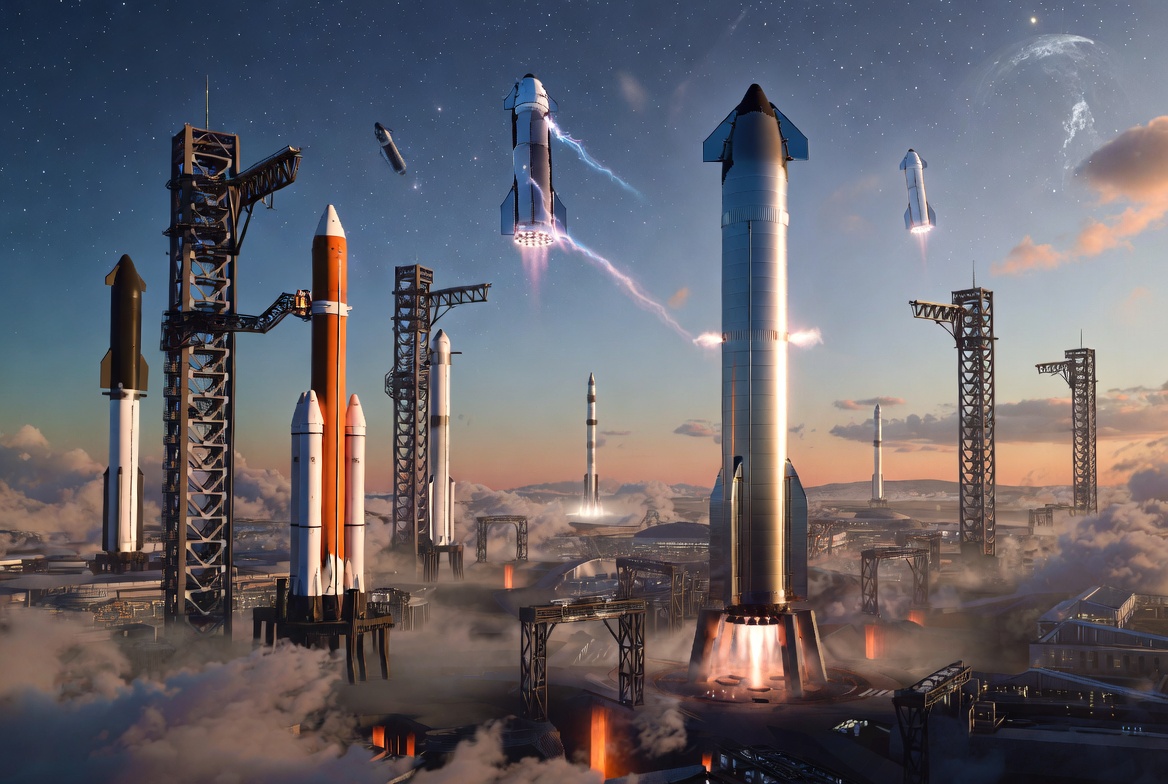
Four launch systems matter most for crewed exploration right now. Each represents a distinct bet on how humans should leave Earth.
NASA’s Space Launch System (SLS) and Orion
SLS is the descendant of the Space Shuttle program. It uses recycled Shuttle main engines (the RS-25), Shuttle-derived solid rocket boosters, and a development lineage that stretches back to the Constellation program of the mid-2000s.
It works. Artemis I flew uncrewed in 2022 and Artemis II flew crewed in April 2026, both successes. But SLS is also expensive and slow. NASA’s own Inspector General has put the cost at around $2.5 billion per launch, and the acting Administrator publicly cited a figure of $4 billion in 2025.
In February 2026, NASA made a significant architectural decision: it standardized on the Block 1 configuration and cancelled the planned Block 1B and Block 2 upgrades. The Exploration Upper Stage and Mobile Launcher 2, both of which had been suffering long delays, were dropped. Instead, the program will fly a simpler, more consistent rocket and rely on commercial landers to do the heavy lifting on the lunar surface.
That is a quietly important shift. NASA has effectively conceded that the right way to get mass to the Moon is no longer to keep scaling up the government-built rocket - it is to launch crew on Orion and let SpaceX or Blue Origin handle the rest.
SpaceX Starship
Starship is the most ambitious launch vehicle ever built. Stainless steel, methane-fuelled, fully reusable, and absolutely enormous - 33 Raptor engines on the Super Heavy booster, a 9-metre upper stage, and a stated goal of putting 100 tonnes or more into low Earth orbit on each flight.
As of late 2025, Starship had launched 11 times, with 6 successes and 5 failures. The “Mechazilla” tower has caught the booster mid-air more than once. Block 2 of the upper stage was retired after Flight 11, and Block 3 - the version aimed at operational missions - is targeted to begin flight testing in 2026.
Two things make Starship qualitatively different from everything else flying. First, the human-rated lunar variant (Starship HLS) is what NASA has selected to land Artemis astronauts on the Moon. Second, the architecture only really makes sense if you can refuel a Starship in orbit using other Starships - a capability that has never been demonstrated and which the entire deep-space concept depends on.
If orbital refuelling works, Starship is a generational leap. If it doesn’t, the program has a much harder road than its public timelines suggest.
Blue Origin’s New Glenn and Blue Moon
Blue Origin has, after a long quiet stretch, become a serious player. New Glenn flew its first mission in January 2025, recovered its booster on the second flight in November 2025, and has been working through the inevitable early-flight problems since - including a grounding by the FAA in April 2026 following an upper stage anomaly on NG-3.
The vehicle itself is an interesting middle path. The first stage is reusable for at least 25 flights, the upper stage is expendable, and payload to LEO is around 45 tonnes in the current 7×2 configuration, scaling toward 70+ tonnes in the planned 9×4. Blue Origin is also building Blue Moon, the lunar lander that will share Artemis surface duties with Starship HLS.
Where SpaceX is betting everything on full reusability, Blue Origin is betting on something more incremental - reuse where it pays off, expendable where it has to be, and a cadence somewhere between SLS and Starship. It is a credible second supplier for both crew and cargo to lunar destinations.
China’s Long March 10
China has not been idle. The Long March 10 is a super-heavy lift vehicle being built specifically for crewed lunar missions under Project 921. Standing 92.5 metres tall and capable of putting 70 tonnes into low Earth orbit and 27 tonnes onto a trans-lunar trajectory, it is in the same class as a stripped-down Saturn V.
A successful suborbital abort test took place in February 2026, and the first orbital test flight is scheduled for September 2026. The mission profile is deliberately conservative - two separate launches per Moon mission, one carrying the Mengzhou crew capsule and one carrying the Lanyue lunar lander, with rendezvous in lunar orbit.
China’s stated goal is to land taikonauts on the Moon before 2030. On current pace, that is plausible.
The Technologies That Make This Possible
Behind the headline rockets sit a handful of engineering breakthroughs that are quietly doing most of the work.
Full and rapid reuse. The economics of human spaceflight change completely when you stop throwing rockets away. SpaceX’s Falcon 9 made first stage recovery routine. Starship is now trying to make full-vehicle recovery routine. Blue Origin’s New Glenn lands its booster on a barge. Even SLS, the most expendable of the bunch, recovers its solid rocket boosters from the Atlantic.
Orbital refuelling. The ability to transfer cryogenic propellant between vehicles in zero gravity is the linchpin of any serious deep-space crewed program. Without it, you cannot put enough mass on a trans-Mars trajectory at any sane price. SpaceX has scheduled propellant transfer demonstrations for the Block 3 Starship campaign; if these succeed, the Mars timeline becomes physically credible. If they slip, everything slips with them.
Heat shield technology. Returning from the Moon means hitting the atmosphere at 25,000 mph. Orion’s AVCOAT heat shield was tested on Artemis I and again on Artemis II. Starship’s tile-based shield - thousands of hexagonal ceramic tiles, similar in spirit to the Shuttle’s but mass-produced - is on its third major iteration after several burns through earlier versions.
Life support and long-duration habitation. A trip to Mars is roughly nine months one way. The closed-loop life support systems being built for Gateway, for the Artemis lunar base, and eventually for Mars transit, are descendants of what currently runs on the ISS - but they need to work for far longer with no resupply.
The cost curve. In 1981, the Shuttle cost roughly $60,000 per kilogram to LEO. Falcon 9 brought that to about $2,500 per kilogram. Starship, if it reaches its design goals at full reuse, targets something closer to $200 per kilogram. That is an order-of-magnitude shift, and it is what makes everything else - permanent lunar bases, Mars exploration, point-to-point Earth travel - even worth talking about.
Crewed Missions Through 2035
Here is what is actually scheduled or seriously planned, separated from speculation.
Moon
| Mission | Target Date | Purpose |
|---|---|---|
| Artemis II | Completed April 2026 | First crewed lunar flyby since Apollo 17 |
| Artemis III | Late 2027 | LEO docking test with Starship HLS and Blue Moon |
| Artemis IV | Early 2028 | First crewed lunar landing of the Artemis program |
| Artemis V | Late 2028 | Second surface landing, Gateway operations |
| Artemis VI+ | ~Annual after 2028 | Sustained lunar presence and base-building |
| China Long March 10 first flight | September 2026 | Uncrewed orbital test |
| China crewed lunar landing | Before 2030 | First Chinese crew on the Moon |
Mars
SpaceX has stated an intent to launch uncrewed Starships toward Mars during the 2026 launch window, with the first crewed flight following four years after a successful uncrewed landing. That puts a notional first crew on Mars in 2030 or 2031, though most independent analysts treat the mid-2030s as more realistic.
Low Earth Orbit
The ISS is scheduled for deorbit around 2030-2031. Several commercial replacements - Axiom Station, Orbital Reef, Starlab, Vast’s Haven-2 - are in various stages of development to take over crewed LEO operations. Private astronaut missions on Crew Dragon and Starliner now run multiple times per year.
The Industrial Reality
The interesting story underneath the rockets is the manufacturing one. SpaceX’s Starfactory in Boca Chica is the first attempt anyone has made to mass-produce orbital-class rockets the way Boeing produces airliners. The stated goal is one Starship every few days, eventually.
Whether that target is realistic is debatable. Whether it is even necessary to get to one Starship a week to make the architecture viable is a more interesting question. Even at one a month, you are operating at a cadence no human spaceflight program has ever come close to.
Compare this to the Apollo era - 13 Saturn Vs total, hand-built, each one a national project. Or the Shuttle - 135 missions across 30 years, with four orbiters. The bet underneath Starship is that human spaceflight only becomes truly transformational when launch starts to feel less like a moonshot and more like an airline.
Where This Is All Heading
The honest forecast for the next ten years looks something like this:
- Late 2020s: Multiple American crews back on the lunar surface. A small Chinese presence on the Moon. Gateway taking shape. Starship operational, possibly with the first uncrewed Mars landings successful.
- Early 2030s: A permanent crewed lunar outpost begins, supported by regular Starship and Long March 10 flights. ISS retired, replaced by commercial LEO stations. First crewed Mars mission, if it happens, in this window.
- Mid-2030s: Lunar base operations become routine. The cost-per-kilogram curve flattens at a point that makes industrial activity in space (mining, manufacturing, in-space construction) economically thinkable for the first time. Mars infrastructure - power, life support, ISRU - begins to grow.
The transition that this decade actually represents is not “humans visiting space more often.” It is the slow, expensive shift from visiting space to living in space. The rockets are the visible part. The harder part is everything that has to follow them.
Risks, Honest Edition
It is worth being clear about what could go wrong.
Technical: Orbital refuelling, deep-space life support, long-duration radiation exposure, and reliable lunar surface operations are all unsolved at the level of routine reliability. Any one of them slipping by two or three years pushes the whole architecture back.
Programmatic: SLS has shed two upgrade tiers in 2026 alone. Starship has had five failures in eleven flights. New Glenn was grounded last month. None of these are program-ending events, but they are reminders that timelines on government PowerPoints rarely survive contact with the actual hardware.
Geopolitical: A serious US-China rivalry on the Moon is a feature of the next decade, not a risk to be avoided. Whether that drives faster progress or messier outcomes (overlapping landing sites, claims to lunar resources, conflicting safety standards) is genuinely uncertain.
Economic: The current generation of programs assumes sustained funding through political cycles. SLS has so far survived every administration. Starship depends partly on continued NASA contracts. Commercial LEO depends on a customer base that mostly does not yet exist.
The Pivot Point
Apollo is often described as a moment that transcended its time - humanity reaching beyond itself, briefly, before pulling back. The 2020s and early 2030s look more like the start of something that does not pull back.
The rockets flying now are not curiosities. They are the foundation of a transport infrastructure. The Moon is becoming a destination, not a flag-planting exercise. Mars is becoming a target with hardware behind it, not a thought experiment. And human spaceflight has finally shaken off the assumption that it must be a single national program with a single rocket and a single goal.
What gets built in the next ten years will determine whether this is the decade humanity becomes a spacefaring species in any meaningful sense - or whether it is, like the 1970s, a brilliant chapter that quietly closes.
The rockets, at least, are finally up to the job.
Further Reading
- NASA Artemis program
- Artemis program (Wikipedia)
- SpaceX Starship (Wikipedia)
- Space Launch System (Wikipedia)
- New Glenn (Wikipedia)
- Long March 10 (Wikipedia)
- SpaceX Mars launch plans
- NASA Artemis architecture update, February 2026