Apple sues OpenAI over trade secrets as Elon Musk and Sam Altman clash on X

Apple Sues OpenAI, and the Musk-Altman Feud Finds a New Stage

TL;DR Apple sued OpenAI on July 10, 2026 in the Northern District of California, alleging the company stole trade secrets “at every level” to build its own hardware - CNBC Central to the claim: Tang Tan, OpenAI’s hardware chief and a former Apple VP, allegedly told job candidates still employed at Apple to bring “actual parts” to interviews for show-and-tell, and circulated an Apple offboarding document that taught new hires how to dodge exit security checks A separate allegation names Chang Liu, a former Apple systems electrical engineer, who allegedly kept an Apple-issued laptop after joining OpenAI in 2026 and used it to pull confidential documents on unannounced Apple products OpenAI’s on-record response: “We have no interest in other companies’ trade secrets. We remain focused on building innovative technology that empowers people everywhere.” Two days later, on July 12, Elon Musk and Sam Altman traded insults on X - Musk opened with “Scam Altman strikes again,” Altman replied with a post that hit 11 million views - CNBC The spat lands seven weeks after a jury dismissed Musk’s own lawsuit against Altman and OpenAI on May 18, 2026, and while both SpaceX (public since June 12) and OpenAI (confidentially filed for IPO) are courting the same public markets Three storylines collided this week, and it’s worth pulling them apart before deciding how much any of it matters. Apple filed a serious federal lawsuit against OpenAI over alleged theft of hardware trade secrets. Two days later, Elon Musk and Sam Altman were back to public insults on X, in a feud that has now run for the better part of a decade. And underneath both, two of the most valuable private companies on the planet - SpaceX and OpenAI - are mid-transition to public markets, which changes the stakes of looking undisciplined in public. ...

July 12, 2026 · 8 min · James M
SpaceX acquires Cursor AI code editor

SpaceX's $60 Billion Cursor Acquisition: Why It Matters

TL;DR SpaceX filed a $60 billion all-stock acquisition of Cursor on June 16, 2026 - marking one of the largest AI/developer tools acquisitions ever (confirmed via SEC filing) Cursor’s revenue metrics are impressive: ~$4 billion annualized revenue with $2.6 billion from enterprise customers, suggesting strong product-market fit Strategic pivot: SpaceX is moving beyond rockets and satellites into the software infrastructure layer that powers AI development itself Signal to the market: This acquisition suggests major tech companies are betting heavily on owning the entire stack - from hardware to the tools developers use to build AI systems Enterprise focus: The majority of Cursor’s revenue coming from enterprise (65%) indicates this is a B2B infrastructure play, not just a consumer developer tool Why SpaceX Acquiring Cursor Matters On the surface, it might seem odd that a company known for rockets and space exploration would acquire an AI code editor. But this acquisition reveals something fundamental about how the largest technology companies are thinking about AI development infrastructure. ...

June 16, 2026 · 4 min · James M
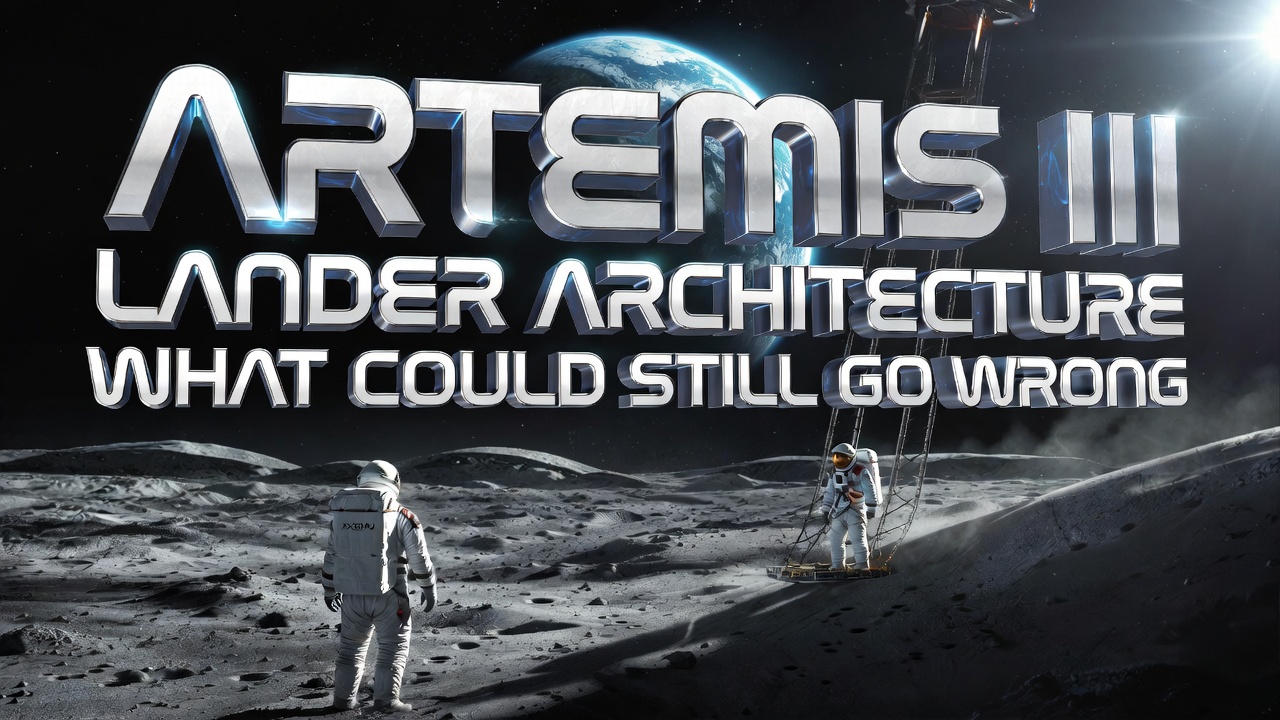
Artemis III Lander Architecture Banner

Artemis III Lander Architecture - What Could Still Go Wrong

TL;DR Artemis III is supposed to land two astronauts near the lunar south pole using a stripped-down SpaceX Starship as the Human Landing System (HLS). The architecture is genuinely audacious - it requires a new super-heavy rocket to fly several times before the crewed mission, on-orbit cryogenic propellant transfer at a scale that has never been demonstrated, and a lunar surface stay enabled by a vehicle three times taller than the Saturn V’s lunar module. The technical risk is concentrated in propellant transfer, boil-off management, engine relight reliability, and crew ingress/egress from a 50-metre tower on a sloped, unprepared surface. The schedule risk is concentrated in everything that has to happen before the crewed flight - and most of it has not happened yet. The mission can succeed. The honest read in mid-2026 is that it will succeed late, and the more interesting question is which of these subsystems is actually the long pole. How Artemis III Is Supposed To Work Artemis III’s architecture is not Apollo. Apollo carried everything it needed in one stack on a Saturn V. Artemis III spreads the mission across multiple launches, multiple vehicles, and two distinct propulsion systems, with a crew transfer in lunar orbit. ...

May 3, 2026 · 8 min · James M
Human Spaceflight Rockets 2026 Banner

Human Spaceflight Rockets in 2026: A New Era Takes Off

TL;DR Artemis II splashed down April 11, 2026 - first crewed lunar return since 1972, setting a new distance record of 252,756 miles Crewed rockets in 2026: SLS/Orion, Starship, New Glenn, and China’s Long March 10 - government and commercial programmes running in parallel The Moon is the near-term focus (Artemis III lander race); Mars remains Starship’s long bet Reusability and launch cadence now matter as much as raw lift capacity This decade may be the most consequential for crewed spaceflight since Apollo - but with a different industrial base A few weeks ago, four astronauts came home from the Moon for the first time since 1972. Artemis II splashed down on April 11, 2026, after a nine-day flight that took its crew further from Earth than any human has ever travelled - 252,756 miles, a new record set by Reid Wiseman, Victor Glover, Christina Koch, and Jeremy Hansen. ...

May 2, 2026 · 12 min · James M
SpaceX Starship vs NASA SLS - two visions for the future of deep space exploration

SpaceX Starship vs NASA SLS: Two Visions for Deep Space

TL;DR SLS and Starship are two bets on the same goal: SLS is the traditional aerospace approach (proven Shuttle-era hardware, simulate everything, launch when confident), Starship is the empirical one (test by launching, iterate fast) The cost chasm is the story: SLS launches are estimated at $2-4 billion each and fully expendable, while SpaceX targets $10 million per launch at scale with full-stack reusability Capability differs less than philosophy - SLS Block 1 lifts 95 tonnes to LEO, Starship 100+ tonnes fully reusable, and both have roles in Artemis SLS looks like a sunset vehicle; Starship is designed as a platform, but it still has to prove orbital refuelling and rapid reuse before the comparison is settled The likely end state is convergence: NASA missions increasingly flown on commercial reusable hardware Two Paths Diverge The 21st century space race isn’t between countries - it’s between philosophies. NASA’s Space Launch System (SLS) and SpaceX’s Starship represent two radically different bets on how to explore deep space. ...

April 7, 2026 · 9 min · James M
SpaceX Cursor Deal Banner

SpaceX Buys the Right to Buy Cursor for $60 Billion

TL;DR SpaceX has signed an option to acquire Cursor (made by Anysphere) for $60 billion, or pay $10 billion for the joint work if it walks away Cursor’s valuation has risen 24x in fifteen months - from $2.5 billion in January 2025 to a $60 billion option price in April 2026 The deal sits under SpaceX rather than xAI directly, because SpaceX holds the balance sheet after the SpaceX - xAI merger valued at $1.25 trillion For xAI, buying Cursor is a faster route to developer relevance than out-marketing OpenAI’s Codex or Anthropic’s Claude Code If the acquisition closes, three of the main AI coding interfaces will sit inside three frontier labs - raising questions about model neutrality and pricing pressure on independent tools It’s rare to see an option contract make the front page, but that is what landed on 21 April 2026. SpaceX disclosed that it has signed a deal with Cursor - the AI coding tool made by Anysphere - giving it the right to buy the startup outright for $60 billion later this year, or to walk away with a $10 billion payment for the joint work the two teams are doing in the meantime. ...

April 2, 2026 · 6 min · James M
SpaceX Starfactory - mass producing Starship rockets at Boca Chica, Texas

SpaceX Starfactory

About The SpaceX Starfactory is the heart of Starship production, located within the Starbase complex in Boca Chica, Texas. Its goal is to mass produce Starship rockets, with an ambitious target of one Starship per day! This vast facility manufactures and assembles Starship vehicles, including both the Starship spacecraft itself and the Super Heavy booster that launches it. The Starfactory is still under construction, but with ongoing expansion it’s expected to reach its full production potential soon. SpaceX views Starfactory as crucial to achieving their long-term goals - regular space travel and missions to Mars. By streamlining Starship production, they hope to dramatically increase launch cadence and make space more accessible. ...

June 22, 2024 · 1 min · James M