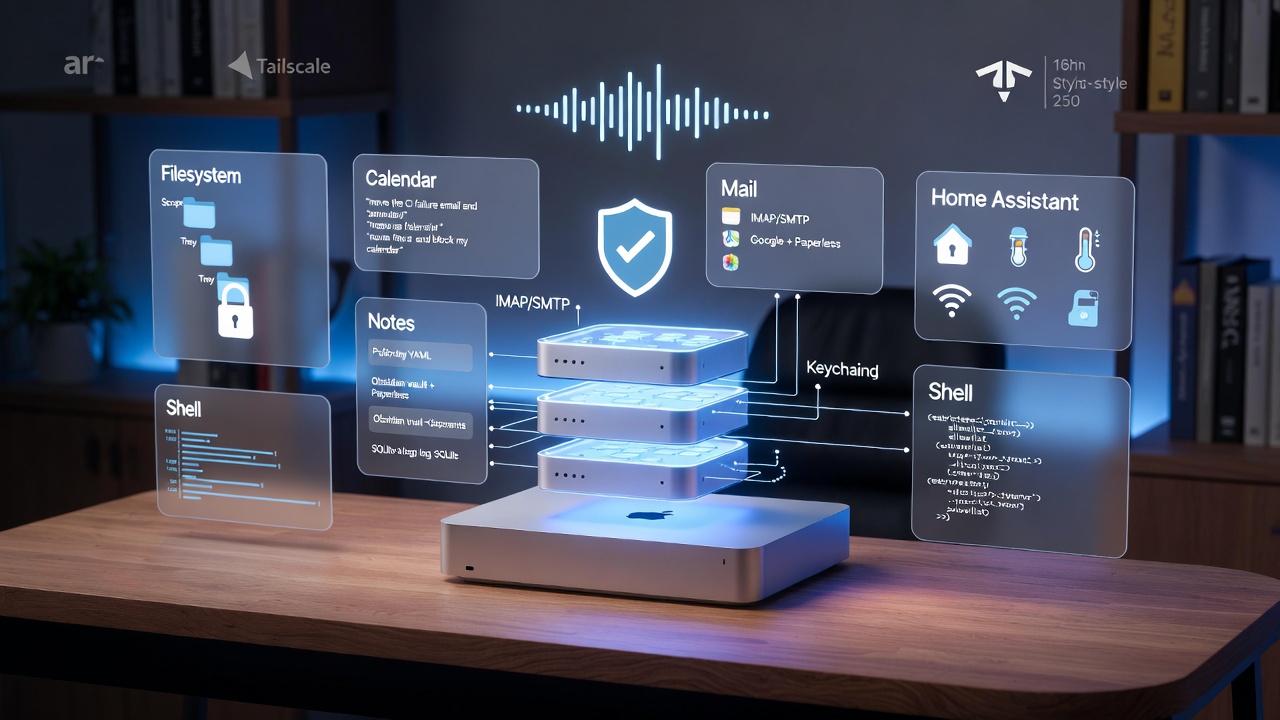
Phone Your Home AI Agent Banner

How to Phone Your Home AI Agent Running on a Mac Studio

TL;DR Goal: Call a real phone number and have a proper back-and-forth with my Mac Studio agent while walking the dog. Hardware: Mac Studio (M2 Ultra, 128 GB) running a local model via Ollama or MLX. Voice pipeline: Twilio SIP in, LiveKit Agents orchestrating STT / LLM / TTS, Whisper for transcription, Piper or ElevenLabs for speech. Brain: A local 30B-class model for chat plus tool calls, with Claude API as a fallback for the harder reasoning. Reach: Tailscale between the Mac and a tiny VPS so I never punch a hole in my home router. Outcome: I can ring a UK landline number, ask “what’s failing on the CI pipeline?” and get a spoken answer in ~2 seconds. Why bother phoning your own agent? Typing is great at a desk. Outside the desk, it’s hopeless. I wanted the simplest possible interface to the box sat under my desk at home - dial a number, talk, hang up. No app, no login, no VPN dance on my phone. ...

April 21, 2026 · 10 min · James M
Hermes Agent Banner

Hermes Agent: Persistent Autonomy That Learns and Grows

TL;DR Hermes Agent by Nous Research is an open-source persistent autonomous system that builds memory across conversations, auto-generates reusable skills from repeated tasks, and compounds in capability over time Unlike stateless agents, Hermes accumulates project context - learning codebase quirks, team conventions, and recurring workflows so it stops asking questions it has already answered It works across Telegram, Discord, Slack, WhatsApp, Signal, Email, and CLI - meeting teams on the platforms they already use rather than requiring a dedicated app Running cost is roughly $20 to $60 per month for a solo developer (a $5-$10 VPS plus LLM API calls); it is MIT licensed with no seat fees or vendor lock-in The honest trade-off: Hermes beats alternatives on persistence and learning depth, but raises open questions about memory scaling, skill auditing, and what happens when an agent learns something wrong Most AI agents are forgettable. You ask them to do something, they do it, you close the window. The next time you need help, they start from zero - no context, no learning, no continuity. Hermes Agent works differently. Nous Research built it as a persistent system that remembers what it learns and gets measurably more capable the longer it runs. ...

April 20, 2026 · 9 min · James M
Claude Opus 4.7 on Databricks Banner

Claude Opus 4.7 Lands on Databricks: Enterprise Reasoning Meets the Lakehouse

Databricks announced this week that Anthropic’s Claude Opus 4.7 is now live on the platform. The headline from Databricks’ own benchmarking is the part worth pausing on - 21% fewer errors than Opus 4.6 on the OfficeQA Pro document-reasoning benchmark when the model is grounded in source information. That single number tells you more about where enterprise AI is going than any launch keynote. Why This Matters More Than Another Model Announcement Most Claude releases get surfaced the same week across the API, Amazon Bedrock, Google Cloud’s Vertex AI, and Microsoft Foundry. That was true of Opus 4.7 on April 16 as well. The Databricks story is different because Databricks is not just another hosting destination - it is where the actual enterprise data lives. ...

April 20, 2026 · 7 min · James M