TL;DR
- 2026 is the inflection point for humanoid robotics - real customers like BMW, GXO, and Mercedes-Benz are paying for deployments, not just watching demos
- Hardware is no longer the bottleneck; the constraints have shifted to physical training data, unstructured-task autonomy, and production supply chains
- The economics work today for two-to-three shift warehouse operations via Robots-as-a-Service contracts at roughly USD 30-50K per year
- Production volumes still lag announcements by 3-5x - Unitree is likely the 2026 volume leader, not Tesla or Figure
- The form factor wins where environments are human-shaped and mixed-use; wheeled robots remain cheaper in purpose-built facilities
For most of the last decade, humanoid robotics looked like a category that would always be three years away. Demos were impressive, factory floors stayed empty, and serious analysts pointed to bipedal locomotion, dexterous manipulation, and the price of high torque-density actuators as reasons the form factor would lose to wheeled and fixed-arm systems for any real industrial work.
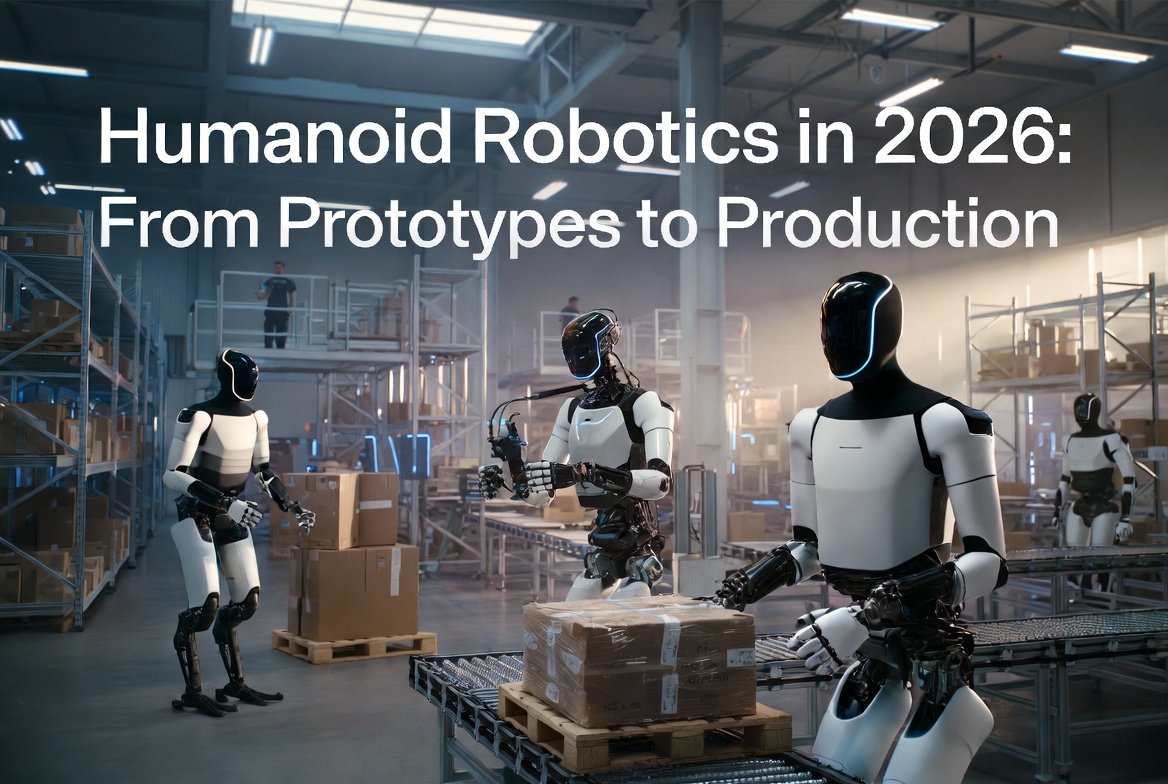
In 2026 that argument no longer holds cleanly. Multiple companies are running paid pilots inside the warehouses and assembly lines of named customers - GXO, Mercedes-Benz, BMW, Amazon, Toyota - and one (1X) is taking deposits on a home robot. Production is still measured in thousands per year rather than tens of thousands, but the curve is unmistakable. This is the year humanoids stopped being a research bet and started being a procurement decision.
This piece walks through where the field actually stands as of May 2026, where the numbers are real, and where there is still significant distance between the demo and the deployment.
The Arc: Demos, Pilots, Production, Scale
The category timeline is unusually clean to draw, which is part of why it is suddenly investable:
- 2020-2023 - Demos. Boston Dynamics parkour videos, Tesla Bot reveal in a leotard, Figure’s first walk. Compelling YouTube, no customers.
- 2024-2025 - Pilots. Digit at Spanx, Apollo at Mercedes-Benz, Figure at BMW, Optimus inside Tesla’s own factories. Small fleet sizes, heavy on supervision, paid in some cases.
- 2026 - Production begins. Multi-thousand-unit orders signed, RaaS contracts at scale, first consumer deposits taken (1X Neo). The point this article is documenting.
- 2027+ - Scale explosion. Production volumes 10-50x higher, autonomy ratios cross the threshold where one supervisor handles a fleet, and price points crack USD 20K for serious units.
That arc matters because the bottleneck shifted in each phase: hardware in the demo era, AI in the pilot era, supply chain and data in the production era, and almost certainly regulation and labour politics in the scale era.
Why 2026 Is the Inflection Point
Three things converged.
First, the AI side caught up to the hardware. Vision language action (VLA) models trained on internet-scale video plus targeted teleoperation data are now good enough to handle the long tail of unstructured tasks - re-grasping a slightly misaligned tote, recovering from a dropped item, taking a verbal correction mid-task - that previously required human intervention. Foundation models like Figure’s Helix, Google DeepMind’s RT-2 / Gemini Robotics lineage, and 1X’s Redwood are doing for manipulation what GPT-3 did for text in 2020.
Second, the cost of the underlying hardware fell faster than most forecasts predicted. Quasi-direct drive (QDD) actuators that cost USD 3-5K per joint in 2022 now cost USD 800-1,500 at volume. Battery cells are cheaper and denser. Onboard compute (Jetson Thor and equivalents) is roughly 10x more capable per watt than the platforms used three years ago.
Third, the labour economics shifted. Sustained shortages in warehousing, manufacturing, and elder care - particularly in Germany, Japan, South Korea, and parts of the US sunbelt - have pushed loaded labour costs above USD 30 per hour for shift work. That changes the payback maths for any robot priced under USD 80K.
Real deployments confirm the shift. Agility Robotics’ Digit is in paid commercial operation at GXO sites under a Robots-as-a-Service (RaaS) contract. Apptronik’s Apollo is running material handling pilots at Mercedes-Benz and a Jabil plant. Figure 03 is in active deployment at BMW’s Spartanburg facility. None of these are stunt videos. They are line items in operations budgets.
The Top Five Humanoid Platforms
Picking five is unfair to several serious contenders (Sanctuary AI’s Phoenix, Fourier GR-1, Boston Dynamics’ new electric Atlas, Galbot, UBTech Walker S2). The list below is the set that combines real customer deployments, credible production volumes, and a defensible AI stack.
| Robot | DOF | Height / Weight | Payload | Battery / Runtime | Status (May 2026) | Indicative Price |
|---|---|---|---|---|---|---|
| Tesla Optimus Gen 3 | 28 (40+ in hands) | 173 cm / 57 kg | ~20 kg | 2.3 kWh / ~5 h | Internal Tesla factory deployment, limited external pilots | Target USD 20-30K at scale |
| Figure 03 | 41 | 168 cm / 60 kg | 25 kg | ~2 kWh / 5 h | Commercial deployment at BMW; home pilots underway | ~USD 60-90K (RaaS billed) |
| Agility Digit (v5) | 30 | 175 cm / 65 kg | 16 kg | Hot-swap / ~4 h | In paid production at GXO, Spanx, others | RaaS ~USD 30K/yr equivalent |
| Apptronik Apollo | 30 | 173 cm / 73 kg | 25 kg | Hot-swap 4 kWh / 4 h | Pilots at Mercedes-Benz, Jabil, GXO | RaaS, ~USD 50-70K equivalent |
| 1X Neo | 35 | 168 cm / 30 kg | ~20 kg | ~1 kWh / 4 h | Consumer deposits open; early home deployments | USD 20K + USD 499/mo |
A few things worth noting under the surface of this table:
Tesla Optimus still has the most aggressive cost target and the largest captive manufacturing base to absorb units. Tesla’s pitch is that its own factories are the proving ground - thousands of bots inside Fremont and Austin doing battery-pack handling and parts kitting before any external customer takes delivery. The claim of a sub-USD 30K price at volume is not absurd when the same vertical integration that drove down EV costs is applied. The risk is the gap between “Elon target date” and “actual ship date” - historically 18 to 36 months.
Figure AI moved fast on its proprietary Helix VLA model and ditched its earlier OpenAI partnership in 2024 to bring the entire AI stack in-house. Figure 03 has notably better hand dexterity than its predecessors, with tactile sensing across the palm and fingertips, and is the first credible attempt by a US firm to ship a humanoid into a real consumer environment.
Unitree is the price disruptor. The G1 starts at USD 16,000 - genuinely an order of magnitude below most western competitors - and the H1 sits around USD 90,000 with research-grade specs. Quality and software polish lag, but for universities, research labs, and Chinese factory pilots the price-to-capability ratio is unmatched. Unitree is doing to humanoids what DJI did to drones, and the strategic implications for the rest of the industry are uncomfortable.
Agility Robotics’ Digit has the most production-hardened deployment story. It is also the most honest about what humanoids are good at right now: tote handling, palletising, line-side replenishment - structured tasks in semi-structured environments. Digit’s bird-leg morphology is unusual but reflects an honest engineering bet that perfect anthropomorphism is not required for warehouse work.
1X Neo is the wildcard. Backed by OpenAI, designed from day one for the home, and built around tendon-driven actuators that are quieter and safer to be near than QDD. Whether the world is ready for a humanoid in the kitchen is a separate question, but 1X is the only credible firm seriously betting yes in 2026.
Honourable mentions: Apptronik’s Apollo with its hot-swap battery and clean industrial design; Boston Dynamics’ electric Atlas, which has the most impressive raw athletic capability but no public pricing; and Sanctuary AI’s Phoenix, which is the closest to genuine general manipulation but ships in very small numbers.
The Economics: When Does a Robot Pay Back?
The numbers are now close enough to make procurement teams pay attention.
A loaded human warehouse worker in the US costs roughly USD 55,000-70,000 per year in fully burdened cost (wages, benefits, taxes, insurance, turnover). One shift, 2,000 hours of useful work. A humanoid robot running on a typical RaaS contract at USD 30-50K per year delivers two to three shifts of work per day, has no turnover, and accumulates skill across the fleet rather than losing it on resignation.
| Cost Component | Human Worker (US, 1 shift) | Humanoid (RaaS, 2-3 shifts) |
|---|---|---|
| Annual fully-loaded cost | ~USD 65,000 | ~USD 35,000-50,000 |
| Useful hours per year | ~1,800 | ~5,000-6,500 |
| Effective USD per hour | ~USD 36 | ~USD 6-10 |
| Onboarding | 2-6 weeks | Hours (download skill) |
| Turnover risk | 30-100% per year (warehouses) | None |
Capex purchase prices are noisier. Unitree G1 sits at USD 16K. Digit and Apollo are typically not sold outright; you rent capability. Figure 03 is in the USD 60-90K range for an outright unit, with maintenance contracts on top. Boston Dynamics has not published Atlas pricing but industry estimates run USD 200-300K per unit.
Total cost of ownership matters more than sticker price. Power draw is roughly 350-500 W average during work, which is around USD 600 per year of electricity at US commercial rates - trivial. Maintenance is the wildcard: actuator wear, gearbox replacement, end-of-life battery swaps. Most operators are budgeting 15-25% of acquisition cost per year for maintenance and software updates. That is not nothing, but it is not the deal-breaker.
Prices are falling for three reasons that reinforce each other: actuator volumes are scaling (China produced an estimated 200,000+ humanoid actuators in 2025 alone), AI training amortises across the fleet rather than per unit, and the second-order vertical integration play - “robots building robots” - is starting to remove labour from the BOM itself.
Manufacturing and Scale: Ambition vs Reality
The gap between announced production and actual delivered units remains large.
| Company | 2026 Stated Target | Realistic 2026 Output (industry estimate) |
|---|---|---|
| Tesla Optimus | 10,000 units | 1,500-3,000 |
| Figure | 12,000 units | 2,000-4,000 |
| Unitree (G1 + H1) | ~10,000 units | ~6,000-8,000 (likely the leader by volume) |
| Agility Digit | ~2,000 units | ~600-1,000 |
| Apptronik Apollo | ~1,500 units | ~300-600 |
| 1X Neo | “thousands” | <500 |
It is worth converting these into throughput terms, because annual unit numbers hide the manufacturing reality. A factory shipping 100,000 robots a year, running 24/7, is producing roughly 11 robots per hour - a finished, tested, calibrated humanoid every five and a half minutes. Tesla’s stated longer-term goal of 1 million Optimus units a year would mean 114 robots per hour, which is automotive-tier throughput for a product an order of magnitude more mechatronically complex than a car. No one is anywhere near that today; the realistic 2026 leader (likely Unitree) is producing closer to one robot per hour of factory operation. The gap between announcement and assembly line is not subtle.
This is the cleanest way to see the central tension of humanoid robotics in 2026: the AI side scaled faster than the atoms. Foundation-model capability for manipulation has roughly doubled per year since 2023. Production volumes have not. Bending steel, machining roller screws, winding stators, and curing tactile-sensor pads are still rate-limited by physical factories, and there is no Moore’s Law for any of them.
The supply chain bottleneck is not the chassis. It is harmonic gearboxes and planetary roller screws (the new actuator architecture of choice for high-torque joints), high-density 21700-format battery cells, and tactile-sensing fingertips. Compute is no longer a constraint - Nvidia and Qualcomm have plenty of headroom for inference at 30-50 W onboard. What there is not enough of is people who can integrate all of it cleanly.
Tesla is the best positioned to break through the supply constraint precisely because it owns the most of the BOM. Figure has been aggressively in-housing actuator design. Unitree benefits from a domestic Chinese supply chain that already serves drones and electric vehicles.
Actuators and Hardware Breakthroughs
If there is a single component that will decide which firms win the next five years, it is the actuator. This is the GPU moment of robotics hardware: a category that used to be a commodity sourced from Maxon or Harmonic Drive is now a strategic, in-housed, IP-protected core capability. Tesla, Figure, Apptronik, and Unitree are all designing and manufacturing their own actuator stacks. Whoever gets to high-volume, high-cycle-life, low-cost actuators first will set the price floor for the rest of the industry.
The most important shift since 2023 has been the move from harmonic-drive QDD actuators to planetary roller screw linear actuators in the legs and torso. Tesla pioneered this approach for Optimus Gen 2 and 3; the rest of the industry is following. Roller screws convert rotary motor torque to linear force with very high efficiency (~90%) and load capacity, in a smaller package than ball screws. They make the standing, lifting, and squatting motions that dominate warehouse work dramatically cheaper to power than rotary-only joints. Unitree, by contrast, has bet on extremely high-torque rotary electric joints derived from its quadruped platform - cheaper, more thermally forgiving, less force-dense.
Three other things to note:
- High torque-density motors using Halbach-array stators and improved cooling are letting designers shrink hip and shoulder joints by 30-40% versus 2023 designs, without losing peak torque.
- Tendon-driven hands (1X, Sanctuary, Shadow) are making a serious comeback against rigid finger drives, because they let the hand be lighter, safer, and more compliant. The trade-off is calibration complexity and tendon wear.
- Tactile sensing is the silent revolution. Capacitive arrays on the palm and fingertips, plus barometric sensors in soft pads, are letting robots detect slip and adjust grip pressure in real time. Without this, dexterity is fundamentally capped.
Battery density has improved more slowly. Most production humanoids run 1.5-3 kWh packs at 250-280 Wh/kg, giving 4-5 hours of mixed-task runtime. Hot-swap (Digit, Apollo) is the practical answer for now; solid-state cells at 400+ Wh/kg are still 18-24 months from production volume.
Software and “Physical AI”
The hardware caught up. The bottleneck is now data and policy.
Vision-language-action (VLA) models trained on a mix of internet video, simulation rollouts, and teleoperation are the dominant architecture. Figure’s Helix, Google’s Gemini Robotics, Nvidia’s GR00T, and Unitree’s open-weight models all share this lineage. They take pixels plus a natural-language instruction, and output joint commands at 100-200 Hz.
Sim-to-real transfer has improved enormously thanks to Nvidia Isaac Sim and similar platforms doing high-fidelity contact physics. But the dirty secret of 2026 is that physical data is still scarce. Internet text gave LLMs trillions of tokens. The equivalent corpus for manipulation - hours of robot-task demonstrations - is still measured in the low millions of episodes globally. One way to frame the gap: if you wanted to assemble a manipulation dataset of comparable scale to the text corpus that trained GPT-4, recorded at typical teleoperation rates, you would need on the order of 100,000 robot-years of continuous demonstration. The world has produced perhaps a few hundred robot-years to date.
Companies like 1X, Tesla, and Figure are running large internal teleoperation farms specifically to harvest training data, and there is a quiet arms race to acquire it. This is the binding constraint of the field. Hardware will keep getting cheaper. Models will keep getting more sample-efficient. But the company that figures out how to harvest, label, and reuse physical-world interaction data at scale wins the decade, and right now no one has cracked it.
The teleoperation-vs-autonomy gap is the elephant in the demo room. Many of the most impressive 2025 demos were partially or fully teleoperated. In production deployments today, autonomy is high for repetitive structured tasks (95%+) and falls off sharply at the long tail. Most operators run a “human supervisor per 5-10 robots” model, with remote takeover for edge cases. This ratio is improving by roughly 2x per year.
Why the Humanoid Form Factor
The strongest argument for legs and arms in human shape is not athletic - it is environmental. Factories, warehouses, restaurants, and homes are designed for the human body. Stairs, door handles, tools, vehicle cabs, and shelf heights all assume a 1.6-1.8 m bipedal operator. A humanoid drops into that environment with zero infrastructure change.
The counter-argument is real too. Wheeled mobile manipulators (Boston Dynamics Stretch, Locus, Symbotic, Neura) are cheaper, faster, and more reliable for any task that does not require stairs or tight aisles. For dense warehouse work, AMRs with arms will out-compete humanoids on cost for years to come.
The likely outcome is a split: humanoids win in mixed-use environments (auto plants, retail back-of-house, eventually homes), wheeled robots win in purpose-built facilities, fixed industrial arms continue to dominate high-throughput repetitive work.
What Is Coming, 2026 to 2030
Expect the following in the next four years:
- Dexterity - tactile sensing plus VLA models will close most of the manipulation gap by 2028. Tasks like cable routing, fabric folding, and unstructured assembly will move from research demos to deployments.
- Autonomy ratio - the supervisor-to-robot ratio will move from ~1:5 today to ~1:50 by 2029, driven by foundation-model improvements and fleet-learning.
- Cost - a sub-USD 10K humanoid is realistic by 2029, almost certainly first from Unitree or another Chinese manufacturer. Western firms will hold a price premium justified by software, safety certification, and support.
- Consumer entry - 1X Neo and probably one other entrant will create a real (if small) consumer market by 2027. Mass adoption is more likely 2029-2031.
The Reality Check
Hype still exceeds reality in several places.
- Most “fully autonomous” demos shown publicly in 2026 still rely on teleoperation or scripted environments somewhere in the loop. Read the press releases sceptically.
- Reliability is poor by industrial standards. MTBF for current humanoids is in the hundreds of hours, not thousands. Industrial arms hit 50,000+ hours.
- Safety certification (ISO 10218, ISO/TS 15066) for collaborative humanoids is incomplete. Most current deployments use cages or keep-out zones, which defeats much of the form-factor advantage.
- The data flywheel that powers LLMs is harder for robots. Each company’s teleoperation data is proprietary, and there is no public-internet equivalent to Common Crawl for manipulation.
These are solvable problems. They are not solved problems.
Three Unique Angles Worth Noting
Robots building robots. This is no longer a thought experiment. 1X has Neo units performing assembly tasks on the Neo production line itself - sub-assembly handling, test-rig loading, simple kitting. Tesla has Optimus units inside Fremont working on battery-pack handling that contributes to Optimus’s own supply chain. Figure has stated publicly that the BMW deployment data is being recycled directly into Helix improvements. This is the same vertical-integration loop that drove EV cost reduction, applied recursively, and it is the single most underpriced dynamic in the category. Once the loop closes properly - around 2028 on current trajectories - the marginal cost curve for humanoid production starts behaving very differently from any prior labour-intensive manufacturing category. Self-scaling labour is not a metaphor; it is a balance-sheet event.
The EV analogy is real but not exact. Tesla’s EV success was driven by a single company solving battery costs. Humanoids have no equivalent single bottleneck - it is actuators, batteries, AI models, and tactile sensors all needing to advance together. The cost curve will look like EVs, but the consolidation pattern will likely be more fragmented for longer, with serious Chinese, US, and possibly Korean competitors all viable.
Energy economics flip the abundance argument. A humanoid running an 8-hour shift consumes roughly 3-4 kWh, or about USD 0.50-0.70 of electricity. A human worker’s metabolic cost is around 1 kWh of food energy per shift, but the supply chain to deliver that food (agriculture, processing, retail) is roughly 10-20x less efficient than grid-to-battery. By the simplest energy-per-work measure, humanoids are already more energy-efficient than human workers for many manual tasks. The labour-market consequences of that fact are still poorly priced into most economic models.
Three Bold Predictions for 2030
- At least one humanoid manufacturer will ship more than 100,000 units in a single year by 2030, almost certainly Tesla, Figure, or Unitree. The category will look more like the smartphone industry circa 2010 than the niche it does today.
- The first work-stoppage strike against humanoid deployment will occur in a major US warehouse before 2028, and it will become a template for labour-relations battles across the developed world. Politics, not technology, will be the rate-limiter for adoption from 2027 onwards.
- A consumer humanoid under USD 10,000 will be on sale to the general public by Q4 2029, sold by a Chinese manufacturer, and it will trigger an aggressive regulatory response in the EU and US around home-environment safety, data collection, and liability.
Key Takeaways
- 2026 is the year humanoid robotics moves from research demo to early production. Real customers are paying real money for paid pilots, and a handful of platforms (Digit, Apollo, Figure 03) are in genuine commercial deployment.
- Hardware is no longer the binding constraint. Actuators, batteries, and onboard compute are good enough. The bottleneck is now physical training data, autonomy in unstructured tasks, and reliability.
- The economics work today for two-shift warehouse operations at RaaS prices around USD 30-50K per year. They do not yet work for general home use, but they are within an order of magnitude.
- Production volumes lag announcements by 3-5x. Treat any 2026 production target with scepticism, but expect the gap to close fast.
- The form factor wins where the environment is human-shaped and mixed-use, and loses where the environment can be purpose-built. Both will coexist for the next decade.
The interesting question is no longer whether humanoids will ship in volume. It is who will own the AI stack, how the labour-market politics play out, and whether western firms can hold a price premium against Unitree-style Chinese disruption. None of those questions have settled answers in May 2026, and the next 18 months will tell us a great deal.
Further reading:
- Figure AI - product and Helix model overview
- Agility Robotics - Digit deployments
- Unitree Robotics - G1 and H1
- Apptronik - Apollo specifications
- 1X Technologies - Neo home robot
- Boston Dynamics - electric Atlas
- Wikipedia - Humanoid robot overview
- Wikipedia - Tesla Optimus