Speech To Text Banner

Grok's New Voice APIs: Speech Recognition and Synthesis at Enterprise Scale

TL;DR xAI launched standalone Speech-to-Text (STT) and Text-to-Speech (TTS) APIs built on the same stack powering Grok Voice, Tesla in-vehicle assistants, and Starlink customer support Grok’s STT is among the cheapest at $0.10/hour (batch) and $0.20/hour (streaming), with features like speaker diarization, word-level timestamps, and Inverse Text Normalization The TTS offering ships with five expressive voices, inline expression control tags ([laugh], [sigh], whisper), and covers 20 languages - priced at $4.20 per million characters xAI’s pitch is vendor consolidation: replacing three separate contracts (transcription, LLM, synthesis) with one stack on one billing account The best fit is teams already building on Grok for reasoning - for lowest-latency TTS, ElevenLabs Flash v2.5 at ~75ms is still unmatched xAI has released two standalone voice APIs - Speech-to-Text (STT) and Text-to-Speech (TTS) - built on the same stack powering Grok Voice, Tesla in-vehicle assistants, and Starlink customer support. The move puts xAI in direct competition with ElevenLabs, Deepgram, and AssemblyAI, three companies that have owned the enterprise voice API market for years. ...

April 24, 2026 · 5 min · James M
GPT-5.5 release illustration

GPT-5.5 Is Here: Real Step Forward or Quiet Iteration?

TL;DR GPT-5.5 (“Spud”) is the first fully retrained base model since GPT-4.5, with architecture and pretraining reworked from scratch with agentic objectives in mind It takes the top spot on Terminal-Bench 2.0 (82.7%) and GDPval (84.9%), narrowly beating Anthropic’s Claude Mythos Preview on agentic coding benchmarks A 1M-token context window is new for OpenAI, enabling whole-codebase reasoning and long multi-step agent runs without context collapse Pricing is competitive ($5/$30 per million input/output tokens) but the strategic story is about OpenAI building an integrated super app - chat, code, browser agent - all driven by one model The gains are incremental, not a leap - but the full retraining signals OpenAI is betting the next two years on autonomous agentic work, not chat OpenAI released GPT-5.5 on April 23, 2026, weeks after GPT-5.4 and only months after GPT-5. The cadence is starting to feel relentless. Codenamed “Spud” internally, GPT-5.5 is the first fully retrained base model since GPT-4.5 - architecture, pretraining corpus, and agent-oriented objectives all reworked from scratch. ...

April 24, 2026 · 6 min · James M
Agent-First Architecture Banner

Agent-First Architecture: The Engineer as System Curator

TL;DR Agent-first architecture imagines a future where the primary unit of work is an AI agent with intent, tools, memory, and a feedback loop - not a human-authored codebase The engineer’s role may shift from building and maintaining systems line by line to curating, governing, and evolving fleets of agents Glue code, routine maintenance, first-pass incident triage, and migration work are plausible candidates for automation; deciding what a system is for and holding architectural intent across time probably are not Managing an agent fleet might resemble logistics fleet management: define intent, set constraints, design feedback loops, curate the roster, and own the outcomes This is a speculative post, not a description of how anything works today - the author is pinning down a hypothesis to revisit when it turns out to be wrong This is a “thinking out loud” post, not a report from the front lines. I have no evidence any of this is happening at scale, and it is not how my current day job looks. These are just ideas I keep turning over, and I wanted to write them down to see if they hold together. ...

April 23, 2026 · 13 min · James M
AI generated image

ChatGPT Images 2.0: Why Everyone Is Impressed

TL;DR ChatGPT Images 2.0 introduces a thinking mode that reasons through complex prompts before generating, dramatically improving instruction-following for multi-part requests Text rendering is finally reliable - legible across English, Japanese, Korean, Chinese, Hindi, and Bengali - unlocking infographics, menus, and slides as genuine use cases Web search during generation means Images 2.0 can pull accurate, current data into visual outputs rather than fabricating plausible-looking information Batch generation produces up to eight images from one prompt with consistent characters and style across all of them, solving a long-standing problem for narrative and sequential content The overall shift is from toy to tool: outputs are more predictable, less stylistically over-processed, and viable for production work rather than just prototyping A year ago, OpenAI’s image generation went viral for Studio Ghibli portraits. That was GPT Image 1 - impressive, playful, and fundamentally still a party trick. ChatGPT Images 2.0, released on April 22nd 2026, is a different thing entirely. It’s the version that starts to look genuinely useful. ...

April 23, 2026 · 6 min · James M
AI Music Tools Comparison 2026

AI Music Tools Shootout 2026: Suno vs Udio vs AIVA vs Riffusion

AI music generation has gone from novelty to legitimate production tool in eighteen months. In 2024 the conversation was “is this cheating?” In 2026 the conversation is “which one do I subscribe to?” Four tools dominate the space right now, and they are not interchangeable. Here is how they actually compare when you sit down and try to make music with them. The Contenders Suno - text-to-song with the best vocal synthesis, now with a full DAW (Suno Studio). Udio - the main challenger to Suno, popular for instrumental and genre-accurate output. AIVA - symbolic composition (MIDI-first), aimed at composers and scoring. Riffusion - spectrogram-based generation, strong for loops and experimental textures. Round 1: Vocal Quality Suno - still the leader. The v5 model handles vowel shapes, breath noise, and consonant articulation with a realism that was science fiction two years ago. Mikey Shulman has talked about this at length and the voice personas feature makes it easy to nail a specific tone. Udio - close, sometimes better on stylised delivery (rap cadence, country twang), but less consistent. AIVA - does not generate audio vocals at all. MIDI only. Riffusion - can produce vocal-like textures but not coherent lyrics. Not a vocal tool. Winner: Suno, with Udio a strong second for specific genres. ...

April 22, 2026 · 5 min · James M
Platform Engineering in 2026 Banner

Platform Engineering in 2026: What It Is and Why DevOps Teams Are Adopting It

Platform engineering used to be the title on a few job adverts at Spotify and Netflix. In 2026 it is the default shape of any infrastructure team larger than a dozen people. The shift is worth understanding, because it is not just a rebrand of DevOps - it is a different operating model, with different tools, different incentives, and a different relationship to the developers it serves. This post is a plain-language walk through what platform engineering actually is, why the industry has converged on it, and how the arrival of AI agents is reshaping the discipline mid-flight. ...

April 22, 2026 · 8 min · James M
Music Production Software 2026

The Best Music Production Software in 2026

The DAW landscape in 2026 looks different to the one I wrote about last year. AI-assisted stem separation is now table stakes, generative co-writers are embedded everywhere, and the “cloud DAW” idea has finally stopped being a novelty. Whether you are sketching your first loop or mixing a full band, here is where I would start in 2026. Ableton Live 12 - Still the Creative Sandbox Live 12 is still the current major version in April 2026, now at 12.3 with 12.4 landing as a free update for Live 12 users. The recent releases have brought Stem Separation in Suite, Splice integration, Bounce Groups, and the new Auto Pan-Tremolo. The Session View remains unbeaten for rapid sketching and live performance, and Max for Live continues to be the quiet superpower that keeps Live feeling fresh a decade on. ...

April 22, 2026 · 5 min · James M
AI Law and Regulation

AI Law Is No Longer Theoretical: What's Here, What's Coming, and What It Means

TL;DR The EU AI Act is now in force with full enforcement of high-risk AI requirements from August 2026, carrying fines of up to 7% of global turnover - this is no longer a distant deadline Over fifty copyright lawsuits against AI developers are working through US courts, and the EU Copyright Directive puts the burden of verifying training data rights on the AI developer, not the rights holder Courts in multiple jurisdictions are consistently finding that deploying AI does not transfer liability to the vendor - “the AI did it” is not a defence that holds up The US has no comprehensive federal AI law; instead, businesses must navigate a patchwork of state statutes (California, Colorado, New York, Texas) alongside existing federal agency enforcement from the FTC, CFPB, and FDA The “move fast and figure out the legal stuff later” era is over - enough of the legal framework has arrived that the gaps are no longer a safe place to operate For the past few years, AI law has been one of those topics that felt perpetually five minutes away. Governments would announce frameworks. Committees would publish white papers. Experts would debate what the rules should eventually look like. ...

April 22, 2026 · 9 min · James M
Math Academy - The Fastest Way to Actually Learn Maths

Math Academy: The Fastest Way to Actually Learn Maths

The Gap Between Knowing Maths and Being Good at It Most adults who went through mainstream education have a complicated relationship with maths. They were taught it, they passed it (or did not), and then they mostly stopped doing it. Somewhere between primary school and the end of formal education, the subject either clicked or it did not - and for a significant majority, it did not. The consequences of that tend to surface slowly. You take a data science course and realise you cannot follow the linear algebra. You try to understand how a model is actually working under the hood and the notation stops you cold. You sit in a finance meeting and the numbers float past you. You always meant to go back and fill the gaps. You never quite did. ...

April 22, 2026 · 7 min · James M
Home AI Agent Memory That Lasts Banner

Giving Your Home AI Agent Memory That Lasts

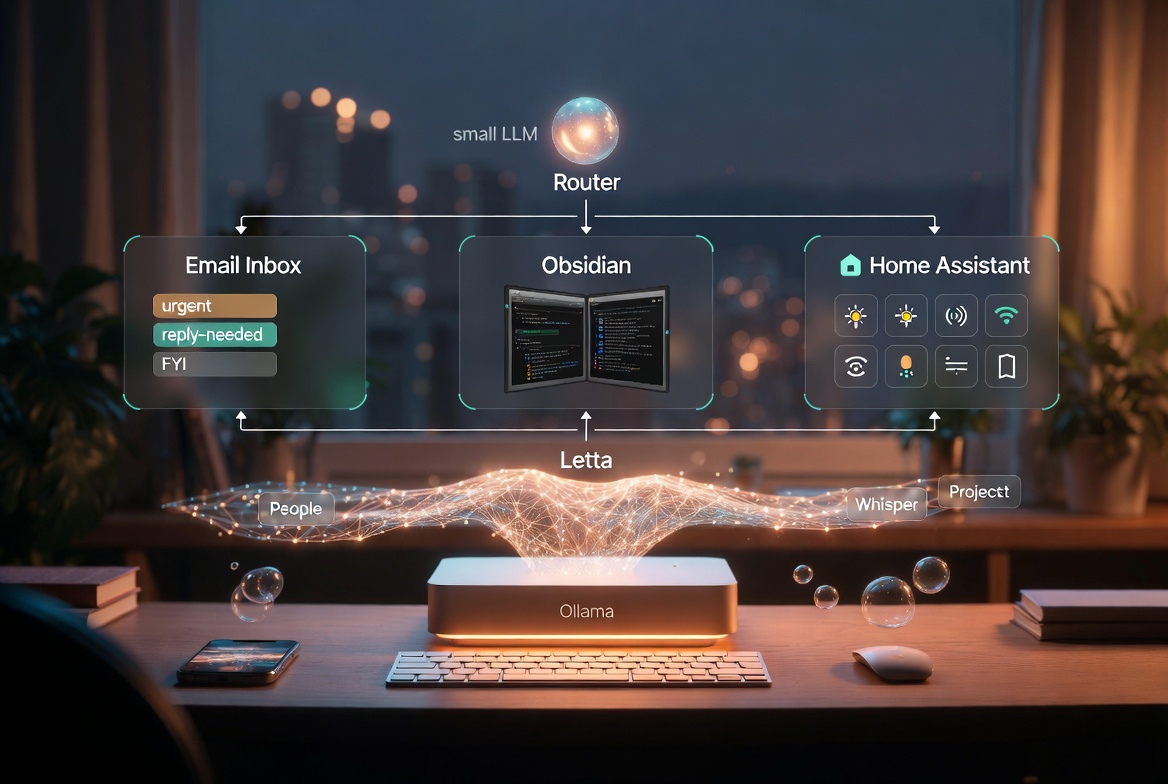
TL;DR Problem: a home agent with tools but no memory is a very well-read goldfish. Every morning it re-meets you. Answer: split memory into three layers - working, episodic, and semantic - and give each layer its own store and its own rules for what gets written. Where it lives: SQLite for episodic and facts, a local vector store for semantic search, and a tiny policy file that decides what is worth remembering in the first place. How it plugs in: a memory MCP server that exposes recall, remember, and forget - nothing else. Result: the agent can say “last Tuesday we tried restarting the Postgres container and it worked” and mean it. It also knows what not to store. The Goldfish Problem The home agent I built over the last few weeks can do real things now. It can read my mail, move files around my workspace, turn lights off, and check my calendar. What it could not do, until this week, was remember any of it. ...

April 22, 2026 · 9 min · James M