TL;DR
- Four AI music tools dominate in 2026 and they are not interchangeable: Suno (best vocals, now with a full DAW), Udio (instrumental and genre accuracy), AIVA (MIDI-first symbolic composition), and Riffusion (loops and experimental textures)
- The conversation has shifted in eighteen months from “is this cheating?” to “which one do I subscribe to?”
- Vocals and producer workflow are Suno’s game; instrumental tracks with specific genre targeting lean Udio; composers scoring to picture want AIVA’s MIDI output and clear licensing
- Legal and licensing terms differ meaningfully between tools - read them before releasing anything commercially
- The honest take: these are production tools now, and the pricing (compared April 2026) is small next to what they replace
AI music generation has gone from novelty to legitimate production tool in eighteen months. In 2024 the conversation was “is this cheating?” In 2026 the conversation is “which one do I subscribe to?” Four tools dominate the space right now, and they are not interchangeable. Here is how they actually compare when you sit down and try to make music with them.
The Contenders
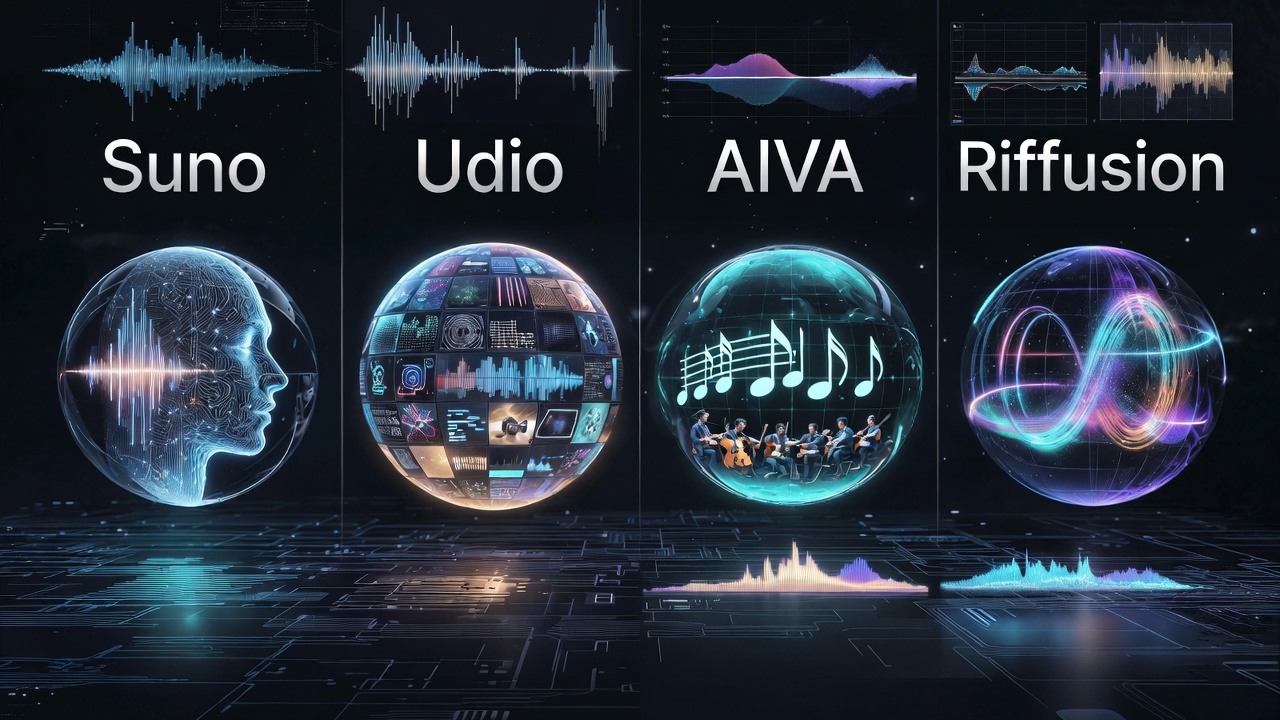
- Suno - text-to-song with the best vocal synthesis, now with a full DAW (Suno Studio).
- Udio - the main challenger to Suno, popular for instrumental and genre-accurate output.
- AIVA - symbolic composition (MIDI-first), aimed at composers and scoring.
- Riffusion - spectrogram-based generation, strong for loops and experimental textures.
Round 1: Vocal Quality
- Suno - still the leader. The v5 model handles vowel shapes, breath noise, and consonant articulation with a realism that was science fiction two years ago. Mikey Shulman has talked about this at length and the voice personas feature makes it easy to nail a specific tone.
- Udio - close, sometimes better on stylised delivery (rap cadence, country twang), but less consistent.
- AIVA - does not generate audio vocals at all. MIDI only.
- Riffusion - can produce vocal-like textures but not coherent lyrics. Not a vocal tool.
Winner: Suno, with Udio a strong second for specific genres.
Round 2: Instrumental and Genre Accuracy
- Udio - genuinely excels here. Give it “90s trip-hop with dusty breaks and a Rhodes” and you get something that could sit on a Mo’Wax compilation.
- Suno - very good, slightly more “average” sounding across genres. Excellent at pop, rock, and mainstream electronic.
- Riffusion - shines on weird, textural, loop-based material. Not the tool for a full song.
- AIVA - strong on classical, orchestral, and cinematic styles, but because it outputs MIDI the realism depends entirely on your sample library.
Winner: Udio for audio, AIVA for notation-based composition.
Round 3: Producer Workflow
This is where the gap has closed dramatically in 2026.
- Suno Studio - the generative DAW. Upload samples, tweak tempo and pitch, export stems, arrange in a proper timeline. This is the most “producer-ready” of the four.
- Udio - offers stem export and a solid editing view, but it is still closer to a generator than a DAW.
- AIVA - exports MIDI and MusicXML. Drop it into your DAW of choice, reassign to your own instruments, and treat it as a composition assistant rather than a finished track.
- Riffusion - generation is the product. Export the audio, chop it in your DAW.
Winner: Suno Studio if you want a one-stop shop, AIVA if you want to stay in your own DAW with your own sounds.
Round 4: Legal and Licensing
Worth paying attention to in 2026. Rights holders have been aggressive, platforms have responded with policies, and the legal picture is still moving.
- Suno and Udio have both faced RIAA litigation and have since tightened their commercial-use terms. Read the licence on the plan you are paying for.
- AIVA has long offered clear commercial licensing tiers and is the safest choice for composers scoring paid work.
- Riffusion - check the current terms; the output is generally usable but the model provenance matters for commercial release.
If you are releasing music commercially, AIVA is the lowest-risk option. For Suno and Udio, the Premier / Pro tiers typically include commercial rights - but verify before you release.
See also: Patents, copyright, and clone synths for the wider context on IP in music tech.
Round 5: Pricing (April 2026)
- Suno Premier - around $30/month, includes Suno Studio and commercial rights.
- Udio Pro - around $30/month, comparable commercial terms.
- AIVA Pro - around €33/month, includes full copyright ownership of generated MIDI.
- Riffusion - freemium, with paid tiers for higher-quality exports.
All four have free tiers worth trying before you commit.
Which One Should You Actually Use?
- Writing pop songs with vocals: Suno.
- Instrumental tracks, specific genre targeting: Udio.
- Film, TV, game scoring where you need MIDI and clear licensing: AIVA.
- Sample packs, loops, experimental textures: Riffusion.
- Sketching ideas to finish in a real DAW: any of them - treat the output as a starting point, export stems, and arrange in Ableton, Logic, or your DAW of choice.
The Honest Take
None of these tools replace a producer. What they do replace is the blank page. In 2026, that is an enormous productivity win - and it is also why the producers I know are using them more, not less.
The tools that will win long-term are the ones that slot into existing workflows rather than trying to replace them. Suno Studio is the clearest bet on that direction. AIVA has been playing that game the longest. Udio is catching up fast. Riffusion is doing its own thing and doing it well.
Pick one, spend a month with it, and see whether it earns a place in your studio.