Music Production Resources

Explore in-depth guides, hardware reviews, and synthesis techniques for modern music production. This section covers digital audio workstations (DAWs), plugin ecosystems, synthesizer design, and workflows for producers using tools like Ableton, Cubase, and Native Instruments. Whether you’re learning synthesis fundamentals or optimizing your production setup, you’ll find practical resources and artist inspiration to elevate your craft.

Suno AI music platform in May 2026

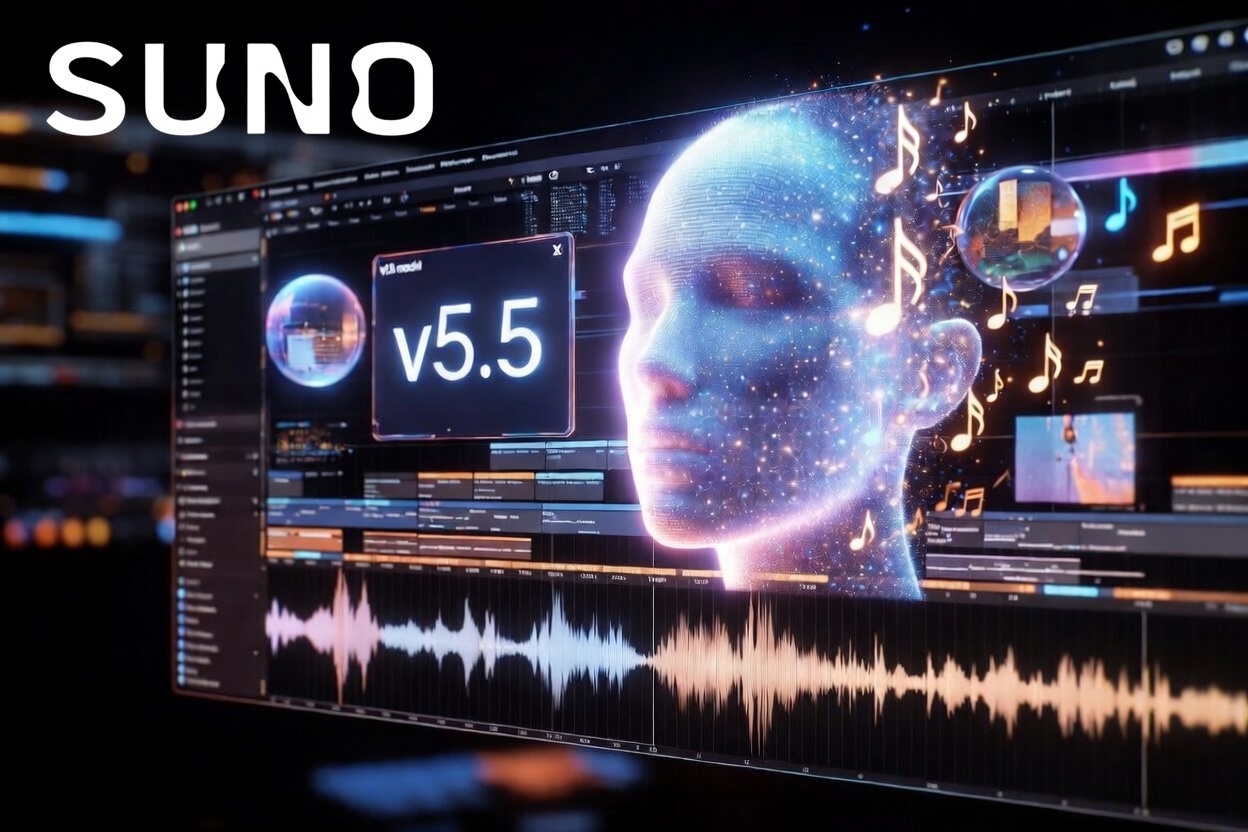
Suno in May 2026: where the platform actually is

TL;DR - Suno v5.5 (March 2026) is the most expressive model yet, and three personalisation features finally make the platform usable as a real workflow: Voices (clone your own verified singing voice), Custom Models (fine-tune v5.5 on your own catalogue), and My Taste (lightweight preference learning for everyone). The Warner Music deal is now visible in the product - older models are being deprecated, free accounts have lost commercial download rights, and the ownership language has softened from “you own this” to “you have commercial rights.” Best used for demos, stem libraries, and personal sound signatures; still risky for releases that need clean copyright provenance. ...
April 29, 2026 · 6 min · James M
AI Music Tools Comparison 2026

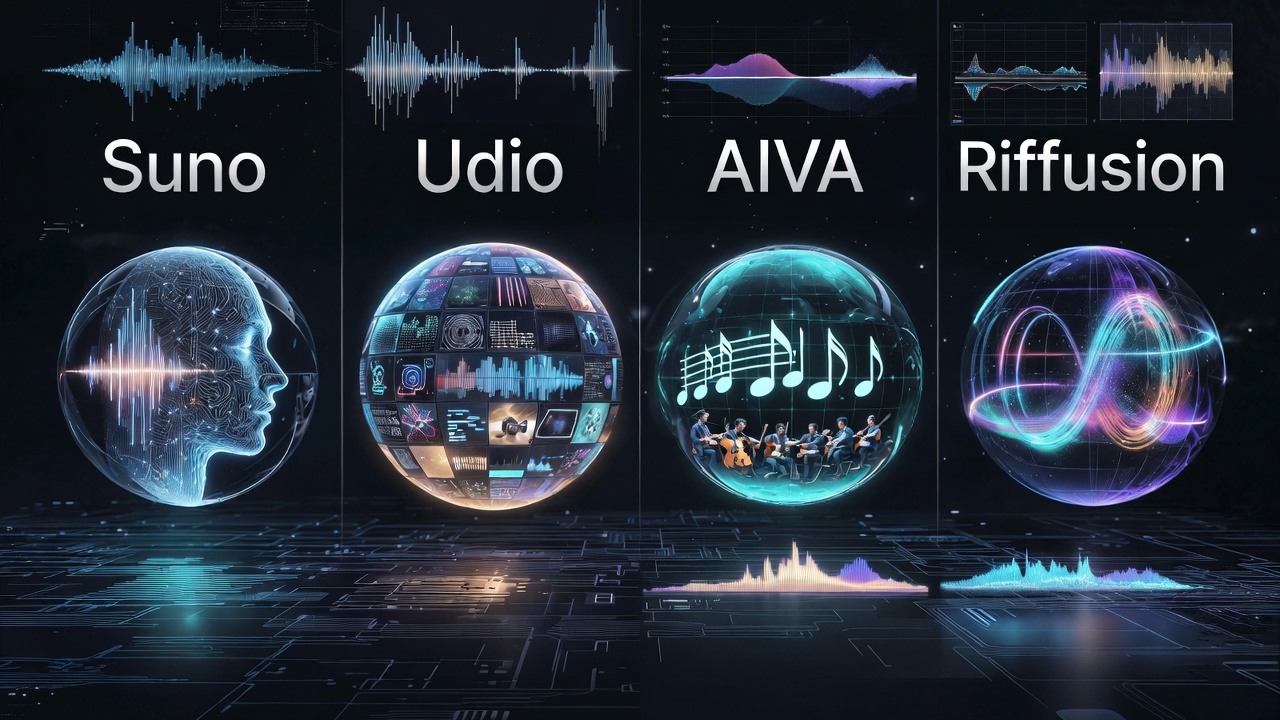
AI Music Tools Shootout 2026: Suno vs Udio vs AIVA vs Riffusion

TL;DR Four AI music tools dominate in 2026 and they are not interchangeable: Suno (best vocals, now with a full DAW), Udio (instrumental and genre accuracy), AIVA (MIDI-first symbolic composition), and Riffusion (loops and experimental textures) The conversation has shifted in eighteen months from “is this cheating?” to “which one do I subscribe to?” Vocals and producer workflow are Suno’s game; instrumental tracks with specific genre targeting lean Udio; composers scoring to picture want AIVA’s MIDI output and clear licensing Legal and licensing terms differ meaningfully between tools - read them before releasing anything commercially The honest take: these are production tools now, and the pricing (compared April 2026) is small next to what they replace AI music generation has gone from novelty to legitimate production tool in eighteen months. In 2024 the conversation was “is this cheating?” In 2026 the conversation is “which one do I subscribe to?” Four tools dominate the space right now, and they are not interchangeable. Here is how they actually compare when you sit down and try to make music with them. ...

April 22, 2026 · 5 min · James M
Music Production Software 2026

The Best Music Production Software in 2026

The DAW landscape in 2026 looks different to the one I wrote about last year. AI-assisted stem separation is now table stakes, generative co-writers are embedded everywhere, and the “cloud DAW” idea has finally stopped being a novelty. Whether you are sketching your first loop or mixing a full band, here is where I would start in 2026. Ableton Live 12 - Still the Creative Sandbox Live 12 is still the current major version in April 2026, now at 12.3 with 12.4 landing as a free update for Live 12 users. The recent releases have brought Stem Separation in Suite, Splice integration, Bounce Groups, and the new Auto Pan-Tremolo. The Session View remains unbeaten for rapid sketching and live performance, and Max for Live continues to be the quiet superpower that keeps Live feeling fresh a decade on. ...

April 22, 2026 · 5 min · James M
Modular Synthesis Building Blocks

Introduction to Modular Synthesis - The Building Blocks

TL;DR Modular synthesis reduces to one idea: signal flow - generate a signal, shape it, modulate it, send it somewhere useful Six module types do the heavy lifting in almost every patch: oscillators (raw material), filters (sculpting), envelopes (shape over time), LFOs (motion), VCAs (controlled loudness), and mixers (combining) A basic patch - oscillator into filter into VCA, with an envelope opening the VCA - is the skeleton behind most of what you hear from any synth Modular feels hard because nothing is pre-wired; that is also exactly why it teaches synthesis better than any preset instrument Start small: understand these blocks before buying a case full of exotic modules Modular synthesis can feel overwhelming at first. There are dozens of modules, hundreds of cables, and infinite ways to patch them together. But underneath all that complexity lies a simple truth: modular synthesis is about understanding how audio flows from one place to another, and learning to shape that signal at every step. ...

April 18, 2026 · 8 min · James M
Best Software Synths 2026

The Best Software Synths of 2026: From AI-Native to Analog Perfection

The landscape of software synthesis has undergone a massive shift over the last two years. While the legends of the 2010s are still present, 2026 has introduced a new generation of “intelligent” instruments that bridge the gap between complex sound design and intuitive creativity. Here are the top software synths currently defining the sound of 2026. 1. Xfer Serum 2 (The Evolution) After years of anticipation, the successor to the most popular wavetable synth in history has finally matured. Serum 2 maintains the workflow we love but adds a “Neural Resynthesis” engine. You can now drop any audio sample into the oscillator, and the AI will reconstruct it as a fully morphable wavetable with uncanny accuracy. ...

April 10, 2026 · 3 min · James M
u-he Zebra 3 Modular Software Synthesizer

u-he Zebra 3: The Modular Beast Unleashed

In the realm of software synthesizers, few names command as much respect and anticipation as u-he. And among their legendary lineup, Zebra has always stood out as a chameleon – a semi-modular powerhouse capable of almost any sound. Now, with the long-awaited arrival of Zebra 3, the beast has truly been unleashed, promising to redefine what’s possible in digital sound design. This isn’t just an update; it’s a complete reimagining, building on the strengths of its predecessor while pushing the boundaries of flexibility, sonic fidelity, and user experience. ...

April 9, 2026 · 4 min · James M
Native Instruments Formal Insolvency and MA

Native Instruments: From Preliminary Insolvency to M&A - What Comes Next

TL;DR Native Instruments has moved from preliminary to formal insolvency proceedings and is simultaneously in active M&A talks with multiple interested buyers - a controlled restructuring, not a death spiral The numbers: roughly €288 million in cumulative losses across 2023-2024 against looming debt maturities of about €262 million Operations continue - products ship, support runs - but CEO Nick Williams’ message is clear: the company needs a new ownership structure to survive The private equity chapter is where much of the community’s anger is justifiably directed - debt-loaded expansion strategy meeting a declining market What happens next depends on who buys and why; the hopeful scenario is a buyer who wants the instruments business, not just the assets When Native Instruments entered preliminary insolvency in late January, it felt like a seismic moment. Two months later, the picture has gotten clearer - and in some ways, more complex. The company has now moved into formal insolvency proceedings, and simultaneously revealed it’s in active merger and acquisition talks with multiple interested buyers. This isn’t a bankruptcy death spiral; it’s a controlled restructuring. But it raises harder questions about what went wrong, and what salvation might actually look like. ...

April 4, 2026 · 6 min · James M
Yamaha DX7 The Most Influential Synthesizer Ever Made

The Yamaha DX7: The Most Influential Synthesizer Ever Made

TL;DR The 1983 Yamaha DX7 sold over 200,000 units by 1989 and remains arguably the most influential synthesizer in history - it did not just change synth design, it changed how modern music sounds It was built on FM synthesis, invented by John Chowning at Stanford in the 1970s and licensed by Yamaha - six operators producing timbres subtractive synths could not touch The glassy electric pianos, basses, and bells of mid-80s pop are DX7 presets; a huge share of the era’s hits used the factory sounds unchanged It was notoriously hard to program, which nobody cared about - and which accidentally created the preset culture that still defines synth use today Its influence runs to the present: FM engines sit inside most modern workstations and software synths The Yamaha DX7 wasn’t the first synthesizer. It wasn’t the most powerful. It wasn’t the cheapest. But in 1983, it became the most important instrument released that decade - and arguably the most influential synthesizer in history. By 1989, over 200,000 units had been sold. Today, it remains the second-best-selling synthesizer of all time (after the Casio VL-Tone, which was technically a calculator with a synth). ...

March 9, 2026 · 9 min · James M
My Tracks - March 2026

My Tracks - March 2026

A selection of my music production work from March 2026. Browse other months All Tracks Related Reading My Tracks - November 2025 My Tracks - October 2025 My Tracks - January 2026 My Tracks - April 2026

March 1, 2026 · 1 min · James M
Patents Copyright and Clone Synthesizers

When Circuits Go Public: Patents, Copyright, and the Rise of Clone Synths

If you’ve ever compared a Behringer Model D or Poly D to a classic Moog, you might have thought: “Wait… that looks exactly like a Minimoog!” Yet somehow, Behringer isn’t breaking any laws. How does that work? The answer lies in the fascinating intersection of patents, copyright, trademarks, and trade dress - the legal forces that shape hardware synth design. Patents: The Clock Ticks Out Patents are the most obvious form of protection for inventors. They grant exclusive rights to an invention for a limited time - usually 20 years. Once a patent expires, the invention becomes public domain. ...

February 8, 2026 · 4 min · James M