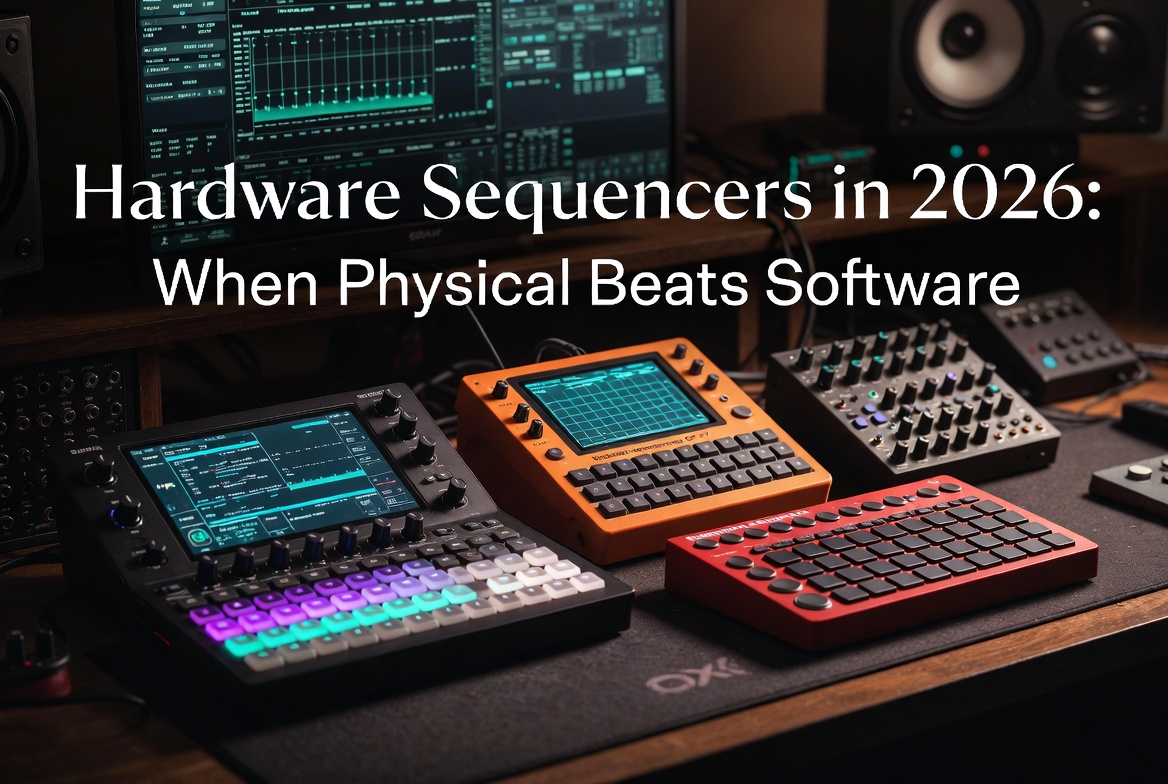
By mid-2026, the “in-the-box” vs “out-of-the-box” debate has fundamentally shifted. We no longer argue about analog warmth or filter aliasing - neural synthesis has made those distinctions almost invisible to the ear. The new battleground is cognitive load, and that is where dedicated hardware sequencers are quietly winning ground back.
As I argued in The Automation Paradox, once AI can generate a passable 16-bar loop in seconds, the human’s job shifts to curation and intent. A hardware sequencer is the most direct tool we have for enforcing that intent.
The anti-choice architecture
The primary strength of something like the Squarp Hapax or the Teenage Engineering OP-XY isn’t what it lets you do - it’s what it quietly prevents you from doing.
Open a DAW and you are staring at a god-object. You can do anything, which often collapses into doing nothing. A hardware sequencer is a constraint-first workflow: a fixed number of steps, a defined set of encoders, a finite way to manipulate data. The boundary is the feature. Inside it, intuition has somewhere to land.
It also forces commitment. Once a pattern is recorded into a Digitakt II or sequenced from a Hapax, the friction of editing it pushes you to keep playing instead of endlessly tweaking - the opposite of every “non-destructive” DAW affordance.
Tactility and muscle memory
In 2026, most of our professional lives are mediated through glass - tablets, monitors, AR overlays. There is a real psychological relief in interacting with carbon: buttons with travel, encoders with resistance, pads that respond to velocity and pressure.
Hardware sequencers turn production into a performance of muscle memory. When you can fire a conditional trigger or arm a pattern chain without looking at a screen, you stop programming a sequence and start playing an instrument. The same logic that makes a LinnStrument or Seaboard feel like an instrument applies here - see my MPE deep dive for the controller side of the same argument.
The “happy accident” engine
Software is precise. Too precise. Even humanisation algorithms in modern DAWs feel calculated. Hardware sequencers - especially those with generative MIDI tools or CV outputs - interact with external gear in ways that are slightly unpredictable.
The tiny timing jitters of a DIN-sync chain, or the way a sequencer’s LFO meets a modular rack, create the kind of happy accidents that current AI models still struggle to emulate convincingly. These imperfections are very often where the soul of a track ends up living.
What to look for in a 2026 sequencer
Before buying, a few things worth weighing up:
- Track count and polyphony. How many independent voices and patterns do you actually need running in parallel? A modular rig often wants more CV/Gate lanes than a desk-based hybrid setup.
- MIDI vs CV/Gate. If you have any modular at all, prioritise boxes with real CV outputs rather than relying on a separate MIDI-to-CV interface.
- MPE support. The bar has moved here in 2026 - the HapaxOS 3.0 update released in April brought multi-track MPE and per-track zone configuration to the Hapax, and most serious sequencers now expect to handle per-note pitch and pressure cleanly.
- Performance vs composition. Some boxes (OP-XY, MPC-style grooveboxes) lean towards live improvisation; others (Hapax, OXI One MKII) are built around longer-form arrangement and song mode.
- Project recall. If you work on multiple tracks at once, fast pattern and project switching matters more than any single feature on the spec sheet.
2026’s standout gear
If you’re looking to put a physical brain at the centre of your setup this year, these are the four I keep coming back to:
The autonomous brain - Squarp Hapax
The Squarp Hapax remains the heavyweight for complex, multi-track arrangements. 16 tracks, 16 patterns per track, dual-project architecture so you can compose on one project while performing another, and full MPE handling after the 3.0 firmware. It is the most natural bridge between vintage synths and modern soft synths I have used.
The portable powerhouse - Teenage Engineering OP-XY
The OP-XY (which I covered in my 2025 sequencer roundup) has matured into a genuinely capable studio-to-stage tool: 64-step grid, eight synth engines, sampler, multi-output jack, and a 16-hour battery. If your goal is to walk out of the studio with a track and play it that night without a laptop, this is the box.
The step-traditionalist - Elektron Digitakt II
The Digitakt II keeps proving that the step-sequence + parameter-lock workflow is one of the most efficient ways to build complex rhythmic patterns ever devised. 16 tracks, 128 steps, six sample engines, conditional triggers, and Euclidean generation - it is still the fastest path from a kick drum sample to a finished pattern.
The modular hub - OXI One MKII
The OXI One MKII is the one to beat if your setup is CV-heavy. Eight independent sequencers, up to 64 tracks, eight CVs and eight gates, six sequencing modes including a stochastic mode, and a portable footprint. It is the sequencer I would build a small modular around.
How they compare
| Sequencer | Approx. price | Tracks | MIDI | CV/Gate | Best for |
|---|---|---|---|---|---|
| Squarp Hapax | €1080 | 16 | ✓ | ✓ | Multi-project arrangement, MPE, hybrid rigs |
| Teenage Engineering OP-XY | £1,799 | 8 + engines | ✓ | Limited | Live performance, all-in-one portability |
| Elektron Digitakt II | £919 | 16 | ✓ | - | Sample-based rhythm and parameter locks |
| OXI One MKII | ~£800 | 64 (8 seq) | ✓ | ✓ | Modular rigs, generative composition |
Prices are approximate UK/EU street prices in May 2026 and shift week to week.
Conclusion
The irony of the 2026 landscape is that the more intelligent our software becomes, the more we crave the dumb reliability of a physical box. A hardware sequencer doesn’t try to finish your track for you - it just waits for your hands to move.
In the era of spec-driven development, where even music can feel like a series of prompts, the hardware sequencer is a reminder that some things are still worth doing the hard way.
How has your hardware setup evolved alongside AI tools this year? Let’s talk gear in the comments.
Video Tutorials & Reviews
Squarp Hapax Review - 4 Pros, 4 Cons & Advanced Sequencing Tutorial
Teenage Engineering OP-XY - The Ultimate Deep Dive
Elektron Digitakt II Review - Still the King of Samplers?
OXI One MKII - What’s New?
Ultimate MIDI Sequencers Compared - OXI One vs Synthstrom Deluge Shootout
Related posts:
- Top 5 Hardware Sequencers of 2025
- The Best MPE Controllers in 2026
- The Automation Paradox: Why More AI Makes Human Judgment More Valuable
- Physical Modeling Synthesis: The Underrated Future of Sound Design