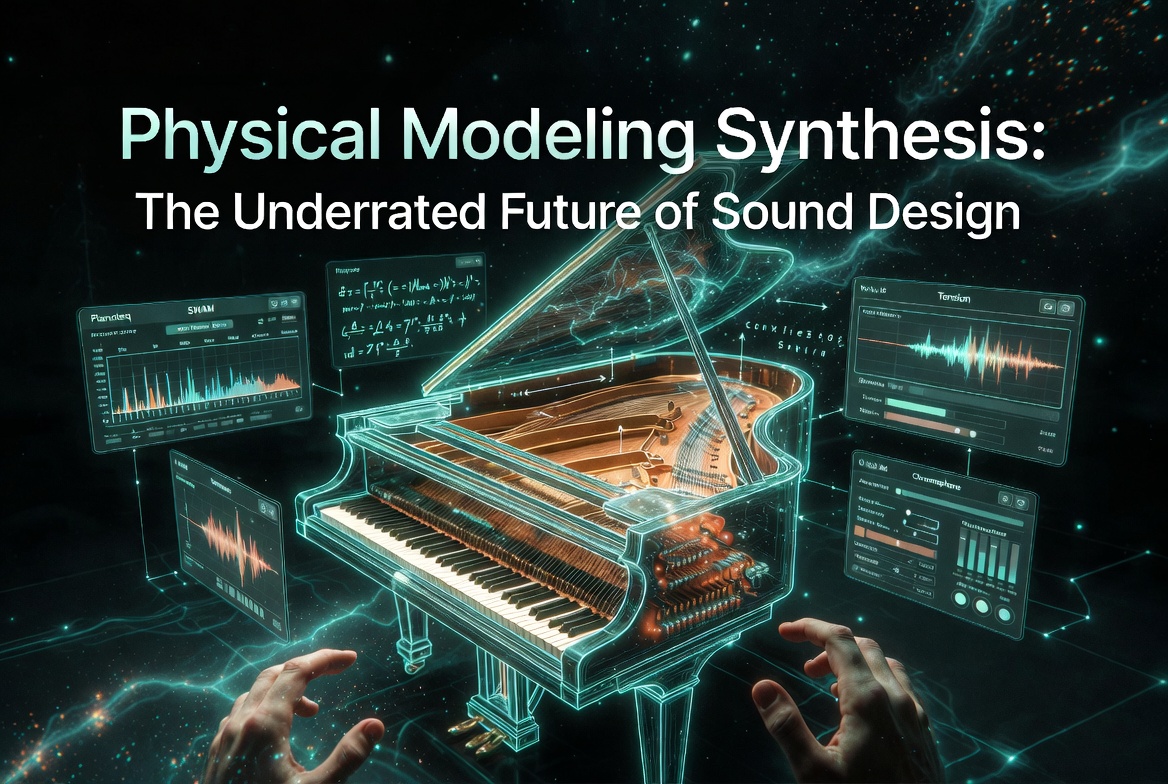
Physical Modeling Synthesis

Physical Modeling Synthesis: The Underrated Future of Sound Design

TL;DR Physical modeling recreates the physics of how an instrument produces sound - string tension, resonant cavities, bowing and striking - rather than storing samples or shaping waveforms The payoff is responsiveness: modelled instruments react to how you play in ways a sample library structurally cannot The practical advantage is scale without bloat - a full modelled piano is megabytes, not the hundreds of gigabytes of a flagship sample library Pianoteq and Audio Modeling’s SWAM line lead the space in 2026, with the main barrier to adoption being that modelled instruments must be played, not just triggered My take: as processing power keeps rising and expressive controllers spread, physical modeling is where expressive digital instruments are heading If you’ve spent any time with Pianoteq or the Audio Modeling SWAM instruments, you’ve felt something different. Not the crisp accuracy of a sampled library, not the flexibility of wavetable synthesis - but something that responds like an instrument. Strings that vibrate with sympathetic resonance. Piano keys with wooden resistance. A cello that sings differently when you bow it hard versus soft. ...
May 3, 2026 · 12 min · James M
Modular Synthesis Building Blocks

Introduction to Modular Synthesis - The Building Blocks

TL;DR Modular synthesis reduces to one idea: signal flow - generate a signal, shape it, modulate it, send it somewhere useful Six module types do the heavy lifting in almost every patch: oscillators (raw material), filters (sculpting), envelopes (shape over time), LFOs (motion), VCAs (controlled loudness), and mixers (combining) A basic patch - oscillator into filter into VCA, with an envelope opening the VCA - is the skeleton behind most of what you hear from any synth Modular feels hard because nothing is pre-wired; that is also exactly why it teaches synthesis better than any preset instrument Start small: understand these blocks before buying a case full of exotic modules Modular synthesis can feel overwhelming at first. There are dozens of modules, hundreds of cables, and infinite ways to patch them together. But underneath all that complexity lies a simple truth: modular synthesis is about understanding how audio flows from one place to another, and learning to shape that signal at every step. ...

April 18, 2026 · 8 min · James M
Best Software Synths 2026

The Best Software Synths of 2026: From AI-Native to Analog Perfection

The landscape of software synthesis has undergone a massive shift over the last two years. While the legends of the 2010s are still present, 2026 has introduced a new generation of “intelligent” instruments that bridge the gap between complex sound design and intuitive creativity. Here are the top software synths currently defining the sound of 2026. 1. Xfer Serum 2 (The Evolution) After years of anticipation, the successor to the most popular wavetable synth in history has finally matured. Serum 2 maintains the workflow we love but adds a “Neural Resynthesis” engine. You can now drop any audio sample into the oscillator, and the AI will reconstruct it as a fully morphable wavetable with uncanny accuracy. ...

April 10, 2026 · 3 min · James M
u-he Zebra 3 Modular Software Synthesizer

u-he Zebra 3: The Modular Beast Unleashed

In the realm of software synthesizers, few names command as much respect and anticipation as u-he. And among their legendary lineup, Zebra has always stood out as a chameleon – a semi-modular powerhouse capable of almost any sound. Now, with the long-awaited arrival of Zebra 3, the beast has truly been unleashed, promising to redefine what’s possible in digital sound design. This isn’t just an update; it’s a complete reimagining, building on the strengths of its predecessor while pushing the boundaries of flexibility, sonic fidelity, and user experience. ...

April 9, 2026 · 4 min · James M
Playing and creating music intuitively

Why I Play & Create Music Intuitively

Playing by ear - discovering by accident The Joy of Surprise I don’t play the piano to master it. I play it because sometimes it surprises me. That sounds backwards, especially in a world obsessed with progress, scales, grades, and measurable improvement. But the thing that keeps pulling me back to the keys isn’t control - it’s discovery. It’s that moment when my fingers land somewhere they’ve never quite been before and something clicks. A sound appears that I didn’t plan, didn’t predict, and definitely didn’t know I knew. ...

January 7, 2026 · 5 min · James M