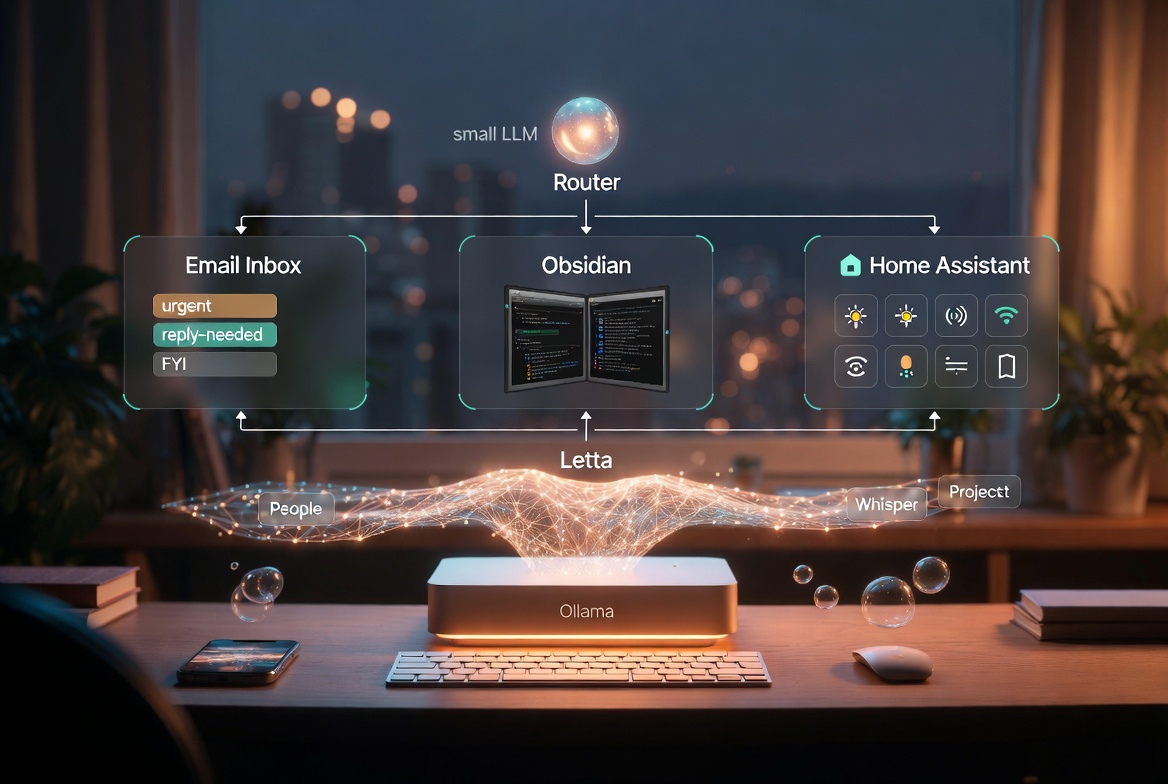
LLM-Powered Personal Productivity Banner

LLM-Powered Personal Productivity: Building a Private Automation Stack

TL;DR The interesting question in 2026 is not “can a local model do this”, it is “which jobs should you give it”. My stack: Ollama for inference, Letta for persistent agent memory, Obsidian as the second brain, Home Assistant for the physical world, and a small router that decides where each thought goes. Three jobs are the sweet spot for local: inbox triage, note enrichment, and routine automation. Each one is repetitive, private, and tolerant of a bit of latency. Two jobs are still worth handing to a frontier cloud model: anything novel-and-hard, and anything where you want the best draft on the first attempt. The bit nobody talks about is the router. The model is not the product. The thing that decides which model gets which job is the product. Why Local Got Interesting For years the answer to “should I run an LLM locally” was “no, just use the API”. The API was cheaper, faster, smarter, and you did not have to think about VRAM. The only reason to go local was privacy, and most people did not actually care about privacy enough to give up the quality gap. ...
May 3, 2026 · 9 min · James M
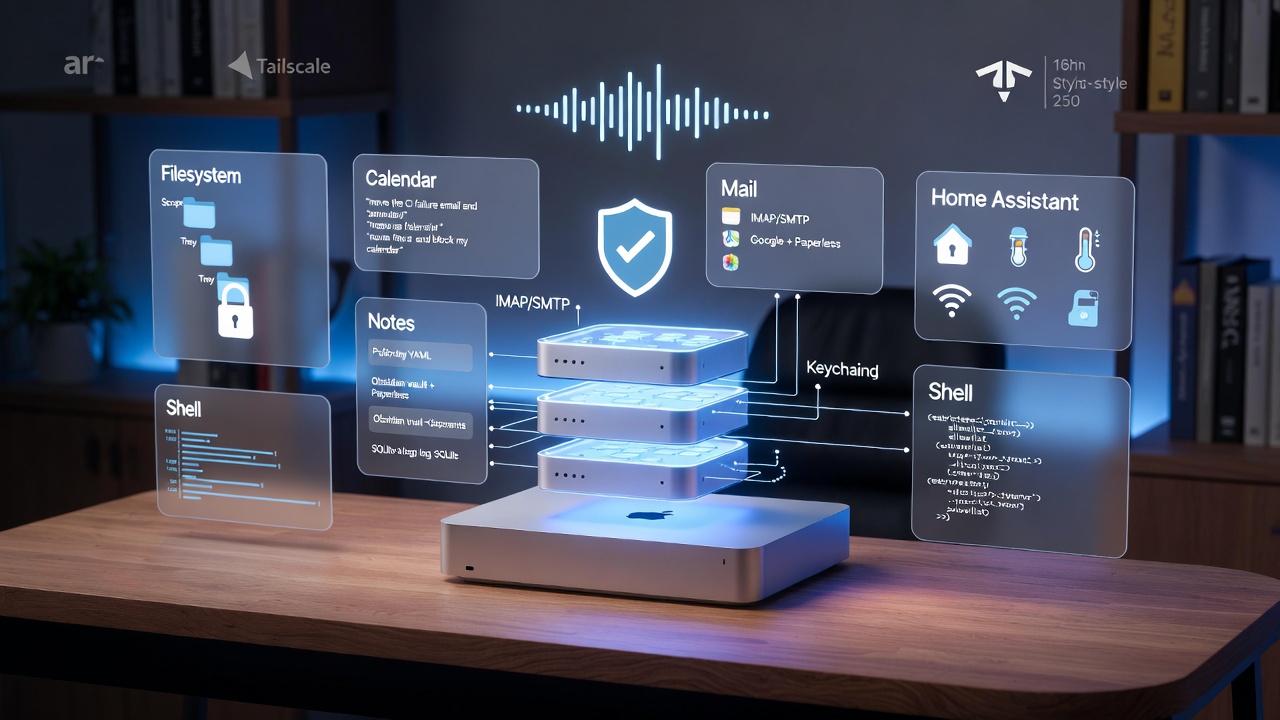
MCP Servers for a Home AI Agent Banner

Giving Your Home AI Agent Real Tools: MCP Servers on a Mac Studio

TL;DR Problem: a local agent that can only chat is a toy. The value is in what it can do. Answer: Model Context Protocol servers, running locally on the Mac Studio, expose filesystem, calendar, mail, notes, and a handful of custom tools. Runtime: one supervisord config, a small router, and per-server allowlists so nothing escapes its box. Security posture: no tool runs without a policy, secrets live in the macOS Keychain, and every call is logged to a local SQLite file I can grep at 11pm. Result: I can phone the agent (see How to Phone Your Home AI Agent), ask “move the CI failure email to triage and put a 15 minute hold on my calendar at 4”, and it actually does it. Why MCP and Not “Just Functions” Before MCP I had a directory of half-finished Python shims. Each one spoke a slightly different dialect: one took JSON arguments, one took positional args, one returned markdown and one returned a dict. Adding a new tool meant editing the agent prompt, the router, and the caller. ...

April 27, 2026 · 8 min · James M
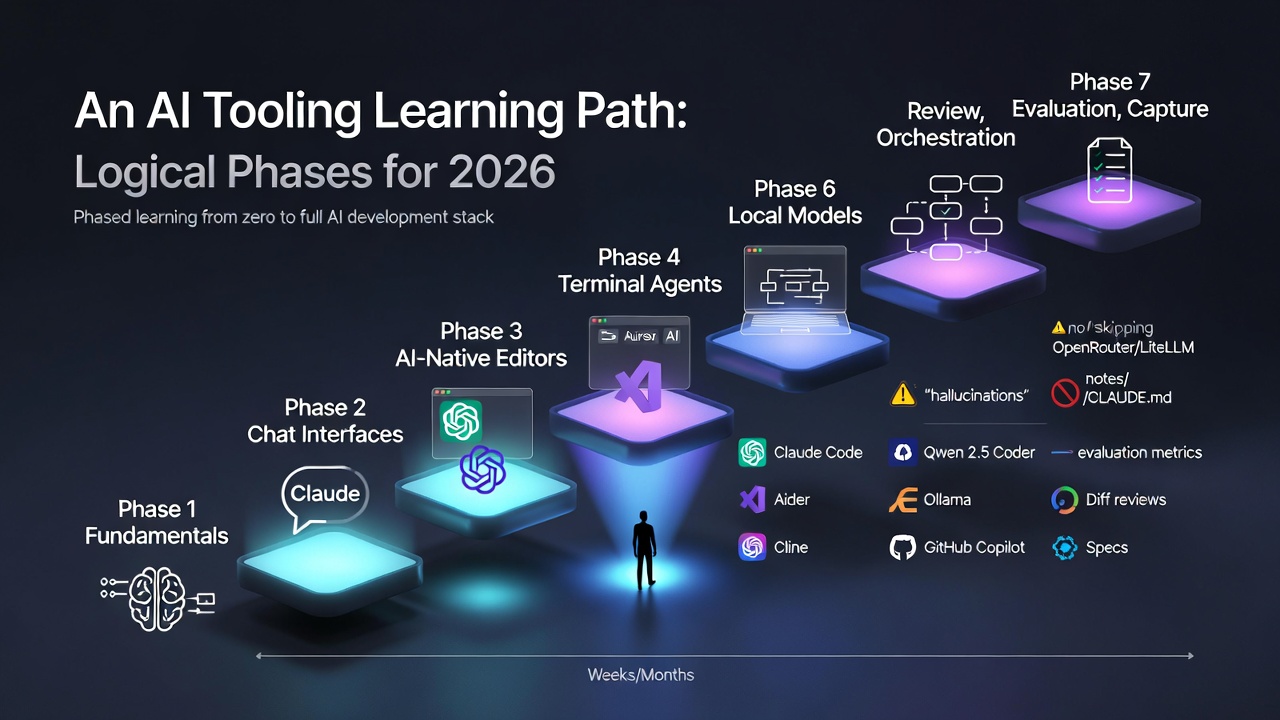
AI Tooling Learning Path Banner

An AI Tooling Learning Path: Logical Phases for 2026

TL;DR The order you learn AI tools matters as much as which tools you learn - most people start with terminal agents or editors before they understand how models actually fail The seven-phase path runs: fundamentals, chat interfaces, AI-native editors, terminal agents, local models, orchestration, and review and evaluation Terminal agents (Claude Code, Cline, Aider) represent the biggest mindset shift - you move from driving with suggestions to specifying and letting the model execute Local models via Ollama belong in phase five, once you have felt the pain of API costs and know which tasks actually need frontier capability Review, evaluation, and capture (phase seven) is the phase most developers skip - and the one that separates AI-curious from AI-competent The hardest part of learning AI tooling in 2026 is not any single tool. It is the order you meet them in. ...

April 21, 2026 · 10 min · James M

Running AI Models Locally with Ollama: From Setup to OpenClaw

TL;DR Ollama is a lightweight tool for running open-source language models locally with no cloud costs, rate limits, or data leaving your machine Models are managed with simple commands (ollama pull, ollama run) and can be queried via a local HTTP API on localhost:11434 Popular models include Mistral 7B for speed, Llama 2 for all-around performance, and OpenClaw for code and reasoning tasks Running models locally delivers privacy, zero per-token cost, lower latency, and full offline capability You don’t need a GPU to start - a 7B model runs on 8GB of RAM, and Ollama automatically uses 4-bit quantization for larger models Running AI Models Locally with Ollama: From Setup to OpenClaw Ollama has quietly become the go-to tool for developers who want to run large language models on their own machines without relying on APIs. No cloud costs, no rate limits, no sending your prompts to third-party servers. Just you, your hardware, and a surprisingly capable AI model running locally. ...

April 14, 2026 · 4 min · James M