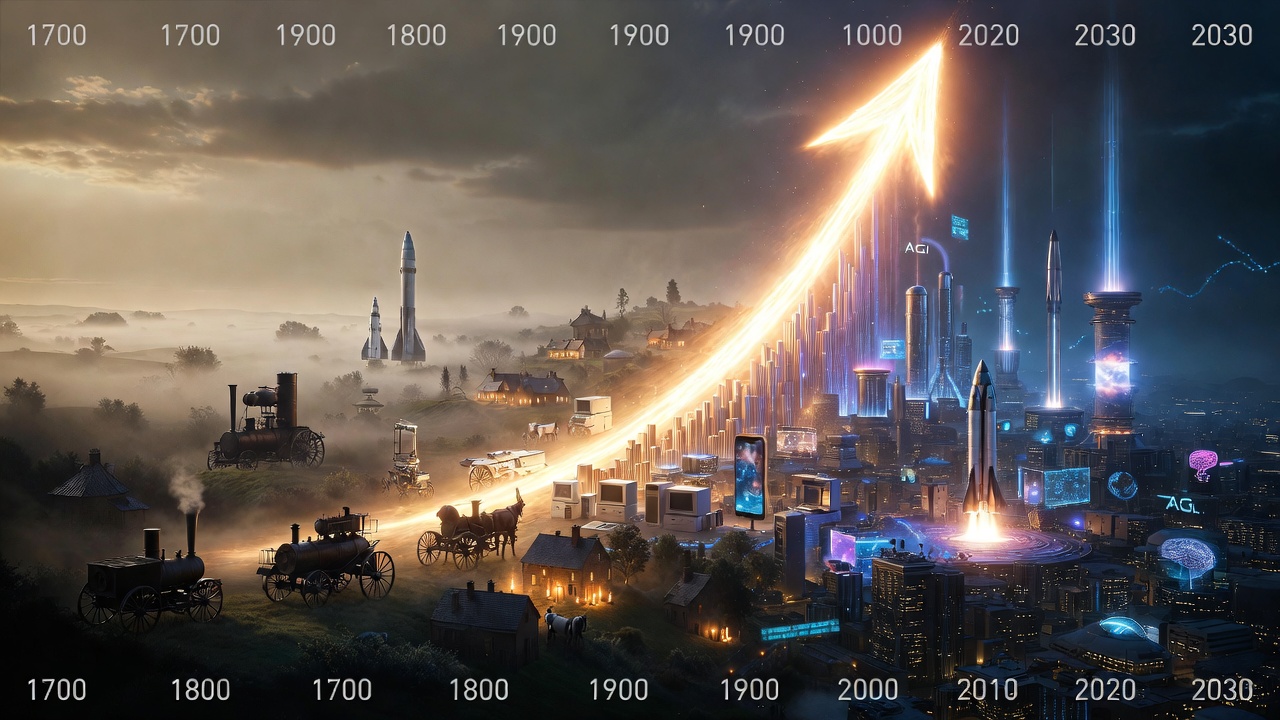
Human Advancement Acceleration Banner

The Exponential Curve: Understanding Human Advancement Acceleration

A child born in 1700 inherited a world barely changed from their grandparents’. A child born in 1900 saw horses give way to automobiles, then aircraft, then space travel within a single lifetime. A child born today will witness more transformation in their first 30 years than humans experienced across the entire 18th century. This isn’t hyperbole. It’s geometry. INNOVATION DENSITY PER DECADE (1700 - 2030) ════════════════════════════════════════════════════════════ 1700s │▏ 1710s │▏ 1720s │▎ The "slow century" 1730s │▎ Marine Chronometer (1735) 1740s │▍ 1750s │▍ 1760s │▌ Spinning Jenny (1764) 1770s │▋ ◀── Steam Engine (1769) - Industrial Revolution begins 1780s │▊ 1790s │▉ 1800s │█ Photography emerges 1810s │█▏ 1820s │█▎ 1830s │█▌ Telegraph (1837) 1840s │█▋ 1850s │█▊ Bessemer Steel 1860s │██ Internal Combustion Engine 1870s │██▎ Telephone (1876), Phonograph 1880s │██▌ Electric Light, Automobile 1890s │██▊ Radio Waves, X-rays 1900s │███ Powered Flight (1903) 1910s │███▎ 1920s │███▌ Television 1930s │████ Antibiotics 1940s │█████ ◀── ENIAC + Transistor - Computing era begins 1950s │██████ Commercial Jets, DNA Discovered 1960s │████████ Integrated Circuit, Moon Landing 1970s │██████████ Microprocessor, Personal Computer 1980s │█████████████ Internet, Mobile Phones 1990s │████████████████ World Wide Web 2000s │█████████████████████ Smartphones, Social Media 2010s │██████████████████████████ Deep Learning, CRISPR 2020s │█████████████████████████████████████ ◀── YOU ARE HERE │ └──→ AGI? Fusion? Age Reversal? ──→ 2030s What ‘Exponential’ Actually Means Most people nod along when someone says “technology is accelerating,” but few grasp what exponential growth looks like up close. ...

April 20, 2026 · 5 min · James M

Copy Protection Wars: The Ingenious Schemes Of 1980s Software

Copy Protection Wars: The Ingenious Schemes Of 1980s Software Before the era of always-online DRM and AI-powered anti-tamper software, the battle against software piracy was fought with cardboard, plastic, and clever manipulation of magnetic disk geometry. In the 1980s, developers faced a simple problem: floppy disks were incredibly easy to copy. Their solutions, however, were anything but simple. This was the “Copy Protection War,” an arms race between software houses and the burgeoning “cracker” scene that birthed the Demoscene and defined digital culture for a generation. ...

April 8, 2026 · 4 min · James M

What the Amiga Got Right (That We're Still Copying)

What the Amiga Got Right (That We’re Still Copying) The Commodore Amiga was not the most successful computer. It was not the fastest. It was not the cheapest. It was introduced in 1985, bought by Commodore in a panic, and discontinued by 1994 as the company collapsed. By most commercial metrics, it was a failure. Yet almost every good idea in modern computing traces back to the Amiga. Preemptive multitasking. Graphics layers and compositing. Named pipes. Memory protection. Hardware acceleration. Plug-and-play peripherals. Scripting languages. Digital audio and video editing. Networking. The Amiga did these things in 1985 when IBM PCs were still running in 8-bit mode. ...

April 3, 2026 · 10 min · James M

Compunet: Britain's Forgotten Pre-Internet Community

Compunet: Britain’s Forgotten Pre-Internet Community Long before Facebook, Twitter, or Reddit, there was Compunet. In 1982, in a small flat in Islington, London, two teenagers set up a computer bulletin board system on a network called Prestel. Within a few years, it had become one of the world’s first genuine online communities - thousands of people meeting in cyberspace, exchanging messages, playing games, and falling in love, all before the internet existed in public consciousness. ...

April 3, 2026 · 10 min · James M

The Demoscene: Where Art Met Assembly

The Demoscene: Where Art Met Assembly The demoscene wasn’t about games. It wasn’t about productivity software or killer apps. It was about taking a computer that wasn’t designed for art, stripping away the operating system, and hand-crafting something beautiful in 512 bytes of RAM. This was the demoscene, and it was the most vital creative community in computing. What Was the Demoscene? A “demo” is a real-time audiovisual production written from scratch - no pre-rendered video, no external assets, just code and mathematics creating sound and graphics in real time on modest hardware. Think of it as a 4-minute music video that weighs 64 kilobytes and runs on a Commodore 64. ...

April 2, 2026 · 7 min · James M

From BASIC in 1981 to Claude Code in 2026: What Programming Has Always Been About

I’m sitting at a desk with two machines. One is a 1981 ZX Spectrum, 16KB of RAM, sitting on a desk in my garage. The other is a 2026 MacBook running Claude Code. Between them lie 45 years of computing history. And here’s the thing that struck me recently: I’m still doing the same thing. On the Spectrum, I’m typing: 10 PRINT "HELLO WORLD" 20 INPUT A$ 30 IF A$ = "YES" THEN GOTO 50 40 GOTO 10 50 PRINT "YOU SAID YES" On Claude Code, I’m typing: ...

April 2, 2026 · 9 min · James M

Favourite Museums

Computing Bletchley Park Bletchley Park - The historic site of World War II codebreaking and the birthplace of modern computing. Located in Milton Keynes, UK. The National Museum of Computing TNMOC - Located on the Bletchley Park estate, this museum houses the world’s largest collection of functional historic computers, including the rebuilt Colossus and the Harwell Dekatron (WITCH). Centre for Computing History Centre for Computing History - Based in Cambridge, this museum focuses on the personal computing revolution and features a massive collection of vintage consoles and computers. ...

September 22, 2024 · 2 min · James M