
Agent-First Architecture Banner

Agent-First Architecture: The Engineer as System Curator

TL;DR Agent-first architecture imagines a future where the primary unit of work is an AI agent with intent, tools, memory, and a feedback loop - not a human-authored codebase The engineer’s role may shift from building and maintaining systems line by line to curating, governing, and evolving fleets of agents Glue code, routine maintenance, first-pass incident triage, and migration work are plausible candidates for automation; deciding what a system is for and holding architectural intent across time probably are not Managing an agent fleet might resemble logistics fleet management: define intent, set constraints, design feedback loops, curate the roster, and own the outcomes This is a speculative post, not a description of how anything works today - pinning down a hypothesis to revisit when it turns out to be wrong This is a “thinking out loud” post, not a report from the front lines. I have no evidence any of this is happening at scale, and it is not how my current day job looks. These are just ideas I keep turning over, and I wanted to write them down to see if they hold together. ...

April 23, 2026 · 13 min · James M
Home AI Agent Memory That Lasts Banner

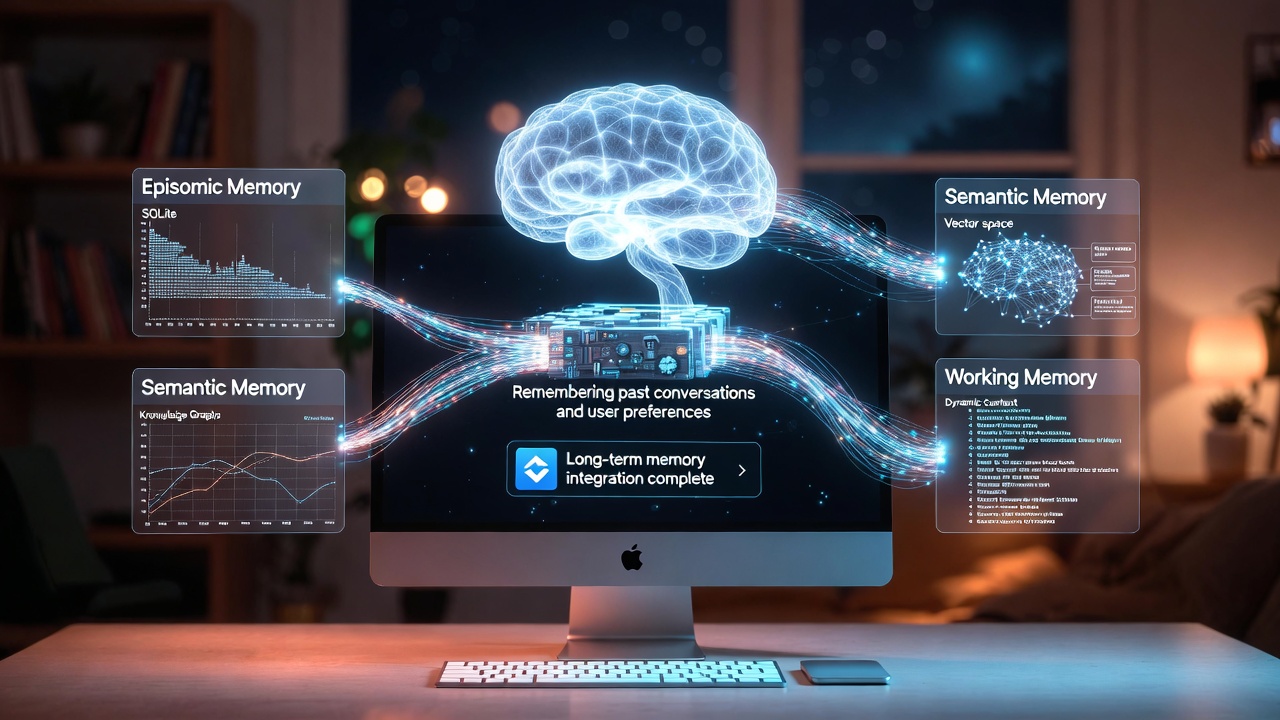
Giving Your Home AI Agent Memory That Lasts

TL;DR Problem: a home agent with tools but no memory is a very well-read goldfish. Every morning it re-meets you. Answer: split memory into three layers - working, episodic, and semantic - and give each layer its own store and its own rules for what gets written. Where it lives: SQLite for episodic and facts, a local vector store for semantic search, and a tiny policy file that decides what is worth remembering in the first place. How it plugs in: a memory MCP server that exposes recall, remember, and forget - nothing else. Result: the agent can say “last Tuesday we tried restarting the Postgres container and it worked” and mean it. It also knows what not to store. The Goldfish Problem The home agent I built over the last few weeks can do real things now. It can read my mail, move files around my workspace, turn lights off, and check my calendar. What it could not do, until this week, was remember any of it. ...

April 22, 2026 · 9 min · James M
Hermes Agent Banner

Hermes Agent: Persistent Autonomy That Learns and Grows

TL;DR Hermes Agent by Nous Research is an open-source persistent autonomous system that builds memory across conversations, auto-generates reusable skills from repeated tasks, and compounds in capability over time Unlike stateless agents, Hermes accumulates project context - learning codebase quirks, team conventions, and recurring workflows so it stops asking questions it has already answered It works across Telegram, Discord, Slack, WhatsApp, Signal, Email, and CLI - meeting teams on the platforms they already use rather than requiring a dedicated app Running cost is roughly $20 to $60 per month for a solo developer (a $5-$10 VPS plus LLM API calls); it is MIT licensed with no seat fees or vendor lock-in The honest trade-off: Hermes beats alternatives on persistence and learning depth, but raises open questions about memory scaling, skill auditing, and what happens when an agent learns something wrong Most AI agents are forgettable. You ask them to do something, they do it, you close the window. The next time you need help, they start from zero - no context, no learning, no continuity. Hermes Agent works differently. Nous Research built it as a persistent system that remembers what it learns and gets measurably more capable the longer it runs. ...

April 20, 2026 · 9 min · James M
Claude Opus 4.7 on Databricks Banner

Claude Opus 4.7 Lands on Databricks: Enterprise Reasoning Meets the Lakehouse

Databricks announced this week that Anthropic’s Claude Opus 4.7 is now live on the platform. The headline from Databricks’ own benchmarking is the part worth pausing on - 21% fewer errors than Opus 4.6 on the OfficeQA Pro document-reasoning benchmark when the model is grounded in source information. That single number tells you more about where enterprise AI is going than any launch keynote. Why This Matters More Than Another Model Announcement Most Claude releases get surfaced the same week across the API, Amazon Bedrock, Google Cloud’s Vertex AI, and Microsoft Foundry. That was true of Opus 4.7 on April 16 as well. The Databricks story is different because Databricks is not just another hosting destination - it is where the actual enterprise data lives. ...

April 20, 2026 · 7 min · James M
Meta employee tracking banner

Meta Is Tracking Its Own Employees to Train AI Agents

TL;DR Meta’s Model Capability Initiative installs software on US employee laptops that captures keystrokes, mouse movements, and screenshots to train AI agents - there is no opt-out The program is US-only because EU and UK employees are protected by GDPR; the scope of the tracking maps directly onto the absence of legal protection Meta CTO Andrew Bosworth openly framed the end state: agents do the work, humans direct and review - the surveillance and the automation plan are the same story The irony is deliberate: Meta’s defence of the program - narrow purpose, safeguards, not used against the person - echoes its long-standing defences of consumer data collection This is a signal about where the agent-training bottleneck actually sits: not reasoning or context windows, but the long tail of real software interactions that only real employees can provide Meta has started installing tracking software on the work laptops of its US-based employees. It captures keystrokes, mouse movements, clicks, and occasional screenshots. The captured activity is fed back into training data for AI agents. There is no opt-out. The program was disclosed to staff in an internal memo in April 2026, and the response from inside the company has been about what you would expect. ...

April 1, 2026 · 8 min · James M
A year of AI agents

A Year of Agents, and What is Coming Next

TL;DR The defining shift from April 2025 to April 2026 is the move from “ask” to “delegate” - agents now run for minutes, open files, execute shells, and return results rather than waiting for each prompt Key developments that drove this: coding agents becoming operators (Claude Code, Cursor, Codex), MCP standardising tool access, spec-driven development going mainstream, and context windows expanding to millions of tokens In the next two years, longer-horizon agents, multi-agent coordination, persistent personal AI memory, and computer-use automation will move from early features to default expectations The working day is reshaping around less typing and more reviewing - the skill that matters is judgement over diffs, not typing speed or boilerplate generation To adapt now: pick a stack and use it daily, write specs before code, build the habit of reviewing diffs fast, and move procedural knowledge into reusable agent skills A year ago, in April 2025, “AI in your workflow” mostly meant a chat window in a browser tab and an autocomplete plugin in your editor. You typed, it suggested, you accepted or rejected. The interaction model was small. The blast radius was small. The verb was “ask”. ...

March 13, 2026 · 12 min · James M