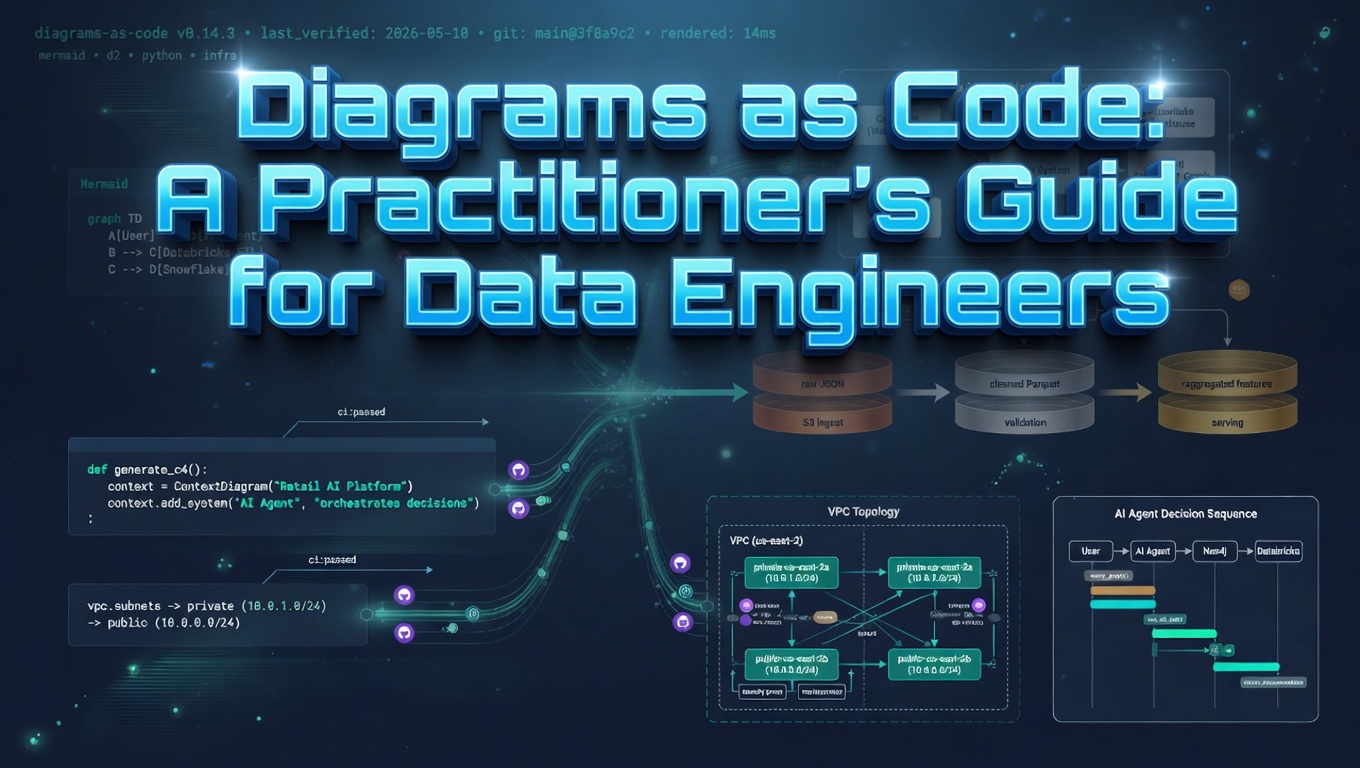
Diagrams as Code Banner

Diagrams as Code: A Practitioner's Guide for Data Engineers

TL;DR Hand-drawn diagrams in Lucidchart, Visio, draw.io or Confluence rot because they live outside the codebase, cannot be diffed, and have no compiler to flag when they go stale. Diagrams as code closes all three gaps by treating the text source as truth and the rendered image as a build artefact. Pick by the question you are answering, not by taste. Mermaid for embedded docs and anything that has to render in GitHub. D2 for aesthetically polished architecture with real cloud icons. Python diagrams for AWS-heavy decks. PlantUML or Structurizr when you need formal UML or the C4 model. The conventions that make trust explicit: co-locate diagrams with the code they describe, add a metadata header with last_verified and next_review_due, encode confidence visually ( verified / stale / proposed ), pair each non-obvious diagram with an ADR, and render in CI. The highest-leverage move is to generate diagrams from the system itself - Terraform state, lineage graphs, dbt manifests, Airflow DAGs. A generated diagram is provably current by construction, which is a much stronger guarantee than “I reviewed it last quarter.” If you have ever opened a Confluence page from two years ago and wondered whether the architecture it shows is still real, you have already met the problem this post is trying to fix. Hand-drawn diagrams in Lucidchart, Visio, draw.io or PowerPoint share three failure modes that no amount of governance ever quite eliminates. They live somewhere your code does not, so nobody updates them in the same PR that changes the system. They cannot be diffed, reviewed, or merged. And they rot silently, because there is no compiler error for “this picture is now a lie.” ...

May 18, 2026 · 19 min · James M
AI Skills banner

AI Skills: One Folder, Any Model

TL;DR A Claude Code skill is just a folder with a SKILL.md file - YAML frontmatter plus natural-language instructions - and the same folder works across Cursor, Gemini CLI, Codex, and a dozen other tools The format is model-agnostic because it contains no provider-specific syntax; any instruction-following model can read it, and any harness that loads markdown can execute it Progressive disclosure keeps large skill libraries cheap: only names and descriptions load at session start, with full instructions loading only when a skill is activated The portability is practically valuable - version-controlled runbooks that survive tool switches, model upgrades, and team growth without being rewritten Core skills are genuinely portable; advanced frontmatter extensions (like allowed-tools or context: fork) are tool-specific and may need tuning across harnesses Most of the tooling I have written about over the last year has been provider-specific. A particular model, a particular harness, a particular set of features. The thing I find interesting about agent skills is that they are not. ...

April 30, 2026 · 9 min · James M
A year of AI agents

A Year of Agents, and What is Coming Next

TL;DR The defining shift from April 2025 to April 2026 is the move from “ask” to “delegate” - agents now run for minutes, open files, execute shells, and return results rather than waiting for each prompt Key developments that drove this: coding agents becoming operators (Claude Code, Cursor, Codex), MCP standardising tool access, spec-driven development going mainstream, and context windows expanding to millions of tokens In the next two years, longer-horizon agents, multi-agent coordination, persistent personal AI memory, and computer-use automation will move from early features to default expectations The working day is reshaping around less typing and more reviewing - the skill that matters is judgement over diffs, not typing speed or boilerplate generation To adapt now: pick a stack and use it daily, write specs before code, build the habit of reviewing diffs fast, and move procedural knowledge into reusable agent skills A year ago, in April 2025, “AI in your workflow” mostly meant a chat window in a browser tab and an autocomplete plugin in your editor. You typed, it suggested, you accepted or rejected. The interaction model was small. The blast radius was small. The verb was “ask”. ...

March 13, 2026 · 12 min · James M