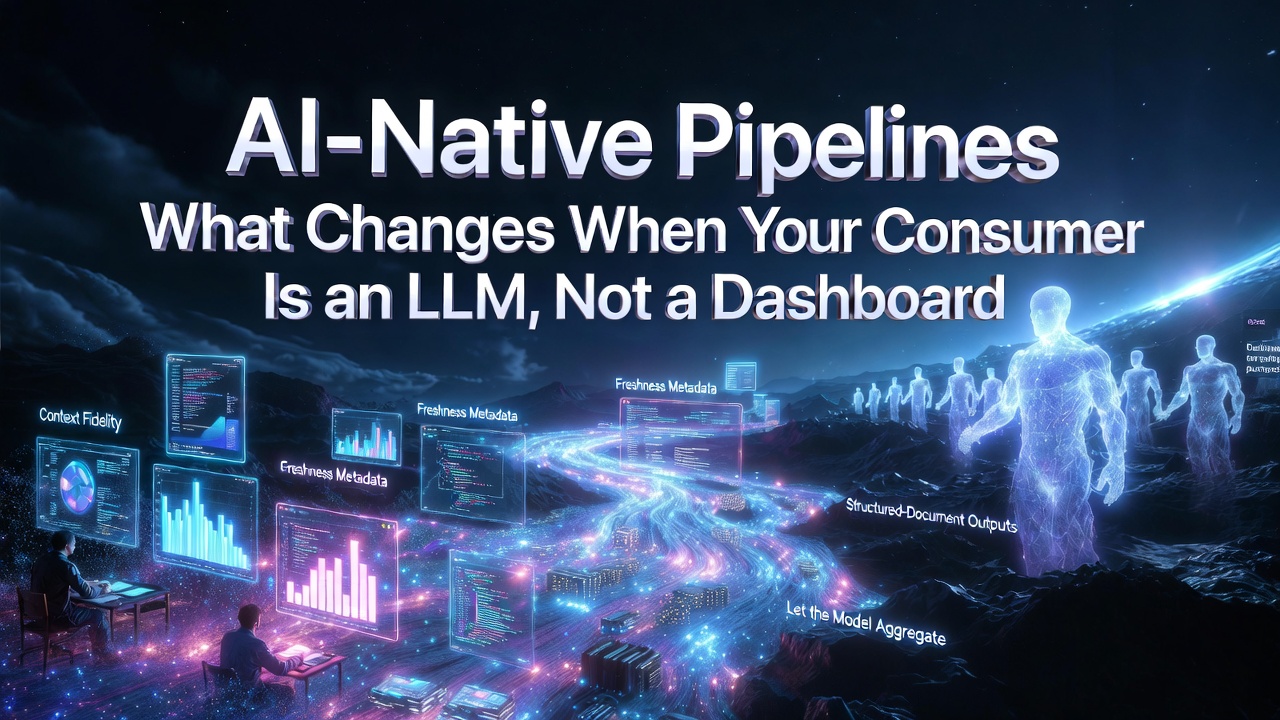
AI-Native Pipelines Banner

AI-Native Pipelines - What Changes When Your Consumer Is an LLM, Not a Dashboard

TL;DR Data pipelines were optimised for human consumers - dashboards, BI tools, analysts. In 2026 a growing share of pipeline output flows directly to language models, agents, and retrieval systems. That changes the design constraints in ways that catch teams off guard. Aggregation matters less. Context fidelity matters more. Freshness behaves differently. Schema moves from rigid to negotiated. Cost shifts from compute to tokens. The biggest mistake is treating an LLM consumer as if it were just another dashboard. It is not. It does not skim, it does not interpret charts, it does not have working memory across rows. It needs to be fed. The new patterns - retrieval-aware partitioning, embedding pipelines, structured-document outputs, prompt-shaped views, evaluation harnesses for data quality - are the actual subject of “AI-native data engineering” in 2026. The Underlying Shift For thirty years the implicit consumer of every data pipeline was a human looking at a screen. Even when the pipeline ended in an API or a CSV, the conceptual end-user was someone who would interpret the output with judgement, context, and skim-reading. ...
May 3, 2026 · 9 min · James M
When to Fine-Tune vs When to RAG Banner

When to Fine-Tune vs When to RAG: Choosing Your AI Architecture

TL;DR The default choice for most teams should be RAG - it is reversible in days, whereas a bad fine-tuning decision is an expensive sunk cost that requires retraining to fix RAG fails when the question requires reasoning across an entire knowledge domain rather than extracting a specific answer from a passage; fine-tuning handles that case better Fine-tuning fails silently when underlying facts change - it produces confidently wrong, stale answers with no warning; RAG automatically picks up changes at query time A practical decision framework: use RAG for volatile facts and cited answers, use fine-tuning for stable style, voice, and cross-domain reasoning The best production systems use both: a fine-tuned base model for stable domain knowledge, augmented with retrieval for current and specific information The question I get asked most often by engineers starting to build with language models is some variation of: “should we fine-tune or should we do RAG?” It is almost always the wrong question, but it is the wrong question in an instructive way. The reason it gets asked so much is that the choice feels architectural, and architectural choices feel like the kind of thing you commit to once and live with. In practice, the choice is closer to “should I use a database or a cache” - the answer is usually some of both, applied to different problems, and the ratio shifts as the system matures. ...

April 29, 2026 · 11 min · James M
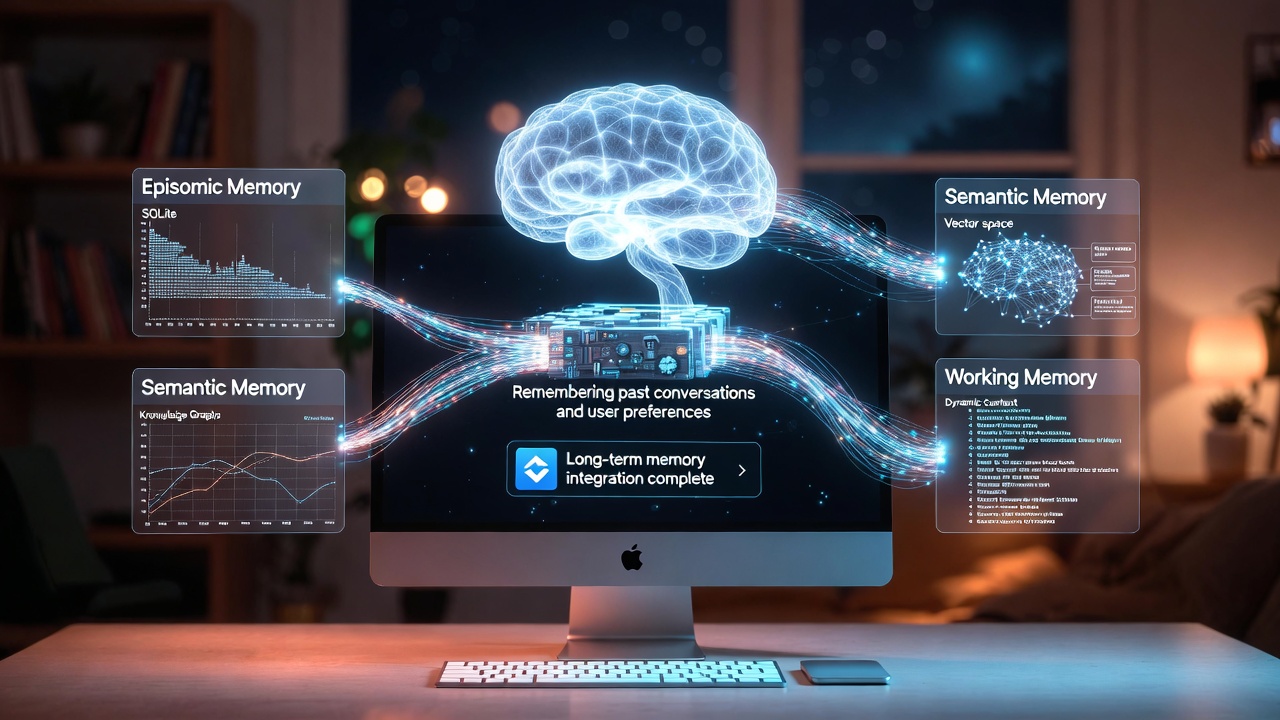
Home AI Agent Memory That Lasts Banner

Giving Your Home AI Agent Memory That Lasts

TL;DR Problem: a home agent with tools but no memory is a very well-read goldfish. Every morning it re-meets you. Answer: split memory into three layers - working, episodic, and semantic - and give each layer its own store and its own rules for what gets written. Where it lives: SQLite for episodic and facts, a local vector store for semantic search, and a tiny policy file that decides what is worth remembering in the first place. How it plugs in: a memory MCP server that exposes recall, remember, and forget - nothing else. Result: the agent can say “last Tuesday we tried restarting the Postgres container and it worked” and mean it. It also knows what not to store. The Goldfish Problem The home agent I built over the last few weeks can do real things now. It can read my mail, move files around my workspace, turn lights off, and check my calendar. What it could not do, until this week, was remember any of it. ...

April 22, 2026 · 9 min · James M