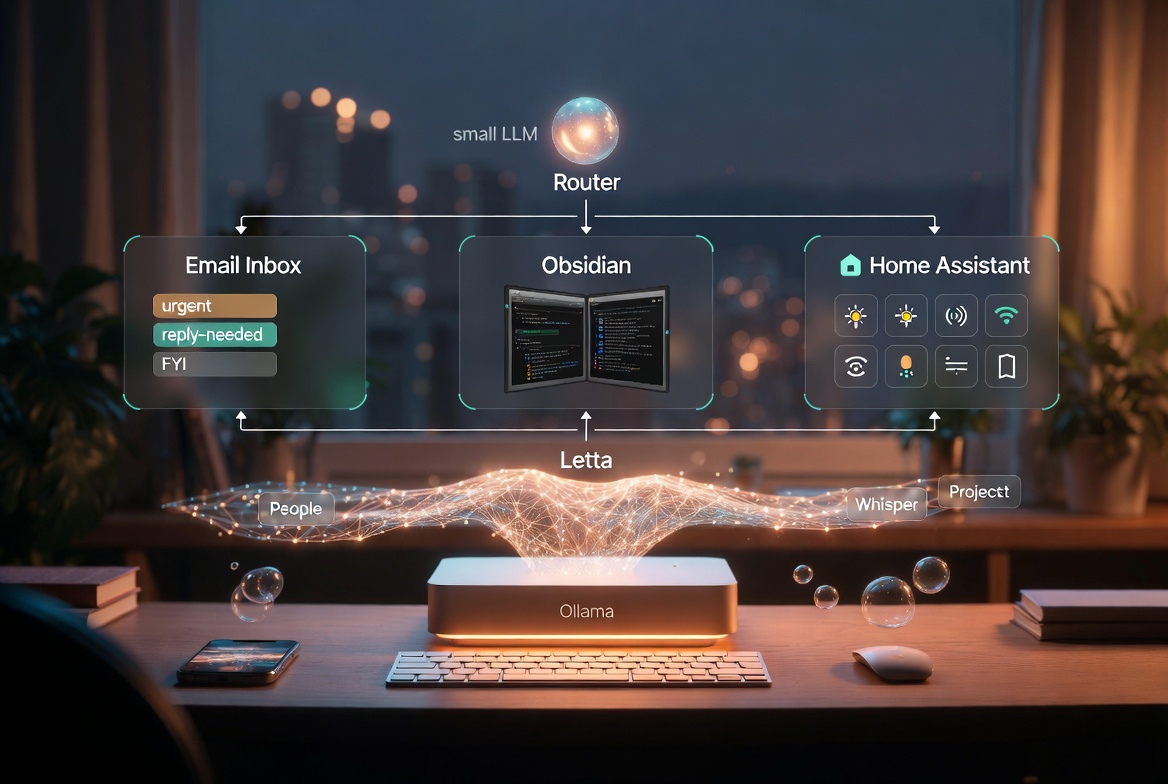
LLM-Powered Personal Productivity Banner

LLM-Powered Personal Productivity: Building a Private Automation Stack

TL;DR The interesting question in 2026 is not “can a local model do this”, it is “which jobs should you give it”. My stack: Ollama for inference, Letta for persistent agent memory, Obsidian as the second brain, Home Assistant for the physical world, and a small router that decides where each thought goes. Three jobs are the sweet spot for local: inbox triage, note enrichment, and routine automation. Each one is repetitive, private, and tolerant of a bit of latency. Two jobs are still worth handing to a frontier cloud model: anything novel-and-hard, and anything where you want the best draft on the first attempt. The bit nobody talks about is the router. The model is not the product. The thing that decides which model gets which job is the product. Why Local Got Interesting For years the answer to “should I run an LLM locally” was “no, just use the API”. The API was cheaper, faster, smarter, and you did not have to think about VRAM. The only reason to go local was privacy, and most people did not actually care about privacy enough to give up the quality gap. ...
May 3, 2026 · 9 min · James M
A year of AI agents

A Year of Agents, and What is Coming Next

TL;DR The defining shift from April 2025 to April 2026 is the move from “ask” to “delegate” - agents now run for minutes, open files, execute shells, and return results rather than waiting for each prompt Key developments that drove this: coding agents becoming operators (Claude Code, Cursor, Codex), MCP standardising tool access, spec-driven development going mainstream, and context windows expanding to millions of tokens In the next two years, longer-horizon agents, multi-agent coordination, persistent personal AI memory, and computer-use automation will move from early features to default expectations The working day is reshaping around less typing and more reviewing - the skill that matters is judgement over diffs, not typing speed or boilerplate generation To adapt now: pick a stack and use it daily, write specs before code, build the habit of reviewing diffs fast, and move procedural knowledge into reusable agent skills A year ago, in April 2025, “AI in your workflow” mostly meant a chat window in a browser tab and an autocomplete plugin in your editor. You typed, it suggested, you accepted or rejected. The interaction model was small. The blast radius was small. The verb was “ask”. ...

April 30, 2026 · 12 min · James M
Speech To Text Banner

MacWhisper vs Wispr Flow vs Superwhisper: The 2026 Dictation Stack Compared

TL;DR MacWhisper is a file transcription tool (audio in, text out) that runs entirely on-device - the right pick for journalists, researchers, and anyone transcribing recordings Wispr Flow is the easiest system-wide dictation option, with AI-powered prose cleanup and cross-platform sync, but it sends audio to the cloud with no on-device option Superwhisper matches Wispr Flow’s system-wide dictation but processes audio locally, with bring-your-own-key LLM cleanup and deep customisation for power users The core decision is simple: if your audio can leave your machine, use Wispr Flow; if it must stay local, use Superwhisper; if you just need transcription, use MacWhisper The real product differentiation is no longer the underlying Whisper model - it is hotkey ergonomics, auto-edit prompts, and workflow integration Voice input on the Mac used to mean fighting with the built-in Dictation feature or paying Nuance a small fortune. In 2026, the landscape looks completely different. A handful of indie and venture-backed apps have turned Whisper-class models into genuinely fast, accurate tools that sit quietly in your menu bar until you hold a hotkey. ...

April 20, 2026 · 7 min · James M
Token efficiency visualization

The Token Efficiency Mindset - Why Your Claude Conversations Cost More Than They Should

TL;DR Token costs don’t scale linearly with productivity - the context window compounds with every follow-up message, so a five-message conversation can cost 2-3x more than one well-structured request Compression is your biggest lever: cutting a prompt in half before sending it reduces cost and often improves answer quality by removing noise Batch tasks that share context together; don’t batch unrelated tasks - real batching spreads the setup cost across related work Build reusable systems (templates, project files, prompt prefixes) instead of solving the same problem repeatedly and paying the context cost each time Prompt caching can cut input token costs by 80-90% on workloads with stable prefixes - the single biggest structural saving most teams are missing If you’re paying attention to your Claude usage, you’ve probably noticed something: your token bills don’t scale linearly with your productivity. Sometimes a conversation that feels quick costs three times more than expected. Other conversations that took hours feel suspiciously cheap. ...

April 17, 2026 · 6 min · James M

Cline: The Next Generation AI Coding Assistant

An exploration of Cline, the autonomous AI coding agent that lives in your IDE and handles complex, multi-step engineering tasks through tool-use and agency.

April 9, 2026 · 4 min · James Myddelton

Paperless-ngx: Self-Hosted Document Management Without the Vendor Lock-in

TL;DR Paperless-ngx is a self-hosted, open-source document management system that scans, OCRs, and auto-organizes physical paperwork with no subscription fees or vendor lock-in Documents are automatically tagged and filed using custom rules, and the full archive is searchable by text extracted via OCR Self-hosting options include a local NAS, Docker on a server, a cheap cloud VPS, or even a Raspberry Pi - the system is not computationally demanding The primary benefits over commercial alternatives are complete data ownership, zero recurring cost at scale, and suitability for sensitive documents under HIPAA or GDPR It suits document-heavy professionals and privacy-conscious individuals best; casual users with few documents don’t need it The paper stack on your desk is growing again. Medical records mixed with tax documents, utility bills, insurance forms - all of it scattered across a filing cabinet that’s become increasingly harder to navigate. There’s probably some important document you can’t quite remember where you filed it. ...

April 8, 2026 · 6 min · James M

Claude Code vs Cursor: A 6-Month Comparison

After six months of daily use, here is how the two heavyweights of AI-assisted coding compare: the terminal-native Claude Code and the IDE-integrated Cursor.

April 8, 2026 · 3 min · James M

The Engineer's Guide to Managing Creative Burnout

The Shape of Engineer Burnout Creative burnout in engineering looks different than burnout in other fields. It’s not just exhaustion from long hours (though that’s part of it). It’s the specific fatigue that comes from: Infinite scope. Features that seemed scoped end up needing architecture work, documentation, refactoring, and support. The work expands to fill available time. Context switching. Ping-pong between your own work, meetings, code reviews, unplanned incidents, and people asking “quick questions” that aren’t quick. Invisible work. You spend days thinking about a problem before writing a line of code. To everyone else, you look idle. Pressure mounts. Decision fatigue. Every technical choice branches into five more questions. Should we use library A or B? Refactor or ship? Upgrade or wait? Your judgment gets spent before lunch. The expectation to be always-on. Slack notifications, on-call rotations, “can you just look at this?” messages at 6 PM. The mental boundary between work and life dissolves. This burnout doesn’t announce itself with a bang. It creeps in through a thousand small surrenders: skipping lunch, saying yes to projects you don’t have time for, staying late “just one more time,” working weekends to catch up. By the time you notice it, you’ve already lost the energy to fix it. ...

April 7, 2026 · 13 min · James M

Boosting Productivity: Essential Habits for Personal Growth

Introduction In today’s fast-paced world, personal development and productivity are more crucial than ever. It’s not just about doing more, but about doing the right things more effectively to lead a fulfilling life. Cultivating essential habits can be the cornerstone of significant personal growth and sustained productivity. This post delves into practical strategies and habits you can adopt to unlock your potential. Setting Clear Goals The journey of personal development begins with a clear destination. Without well-defined goals, efforts can be scattered and ineffective. ...

April 6, 2026 · 3 min · James M

Mac Applications & Utilities

This is the working set of Mac applications I actually use, grouped by the job they do rather than by category of app. Most of these I have paid for at some point - the investment has usually been justified within a week. A handful are free and just happen to be best-in-class. For command-line tooling installed through Homebrew, see the companion Mac Homebrew Packages page. Legend: 🆓 Free - 💰 Paid or Freemium ...

April 4, 2026 · 3 min · James M