LLM-Powered Personal Productivity Banner

LLM-Powered Personal Productivity: Building a Private Automation Stack

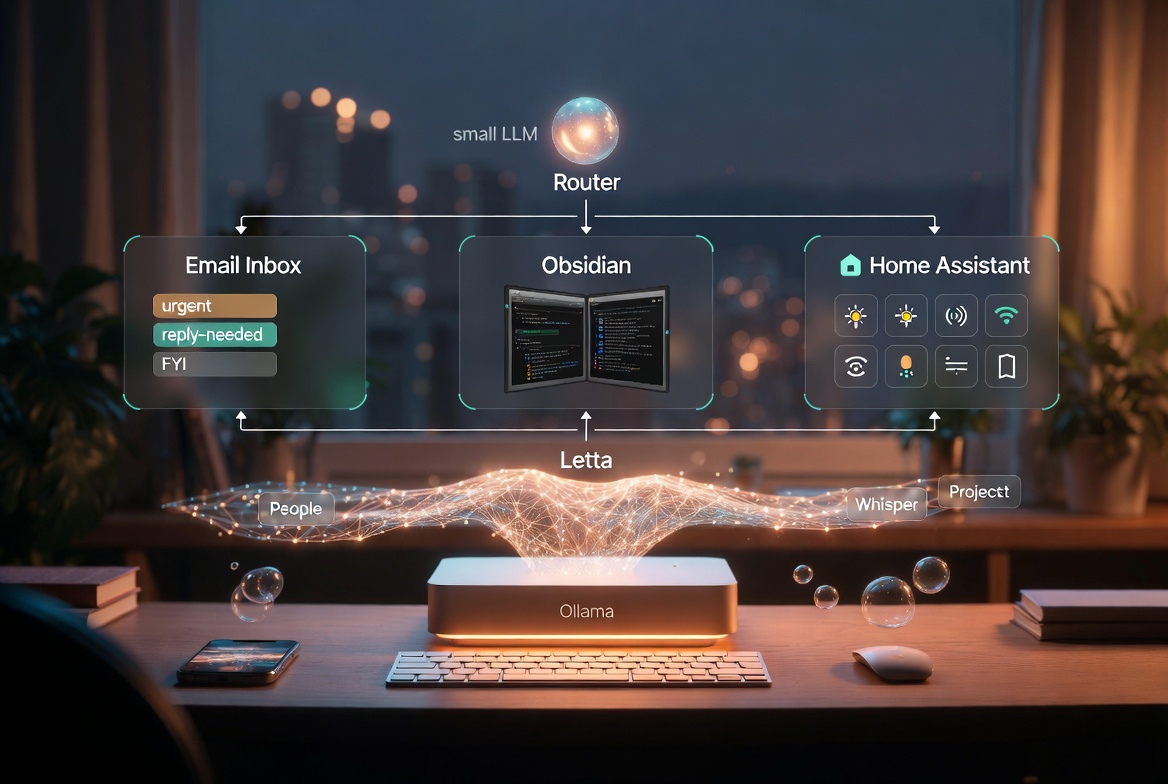
TL;DR The interesting question in 2026 is not “can a local model do this”, it is “which jobs should you give it”. My stack: Ollama for inference, Letta for persistent agent memory, Obsidian as the second brain, Home Assistant for the physical world, and a small router that decides where each thought goes. Three jobs are the sweet spot for local: inbox triage, note enrichment, and routine automation. Each one is repetitive, private, and tolerant of a bit of latency. Two jobs are still worth handing to a frontier cloud model: anything novel-and-hard, and anything where you want the best draft on the first attempt. The bit nobody talks about is the router. The model is not the product. The thing that decides which model gets which job is the product. Why Local Got Interesting For years the answer to “should I run an LLM locally” was “no, just use the API”. The API was cheaper, faster, smarter, and you did not have to think about VRAM. The only reason to go local was privacy, and most people did not actually care about privacy enough to give up the quality gap. ...

May 3, 2026 · 9 min · James M

Local AI vs Cloud AI: The Tradeoff Landscape in 2026

By early 2026, the “Local vs. Cloud” debate has moved past the experimental phase. We are no longer just “trying to see if Llama runs on a Mac.” Instead, professional engineers are building sophisticated Hybrid AI Stacks where local and cloud models work in tandem. The landscape has shifted because the hardware caught up to the software. With the prevalence of unified memory on Apple Silicon and the accessibility of 24GB+ VRAM cards like the RTX 50-series, the “local” ceiling has been smashed. ...

April 11, 2026 · 5 min · James M
Meta employee tracking banner

Meta Is Tracking Its Own Employees to Train AI Agents

TL;DR Meta’s Model Capability Initiative installs software on US employee laptops that captures keystrokes, mouse movements, and screenshots to train AI agents - there is no opt-out The program is US-only because EU and UK employees are protected by GDPR; the scope of the tracking maps directly onto the absence of legal protection Meta CTO Andrew Bosworth openly framed the end state: agents do the work, humans direct and review - the surveillance and the automation plan are the same story The irony is deliberate: Meta’s defence of the program - narrow purpose, safeguards, not used against the person - echoes its long-standing defences of consumer data collection This is a signal about where the agent-training bottleneck actually sits: not reasoning or context windows, but the long tail of real software interactions that only real employees can provide Meta has started installing tracking software on the work laptops of its US-based employees. It captures keystrokes, mouse movements, clicks, and occasional screenshots. The captured activity is fed back into training data for AI agents. There is no opt-out. The program was disclosed to staff in an internal memo in April 2026, and the response from inside the company has been about what you would expect. ...

April 1, 2026 · 8 min · James M