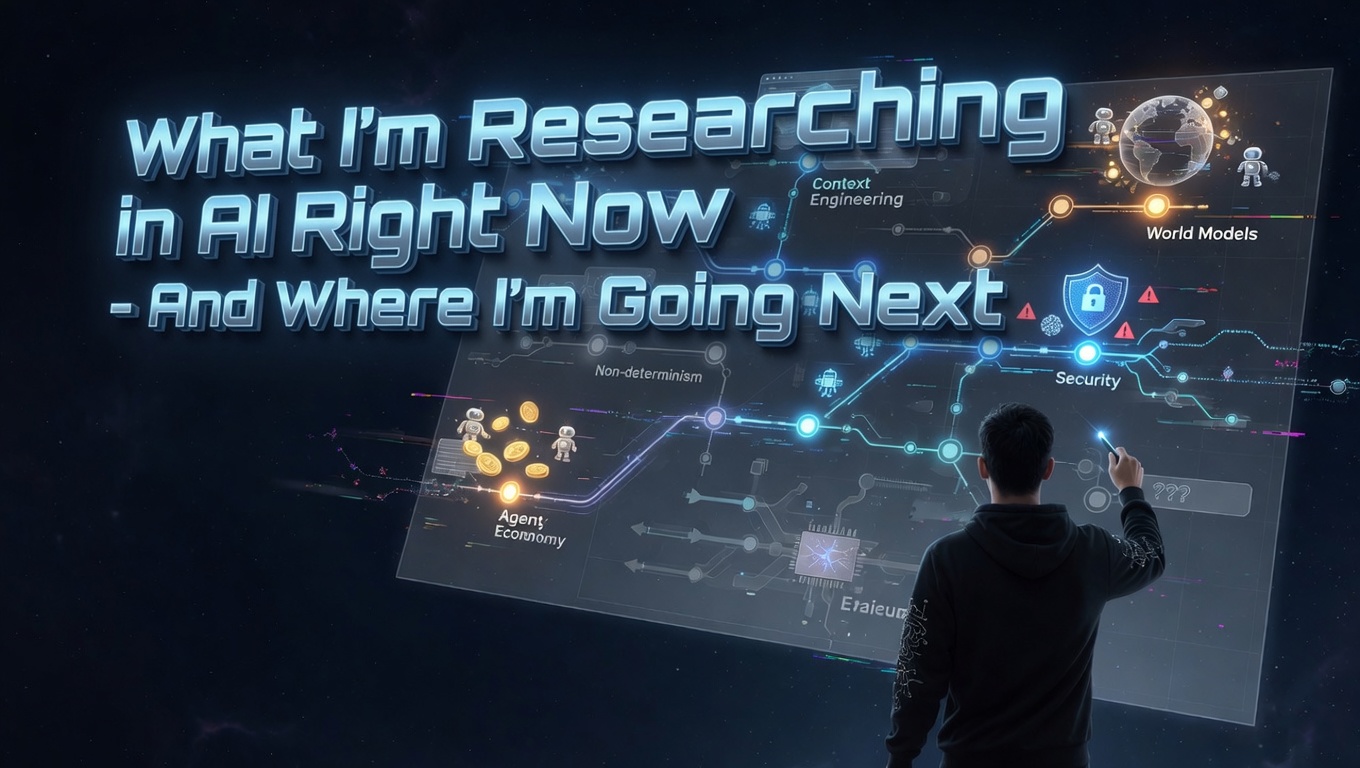
What I'm Researching in AI Right Now - And Where I'm Going Next
TL;DR I treat my own learning like a research agenda - a small set of questions I am actively chasing, not a reading list I feel guilty about The work I have been deep in clusters into four areas: agent reliability and non-determinism, context engineering and memory, the economics of intelligence, and the open-weight and small-model frontier The areas I have decided to move into next are the ones where I keep hitting questions I cannot answer well: securing agents that hold real tool access, evaluating agents on their trajectory rather than their final answer, world models beyond the language-only era, and the machine-to-machine agent economy I treat AGI timelines less as a forecast to win and more as a planning input - what changes for an engineer if capable autonomous systems arrive in three years rather than fifteen I am deliberately not chasing every frontier. Quantum machine learning and neuromorphic hardware sit on my watch list, not my work list, and being honest about that line is the whole point Most people consume AI news. I used to do the same - a feed of model releases, benchmark claims, and launch threads that left me feeling informed and changed nothing about what I could actually build. ...