AI Tooling Learning Path Banner

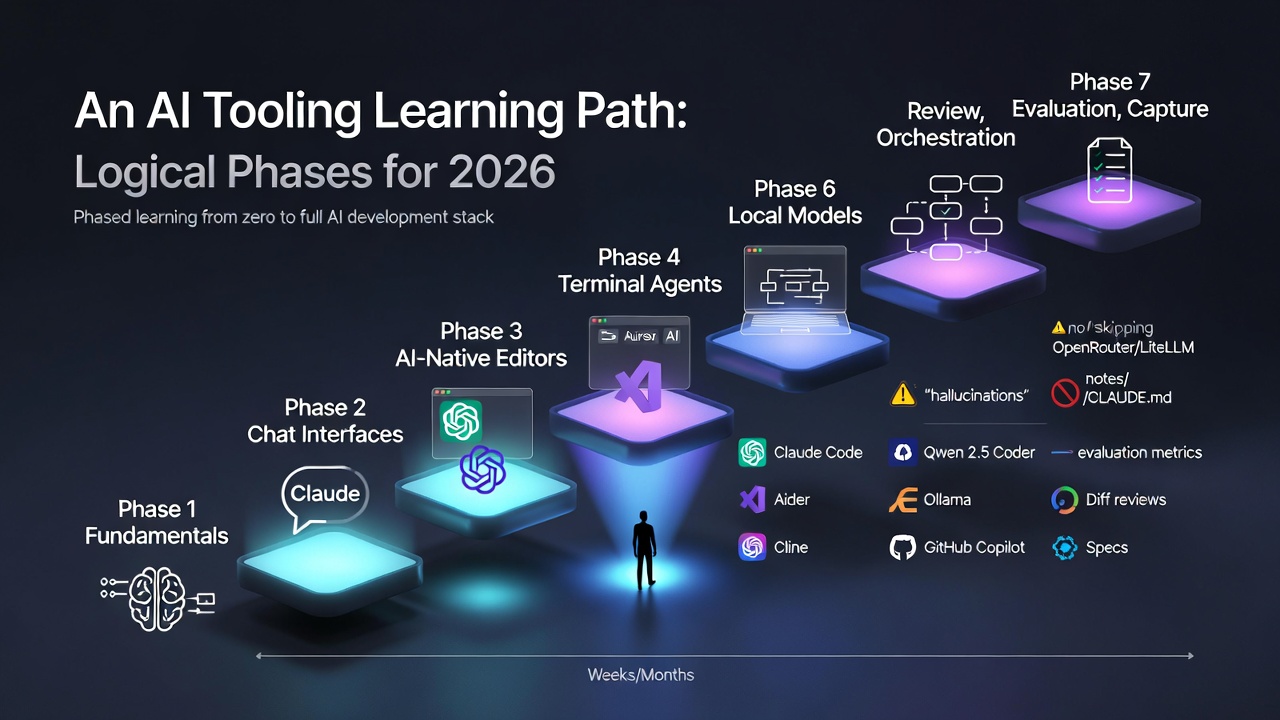
An AI Tooling Learning Path: Logical Phases for 2026

The hardest part of learning AI tooling in 2026 is not any single tool. It is the order you meet them in. Most people start in the wrong place. They install a terminal agent before they have ever sat with a chat UI long enough to understand how models fail. They buy a Cursor subscription before they have written a single decent prompt. They wire up local models with Ollama before they know which tasks actually benefit from running offline. ...

April 21, 2026 · 9 min · James M

Cline: The Next Generation AI Coding Assistant

An exploration of Cline, the autonomous AI coding agent that lives in your IDE and handles complex, multi-step engineering tasks through tool-use and agency.

April 9, 2026 · 3 min · James Myddelton

Cline + Kanban: Autonomous Development Meets Project Management

In the evolution of agentic software engineering, one critical gap remains: the disconnect between project management and code execution. Your Kanban board tracks what needs doing, but your AI assistant lives in your IDE. Cline + Kanban closes that gap. The Problem: Two Separate Systems Most teams operate with a frustrating split: Kanban board (Linear, GitHub Projects, Jira, Trello): “Build the user authentication flow” IDE with Cline: “Let me write code” Manual sync: You paste the task, manually update the board status, context-switch constantly This handoff is where developers lose hours to context-switching and where tasks fall through the cracks. ...

April 9, 2026 · 4 min · James M

What Actually Belongs in My AI Dev Stack in 2026

There is a big difference between using AI for development and having an actual AI development stack. Most developers still seem to be operating with a single-tool mindset. They pick one assistant, one model, one editor, and then expect it to handle everything from planning and architecture to implementation, debugging, review, and documentation. That approach breaks down quickly. In practice, the best AI workflow in 2026 is not about finding one perfect tool. It is about assembling a small stack where each part has a clear job. Fast models handle cheap iteration. Stronger models handle harder reasoning. Specs keep the whole process coherent. Review loops stop you from shipping nonsense with confidence. ...

April 6, 2026 · 8 min · James M