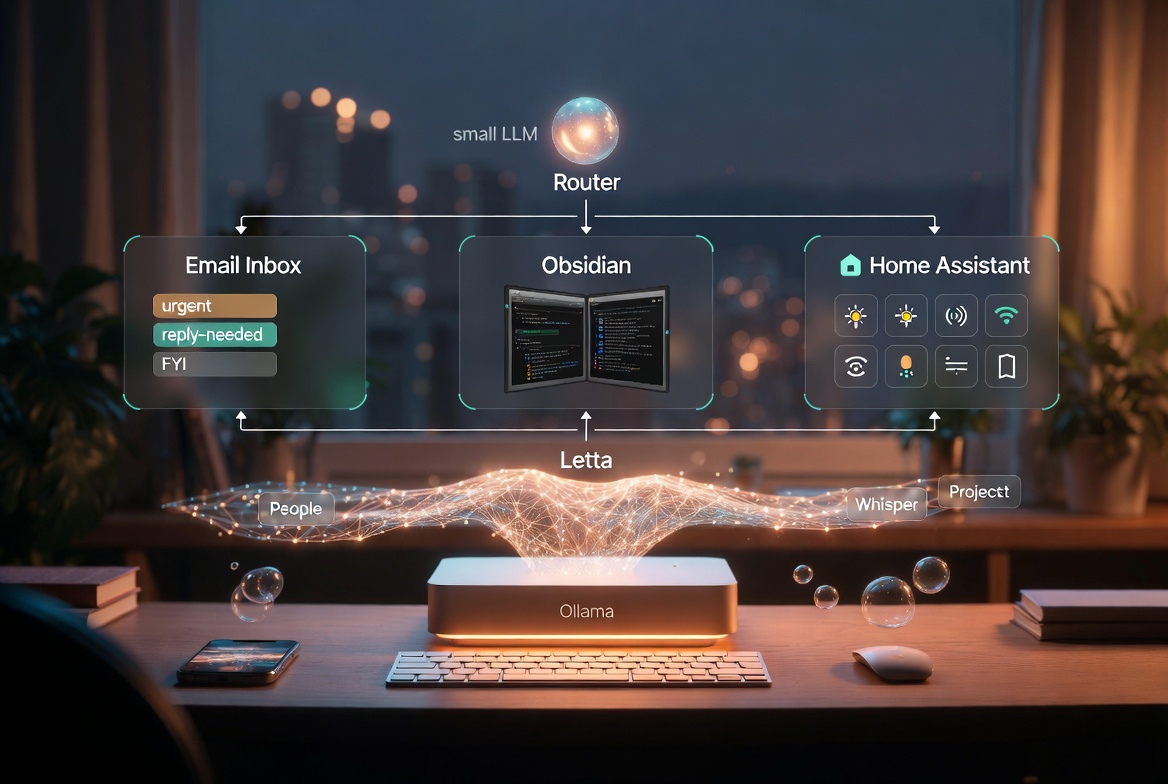
LLM-Powered Personal Productivity Banner

LLM-Powered Personal Productivity: Building a Private Automation Stack

TL;DR The interesting question in 2026 is not “can a local model do this”, it is “which jobs should you give it”. My stack: Ollama for inference, Letta for persistent agent memory, Obsidian as the second brain, Home Assistant for the physical world, and a small router that decides where each thought goes. Three jobs are the sweet spot for local: inbox triage, note enrichment, and routine automation. Each one is repetitive, private, and tolerant of a bit of latency. Two jobs are still worth handing to a frontier cloud model: anything novel-and-hard, and anything where you want the best draft on the first attempt. The bit nobody talks about is the router. The model is not the product. The thing that decides which model gets which job is the product. Why Local Got Interesting For years the answer to “should I run an LLM locally” was “no, just use the API”. The API was cheaper, faster, smarter, and you did not have to think about VRAM. The only reason to go local was privacy, and most people did not actually care about privacy enough to give up the quality gap. ...

May 3, 2026 · 9 min · James M

Career-Ops: Flipping the Script on AI-Powered Job Search

TL;DR Career-Ops is an open-source tool built on Claude Code that inverts the job search power dynamic - giving candidates AI-powered evaluation and application tools to match what companies use to filter them Each opportunity is scored across 10 weighted dimensions on an A-F scale, producing a structured comparison that replaces the ad hoc spreadsheet most candidates rely on The system generates ATS-optimized resumes dynamically tailored to each job description and auto-discovers new postings from 45+ pre-configured job boards A key design principle is human-in-control: nothing auto-submits, the AI recommends and the candidate decides, making it a decision-support system rather than an automation Career-Ops is a clean example of the broader pattern of AI tools that amplify individual judgment rather than replace it - worth studying for its architecture as much as its use case The job search has long been a one-way mirror - companies deploy AI to filter applications while candidates manually juggle spreadsheets, tailor cover letters, and hope their resume gets past the automated screener. Career-Ops flips that script entirely. Built on Claude Code, it’s an open-source system that gives job seekers their own AI advantage: intelligent evaluation of opportunities, automated customized applications, and systematic candidate strategy. ...

April 9, 2026 · 5 min · James M

Cline + Kanban: Autonomous Development Meets Project Management

TL;DR Cline integrates with Kanban boards (Linear, GitHub Projects, Jira, Trello) via Model Context Protocol (MCP), closing the gap between project management and code execution Instead of manually copy-pasting tasks, Cline reads directly from your board, works through the implementation, and updates the task status automatically when done This makes the Kanban board the single source of truth - it stays in sync with reality rather than being an afterthought you update when you remember Works best with clear, testable acceptance criteria; vague tasks like “improve performance” need refinement before Cline can act on them autonomously Even with full autonomy, human code review remains essential - Cline completing a task means it is “Ready for Review”, not that it ships In the evolution of agentic software engineering, one critical gap remains: the disconnect between project management and code execution. Your Kanban board tracks what needs doing, but your AI assistant lives in your IDE. Cline + Kanban closes that gap. ...

April 9, 2026 · 5 min · James M

Paperless-ngx: Self-Hosted Document Management Without the Vendor Lock-in

TL;DR Paperless-ngx is a self-hosted, open-source document management system that scans, OCRs, and auto-organizes physical paperwork with no subscription fees or vendor lock-in Documents are automatically tagged and filed using custom rules, and the full archive is searchable by text extracted via OCR Self-hosting options include a local NAS, Docker on a server, a cheap cloud VPS, or even a Raspberry Pi - the system is not computationally demanding The primary benefits over commercial alternatives are complete data ownership, zero recurring cost at scale, and suitability for sensitive documents under HIPAA or GDPR It suits document-heavy professionals and privacy-conscious individuals best; casual users with few documents don’t need it The paper stack on your desk is growing again. Medical records mixed with tax documents, utility bills, insurance forms - all of it scattered across a filing cabinet that’s become increasingly harder to navigate. There’s probably some important document you can’t quite remember where you filed it. ...

April 8, 2026 · 6 min · James M
The Automation Paradox Why More AI Makes Human Judgment More Valuable Banner

The Automation Paradox: Why More AI Makes Human Judgment More Valuable

TL;DR Every time AI automates a specific task, the monetary value of doing that task falls - the scarce resource shifts from execution to the judgment of what is worth doing at all Historical precedent holds: Deep Blue did not kill professional chess, calculators did not kill accountants - automation raises the value of the thinking above the automated layer The new hierarchy of work puts judgment first (irreplaceable), direction second (human but scalable), and execution last (increasingly commodity) Judgment is constrained opinion - it requires trade-off awareness, skin in the game, pattern recognition, and willingness to be wrong - none of which AI can replicate The economic inversion means hiring shifts from paying for output to paying for prevention: the bad decisions not made, the features not built, the wrong paths not taken The automation paradox is quietly reshaping what we pay for. ...

April 7, 2026 · 6 min · James M

DevOps in the Age of AI Agents

For years, DevOps has been about breaking down silos and automating the software delivery lifecycle. We moved from manual deployments to Jenkins scripts, then to YAML-defined pipelines, and eventually to Infrastructure as Code (IaC). But in 2026, the bottleneck is no longer the speed of the pipeline - it’s the speed of human decision-making within that pipeline. We are entering the era of Agentic DevOps. From Automation to Autonomy Traditional DevOps automation follows a strict “if this, then that” logic. AI-driven DevOps uses reasoning models to handle the “I’m not sure, let me figure it out” scenarios that typically stall a release. ...

April 5, 2026 · 3 min · James M

CI/CD Tools

CI/CD is the plumbing that turns a commit into running software. The tools below cover the full spectrum - from fully managed SaaS that you never have to operate, to self-hosted automation servers you tune yourself, to GitOps controllers that treat your Kubernetes cluster as the deployment target. How to choose A few questions that tend to cut through the vendor noise: Is your code in GitHub, GitLab, or Bitbucket? Staying in-ecosystem reduces integration effort dramatically Do you deploy to Kubernetes? GitOps tools like Argo CD and Flux are often a better fit than traditional pipelines Do you want to operate the control plane yourself? Jenkins gives you maximum flexibility and maximum operational burden How many parallel runners will you need at peak, and who pays for them? Hosted CI/CD platforms Low operational overhead, tight integration with their source-control parents, and usage-based pricing. ...

August 21, 2022 · 3 min · James M