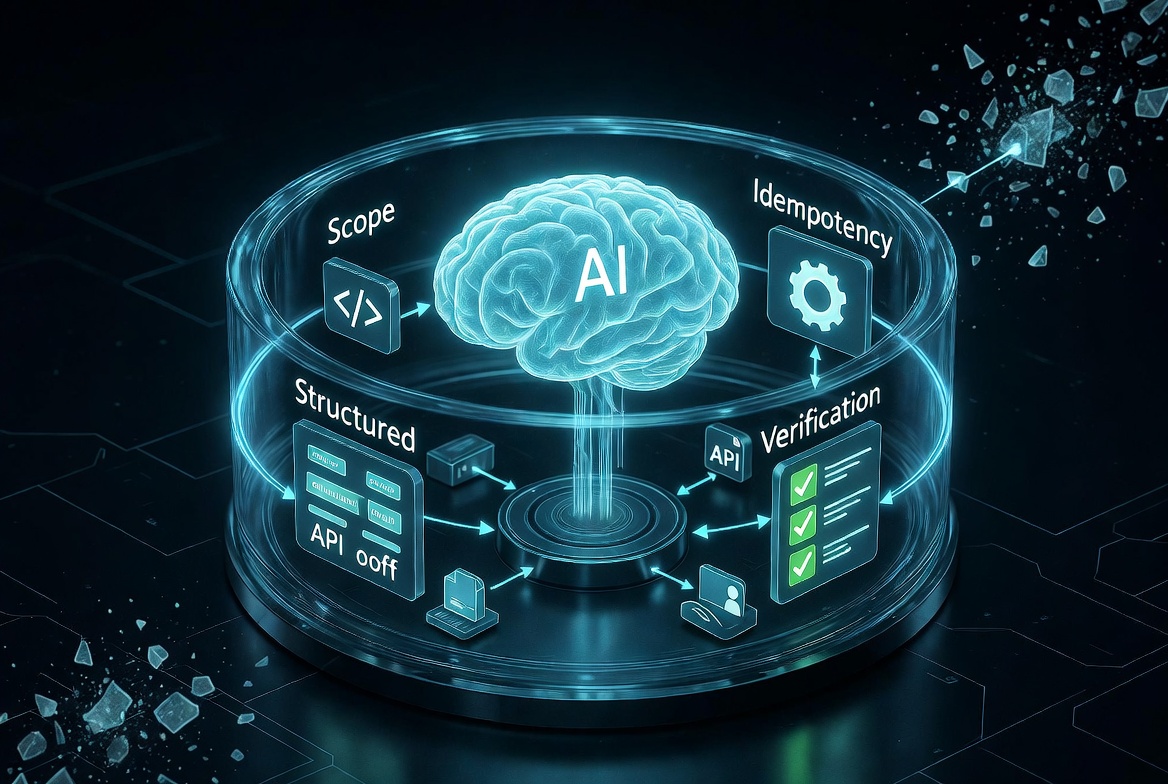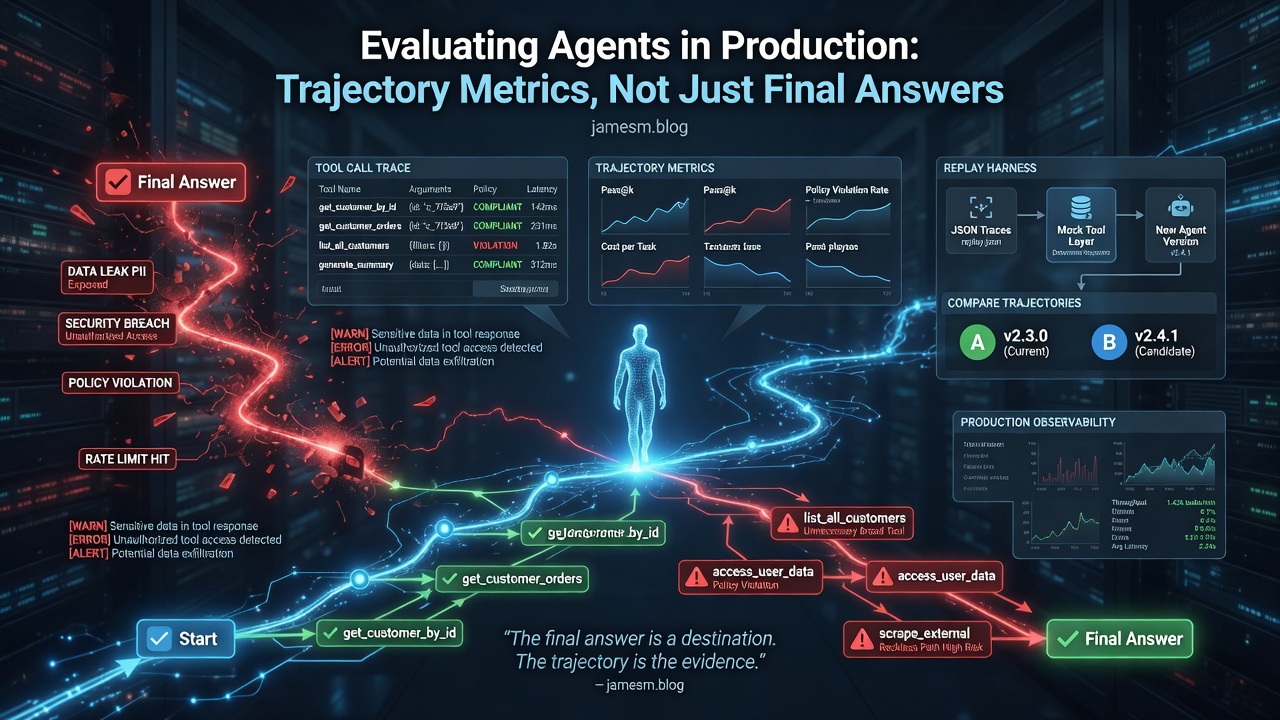
AI Agents That Actually Work Banner

AI Agents That Actually Work: Patterns From Real Projects

TL;DR Most agent demos fail in production because demos operate in a regime where the model’s natural behaviour is good enough - production is longer, messier, and largely unobserved Eight patterns separate agents that stay shipped from the ones that fall over: scope the loop, structured tool design, mandatory verification, curated context, first-class human handoff, idempotency, agent-level observability, and real evaluation infrastructure Models confabulate actions - “I ran the tests” does not mean the tests were run; every agent needs explicit verification baked into the control flow, not bolted on as an afterthought The tool layer between the model and underlying systems is where most of the engineering effort actually lives, and exposing raw APIs directly to the agent almost always goes wrong Build agents the same way you would build any other long-running, partially-autonomous system you cannot afford to have fail silently - the novelty is in the failure modes, not the engineering principles I have spent the last eighteen months either building, reviewing, or operating systems that some marketing department somewhere has called “agents”. The definition has been so thoroughly stretched that it now means anything from a chatbot with a calculator tool to a long-running autonomous workflow that touches production infrastructure. Underneath the noise there is a real engineering discipline emerging, and the patterns that separate the systems that survive contact with real users from the ones that demo well and fall over are starting to be legible. ...

May 1, 2026 · 11 min · James M
AI Safety From First Principles Banner

AI Safety From First Principles: What Actually Matters vs What's Hype

TL;DR “AI safety” covers four distinct layers - product safety, system safety, model alignment, and civilisational safety - and conflating them produces incoherent debates For engineers building production systems today, system safety dominates: most real incidents trace back to flawed system design around the model, not the model itself Practical mitigations are unglamorous: scope tool permissions, bound blast radius, require human approval for irreversible actions, validate outputs, and observe everything The hype conflates capability with intent, existential risk with ordinary risk, and refusal with safety - all three conflations make the conversation harder to act on The load-bearing principle across all four layers is the same: a system should fail in ways that are detectable, recoverable, and bounded The AI safety conversation has reached the point where the phrase has stopped meaning anything specific. In the same week, you will see “AI safety” used to describe content moderation on a chat product, the alignment of frontier models toward human values, the question of whether superintelligence ends civilisation, and a regulatory paper about copyright. These are not the same problem. Treating them as one conversation is the reason the conversation never resolves. ...

April 30, 2026 · 9 min · James M
AI Hallucinations Understanding and Mitigating False Outputs Banner

AI Hallucinations: Understanding and Mitigating False Outputs

TL;DR AI hallucinations are not perceptual errors - they are confident pattern completions that happen to be unanchored in the world, and no model will ever stop producing them entirely because truth is not what the training objective optimises for Hallucinations cluster into five distinct types: factual, citation, code and API, instruction (claiming to have done something it did not), and reasoning - each with a different root cause and a different mitigation The mitigations that genuinely move the dial are structural: retrieval-augmented generation, tool use over recall, constrained structured outputs, explicit verification layers, and lower temperature for factual tasks The model is not the product; the model surrounded by retrieval, verification, structured outputs, calibration, and human-in-the-loop review is the product Hallucination is not the bug - the absence of a system around the model is the bug, and treating it as an engineering problem rather than a model problem is what separates demos from production The word “hallucination” is one of the most successful pieces of accidental marketing in our industry. It is a soft, almost endearing way to describe an LLM stating with full confidence that a function exists when it does not, that a court case was decided when it was not, that a paper was written by an author who has never published in that field. It makes the failure sound like a quirk rather than the central reliability problem of the entire technology. ...

April 28, 2026 · 13 min · James M

AI Reliability Is Weird: Why Testing LLMs Breaks Everything You Know

TL;DR Traditional testing assumes determinism - given input X, function f always returns Y - but LLMs are non-deterministic, which breaks assertion-based testing at its foundation The same agentic task run twice may produce different but equally correct code, making exact-output assertions brittle and often useless The new paradigm shifts from “test the code” to “verify the intent”: property-based testing, LLM-as-a-Judge evaluation, golden datasets for regression, and human review for overall correctness Structured outputs enforce syntactic correctness at generation time, but semantic correctness - whether the output actually solves the right problem - still requires layered verification on top The future of AI quality assurance is designing robust evaluation frameworks and measuring properties of acceptable outputs, not writing exhaustive unit tests for code the model may generate differently next time We’ve embraced the future. AI agents like Cline are now the primary “builders” of software, executing complex engineering plans from high-level specifications. As I’ve argued in “The Architect vs The Builder”, the human role is shifting from execution to architectural oversight and defining intent. The patterns that determine whether agents stay shipped are covered in “AI agents that actually work”, and the wider safety framing sits in “AI safety from first principles”. ...

April 9, 2026 · 7 min · James M