Arturia Pigments 7 — A Sonic Canvas for the Modern Creator
Arturia’s Pigments has long been beloved by producers, sound designers, and musical adventurers for its bold combination of synthesis power and visual clarity. Pigments 7, the newest iteration of this flagship software synthesizer, continues that tradition — adding fresh expressive tools, workflow refinements, and creative content that invite both deep exploration and instant inspiration.
https://www.arturia.com/products/software-instruments/pigments/overview
At its heart, Pigments is an all-in-one synth engine built to blur the line between imagination and sound. It brings together six distinct synthesis engines — including wavetable, virtual analog, granular, sample, harmonic and the increasingly explored modal engine — all within a responsive, color-coded interface designed for playful experimentation.
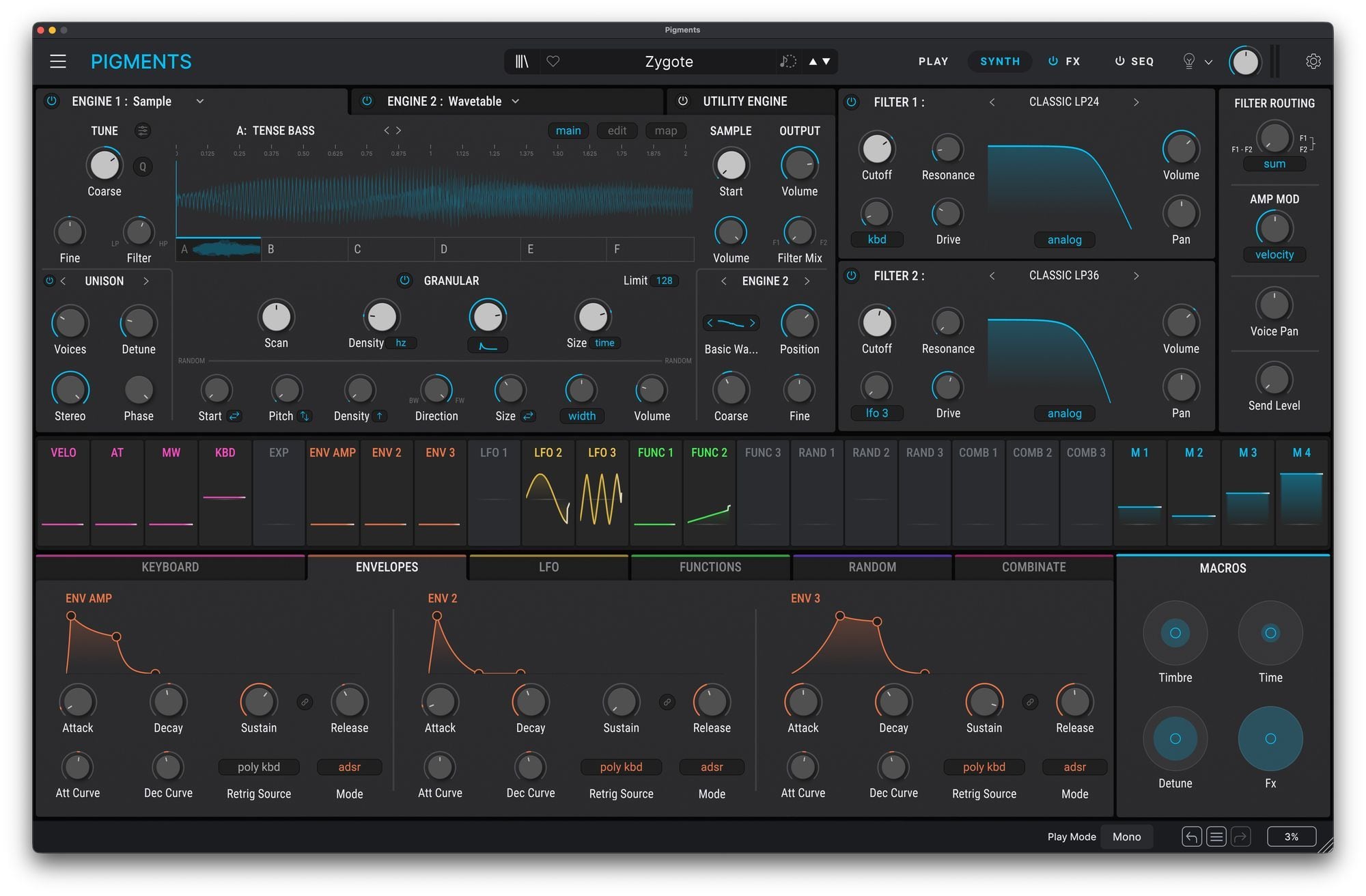 (Image:Arturia Pigments 7)
What’s New in Pigments 7
Version 7 doesn’t reinvent the wheel, but it gives the wheel a whole new set of tires.
One of the first things you’ll notice is the redesigned Play page. This stripped-back view lets you visualize the character of a preset in real time, making it easier to audition and shape sounds without getting lost in menus. The interface reacts to the audio, providing intuitive visual feedback — a huge usability boost if you like to work by feel.
https://support.arturia.com/hc/en-us/articles/23729034214940-Pigments-New-in-Pigments-7
Underneath the hood, Pigments 7 introduces three new filter types:
- Rage — adds aggressive feedback-driven distortion, ideal for acid-style leads and growling basses
- Ripple — a cascaded all-pass filter producing phase-rich, laser-sharp textures
- Reverb filter — blends spatial depth directly into tone shaping, perfect for evolving pads and cinematic bass
A brand-new Corroder effect expands Pigments’ distortion palette further, using noise-based saturation that can move from subtle grit to brutally fractured sound design.
The modulation workflow has also been refined with Quick Edit V3, offering clearer visualization of modulation ranges and faster routing between sources and destinations — particularly useful in complex patches.
Performance, Power, and Play
Pigments 7 isn’t only about new creative tools — it also delivers meaningful technical improvements. Arturia refined the amplitude envelopes for smoother transients and introduced CPU optimizations, making the synth more efficient even when running dense, layered patches.
The update ships with a substantial content expansion:
- ~150 new presets
- 50 new wavetables
- 30 new samples
- 20 new noise sources
Additional sound banks and genre-focused expansions cover everything from dubstep and techno to ambient, cinematic, and experimental textures.
Why Pigments Still Matters
What keeps Pigments distinct in an increasingly crowded soft-synth landscape is its balance of depth and immediacy. Many synths aim for power, but Pigments pairs that power with visual clarity: modulation paths are color-coded, envelopes and LFOs animate in real time, and envelopes can even be triggered by incoming audio.
For experienced sound designers, the expanded filter selection and modulation enhancements unlock deeper sculpting possibilities. For newcomers, the visual feedback and in-app guided tutorials reduce the intimidation factor of synthesis. Pigments doesn’t just generate sounds — it helps users understand how those sounds are built.
Conclusion
Pigments 7 isn’t a radical reinvention, but it is a carefully considered evolution. By refining workflow, expanding tonal possibilities, and improving performance, Arturia has strengthened Pigments’ position as one of the most versatile and educational software synthesizers available today.
Whether you’re crafting expressive leads, cinematic soundscapes, or crushing modern basses, Arturia Pigments 7 remains a powerful, intuitive canvas for turning musical ideas into fully realized sound.